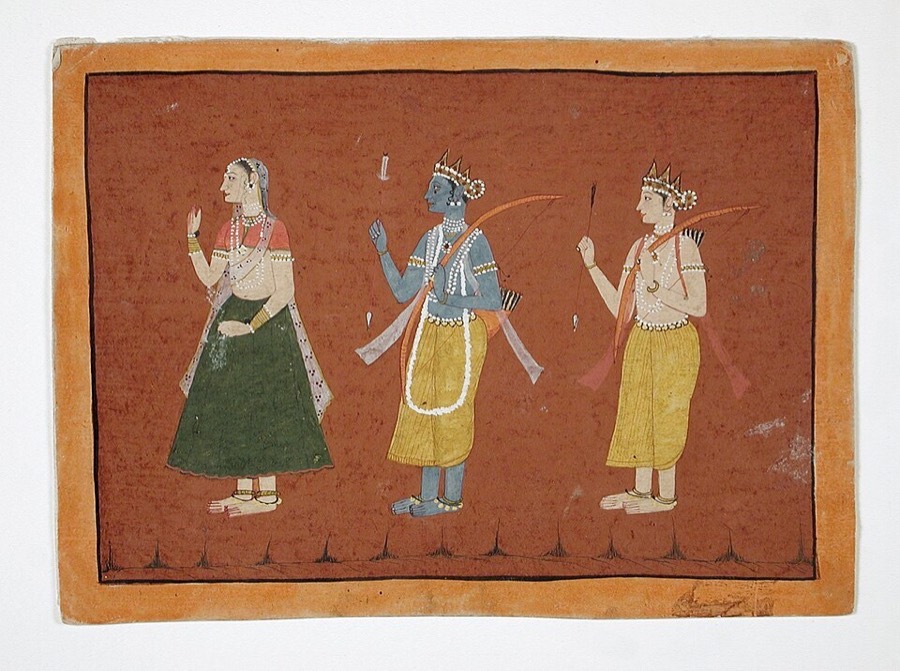
The Rāmāyaṇa of Vālmīki
A poet asks whether a righteous man still exists. A hunter kills a crane, and the curse that comes out of the poet becomes the first line of Sanskrit poetry — and the poem that answers his question is sung back to its own hero by his sons.
The question the poem starts with
The epic does not begin with Rāma. It begins with a poet asking a question.
The sage Vālmīki asks Nārada whether there is a righteous man left in the world 1. Nārada answers that there is: Rāma 1.
That is the frame, and it is worth pausing on, because it means the story is told as an answer to a question about whether goodness survives. Rāma is not introduced as a hero. He is introduced as an answer.
The verse born of a hunter's arrow
Before the story, the finding aid gives the origin of the meter — and it is the entry's own inheritance, which this rewrite now sources.
Vālmīki was going to the Gaṅgā for his daily ablutions, with his disciple Bharadvāja carrying his clothes. At the Tamasā stream he stopped, remarking on how clear the water was, like the mind of a good man. Looking for a place to step in, he saw a pair of cranes mating, and it pleased him.
An arrow struck the male bird and it died on the spot. Its mate screamed in agony and died of shock. Vālmīki's heart melted at the sight. He looked around, found the hunter, and his lips opened in rage and grief:
mā niṣāda pratiṣṭhā tvamagamaḥ śāśvatīḥ samāḥ yat krauñcamithunādekam avadhīḥ kāmamohitam
"You will find no rest for the long years of eternity — for you killed a bird in love and unsuspecting" 1. (Niṣāda is the hunter; krauñca the bird.)
Emerging spontaneously, that couplet is considered the first śloka in Sanskrit literature 1. Vālmīki composed the entire Rāmāyaṇa in the same meter. He is revered as Ādi Kavi, the first poet, and the Rāmāyaṇa as the first kāvya 1.
A poet's first words are a curse on a hunter. The tradition has never softened that, and the poem that follows is a long argument with exactly the thing the hunter did.
The frame inside the frame
And then the structure resolves, because the poem Vālmīki composes in that meter is taught to the boys Lava and Kuśa, who recite it across the land — and eventually at the court of King Rāma 1.
Rāma hears his own story sung back to him. The entry's inherited closing note, about the hunter's arrow and the first verse ever made, is correct; what it left out is that the poem ends up inside its own story, performed by Rāma's sons in Rāma's court. That is why the entry's sit_with still stands: the first verse is not a prologue, it is a loop.
What kind of object it is
Before the narrative, the shape of the thing, because it explains why a "story" page on this site is really a library reference.
The epic consists of nearly 24,000 ślokas — each śloka a couplet, two individual lines — divided into seven kāṇḍas and about 500 sargas 1. It is one of the longest epic poems ever written: roughly 480,002 words, about a quarter of the length of the Mahābhārata and about four times the length of the Iliad 4.
The seven kāṇḍas are Bāla, Ayodhyā, Araṇya, Kiṣkindhā, Sundara, Yuddha and Uttara 1. The name itself is not a title but a sentence: Rāma plus ayana, journey, joined by sandhi, makes Rāmāyaṇa — Rāma's journey 1. The name of the protagonist carries two contextual meanings in the older texts: in the Atharvaveda, "dark-coloured or black", related to the stillness of night; in the Mahābhārata, "pleasing, pleasant, charming, lovely, beautiful" 1. A poem called "his journey" about a man whose name means both dark and lovely.
Its genre is Itihāsa — narratives of past events — which it shares with the Mahābhārata and the Purāṇas, and which also carries the teachings on the goals of human life 1. It depicts the duties of relationships by portraying ideal types: the ideal son, servant, brother, husband, wife and king 1. Modern scholars often simply place it among the epics 1.
Its most significant moral influence has been the importance of virtue in the life of a citizen and in the ideals guiding the functioning of a state — the state the tradition calls Rāmarājya 1.
How old, and how it was settled
The entry's inherited period read "c. 5th c. BCE (traditional)". The finding aid is more careful, and more interesting.
Scholarly estimates for the primary oral stage of the text range from the 8th–5th to the 5th–4th centuries BCE, "although the legends constituting it go back farther in time", with later stages extending up to the 3rd century CE 1.
Robert P. Goldman gives 750–500 BCE as the probable date of the oral composition, on two arguments that are worth stating because they are arguments from silence. The core portions could not have been composed later than the 6th or 5th century BCE, because the narrative neither mentions Buddhism — founded in the 5th century BCE — nor reflects the later prominence of Magadha, which rose to power in the 7th century BCE. The text also consistently names Ayodhyā as the capital of Kosala, and never by the later name Sāketa or the successor capital Śrāvastī 1. Goldman and Sally Sutherland Goldman consider the whole to have been composed around the mid-first millennium BCE 1.
And the finding aid marks the internal seam. Books two through six are the oldest portion of the epic, while the first and last — the Bāla and Uttara Kāṇḍas — are considered later additions. Differences in style and narrative contradictions between those two volumes and the rest have led scholars including Hermann Jacobi toward that consensus 1.
A poem that is honest about its own accretion is a poem that can be edited honestly.
Two recensions and one critical edition
The text as read today is the product of a specific 20th-century editorial decision, and the entry's source_text cites the critical edition, so this belongs on the page.
The Rāmāyaṇa exists in two major regional recensions, the northern and the southern, which inherited a common oral source from the original composition but developed profound verbal differences because oral transmission continued along two separate regional pathways for a long period before being fixed in writing 1. The northern tradition gradually shifted toward a popularised, simplified gloss for local audiences; the southern tradition followed a more conservative trajectory, preserving a more uniform and archaic structure that now serves as the backbone for modern critical editions 1.
Romesh Chunder Dutt put it in one sentence: the Rāmāyaṇa, like the Mahābhārata, is a growth of centuries, but the main story is more distinctly the creation of one mind 1.
The critical edition itself was compiled in India in the 1960s and 1970s by the Oriental Institute at Maharaja Sayajirao University of Baroda, working from dozens of manuscripts collected across India and the surrounding region 1. Robert P. Goldman's English translation of that critical edition was completed in November 2016; Bibek Debroy produced another English translation of it 1.
There are around thirty-three commentaries on the Rāmāyaṇa 1. The three best known — Maheśvaratīrtha's Tattvadīpikā, Govindarāja's Bhūṣaṇa and Śivasahāya's Śiromaṇi — are collectively called the ṭīkatraya, the commentary trio 1.
Ayodhyā
Daśaratha, king of Ayodhyā in the kingdom of Kosala, has three wives — Kausalyā, Kaikeyī and Sumitrā — and no son. Desiring a legal heir, he performs the fire sacrifice called the Putrīyā Iṣṭi 1.
Meanwhile the gods are petitioning Brahmā and Viṣṇu about Rāvaṇa, king of the rākṣasas, who is terrorising the universe. Viṣṇu opts to be born into mortality in order to combat him 1. So the four sons are born: Rāma to Kausalyā, Bharata to Kaikeyī, and Lakṣmaṇa and Śatrughna to Sumitrā 1.
When Rāma is sixteen, the sage Viśvāmitra comes to Daśaratha's court seeking help against demons disturbing sacrificial rites 1. He chooses Rāma, and Lakṣmaṇa goes as his constant companion. The two receive instruction and supernatural weapons from Viśvāmitra and destroy Tāṭakā and other demons 1.
The party then attends King Janaka's sacrifice at Mithilā, where a bow called the Pinaka is kept — one nobody has been able to string 1. Janaka recounts its history and tells them that whoever strings it wins the hand of his daughter Sītā, whom he found in the earth while ploughing a field 1. Rāma strings it, and breaks it in the process 1.
The wedding that follows is not one marriage but four: Rāma to Sītā, Lakṣmaṇa to Urmilā, Bharata to Mandavi, and Śatrughna to Śrutakīrti — the four daughters of Janaka of Mithilā and of Kuśadhvaja 1. The marriage party returns to Ayodhyā in festivity.
The promise
After the marriage, the elderly Daśaratha wishes to crown Rāma, and the Kosala assembly and his subjects support it 1. On the eve, Kaikeyī is pleased — until she is provoked by Mantharā, a maidservant, to claim the two boons Daśaratha had granted her 1. She demands fourteen years of exile for Rāma, and the succession for her own son 1.
The grief-stricken king, bound by his word, accedes. Rāma accepts his father's reluctant decree with the absolute submission and calm self-control that characterises him throughout the story 1. He asks Sītā to remain in Ayodhyā; she convinces him to take her 1. Lakṣmaṇa resolves to follow 1.
After Rāma's departure, Daśaratha, unable to bear the grief, dies 1. Bharata, visiting his maternal uncle, learns what has happened, refuses to profit from his mother's scheming, and goes to the forest to beg Rāma to return. Rāma refuses to come back before the term is served 1. Bharata rules Ayodhyā on his brother's behalf 1.
This is the structural fact most retellings drop: for fourteen years, Ayodhyā is not ruled by Rāma at all.
The forest, and the line that is not there
In exile the three journey south along the banks of the Godāvari, build cottages, and live off the land 1. At the Pañcavatī forest they are visited by Śurpaṇakhā, Rāvaṇa's sister, who tries to seduce the brothers and, failing, tries to kill Sītā out of jealousy. Lakṣmaṇa stops her by cutting off her nose and ears 1. Her brothers Khara and Duṣaṇa attack; Rāma defeats Khara and his rākṣasīs 1.
When the news reaches Rāvaṇa he resolves to capture Sītā through Mārīca, who takes the form of a golden deer 1. Entranced, Sītā pleads with Rāma to catch it. Rāma, aware that this is the demons' ploy, cannot dissuade her, and chases the deer into the forest, leaving Sītā under Lakṣmaṇa's guard 1.
Sītā hears Rāma calling; fearing for his life, she insists Lakṣmaṇa go to him. He tries to assure her that Rāma cannot be hurt that easily and that his orders are to protect her. On the verge of hysterics, she insists that it is not she but Rāma who needs him 1. He obeys, stipulating only that she not leave the cottage or entertain any stranger — and the finding aid notes, in its own editorial aside, that the line drawn at the cottage was not in the original Rāmāyaṇa 1.
The Lakṣmaṇa-rekhā, the most quotable image in the abduction sequence, is a later accretion. This entry records that rather than repeating it as text.
Then Rāvaṇa comes, dressed as a mendicant, and carries Sītā away. Jaṭāyu, the old vulture, fights him in the air and falls mortally wounded 1.
Kiṣkindhā, and the queen who argued
Rāma and Lakṣmaṇa meet Hanumān — the greatest of the Vānara heroes and a devotee of Rāma — and Sugrīva, the banished pretender to the throne of Kiṣkindhā 1. Rāma befriends Sugrīva and helps him by killing his elder brother Vāli, thus regaining the kingdom, in exchange for help recovering Sītā 1.
Sugrīva then forgets his promise and enjoys his new power. The former Vānara queen Tārā, Vāli's wife, calmly intervenes to prevent an enraged Lakṣmaṇa from destroying the ape citadel, and then eloquently convinces Sugrīva to honour his pledge 1.
Search parties go to the four corners of the earth and return empty-handed from north, east and west. The southern party, led by Aṅgada and Hanumān, learns from a vulture named Sampātī — Jaṭāyu's elder brother — that Sītā was taken to Laṅkā 1.
The finding aid glosses Vānara as vana-nara, forest-dwelling humans 1, while also describing Hanumān as the greatest of the ape heroes and Tārā as the former ape queen 1. Both descriptions are recorded and neither is resolved here.
Sundara
Hanumān assumes a gigantic form and makes a colossal leap across the sea. On the way he meets a Gandharva-kanyā who comes in demonic form to test him, and encounters the mountain Maināka, who offers him assistance and a place to rest. Hanumān refuses, because little time remains to find Sītā 1.
In Laṅkā he finds the demoness Laṅkinī guarding the city, fights and subjugates her to get inside. Laṅkinī, who had a vision or warning from the gods, knows that Laṅkā's end is near if someone defeats her 1.
He locates Sītā in the Aśoka grove, where Rāvaṇa and his rākṣasīs are wooing and threatening her. Hanumān reassures her and gives her Rāma's signet ring as proof that Rāma is alive 1.
He offers to carry her back to Rāma. She refuses, and says it would not be dharma — for if Rāvaṇa carried Sītā away when Rāma was absent, and Hanumān carried her back when Rāvaṇa was absent, the Rāmāyaṇa would have no significance. Rāma himself must come and avenge the insult 1. She gives Hanumān her comb as a token that she is alive 1.
This is the single most under-told exchange in the epic. The rescue is refused by the person being rescued, on grounds of what the story is for.
Leaving her, Hanumān decides to wreak havoc: he destroys the trees of the Naulakha garden and buildings, kills Rāvaṇa's warriors, then lets himself be captured and delivered to Rāvaṇa. He lectures Rāvaṇa boldly to release Sītā. Condemned, with his tail set on fire, he escapes his bonds, leaps across the rooftops, sets fire to the citadel, and makes the giant leap back 1.
Yuddha
Rāma and Lakṣmaṇa proceed with their allies to the shore of the southern sea and are joined there by Rāvaṇa's renegade brother Vibhīṣaṇa. The Vānaras Nala and Nīla construct the Rāma Setu 1. The armies cross and a lengthy war ensues.
During the battle Rāvaṇa's son Meghanāda — Indrajit — hurls a powerful weapon at Lakṣmaṇa, mortally wounding him. Hanumān assumes his gigantic form, flies from Laṅkā to the Himalayas, is unable to identify the herb that would cure Lakṣmaṇa, and brings the entire mountain back 1.
The war ends when Rāma kills Rāvaṇa, and Rāma installs Vibhīṣaṇa on the throne of Laṅkā 1.
On meeting Sītā, Rāma says that the dishonour done to him and the wrong done to her by Rāvaṇa have been wiped off by his victory over the enemy with the assistance of Hanumān, Sugrīva and Vibhīṣaṇa 1.
The fire she asked for
But criticism about Sītā's chastity now comes from people in his own kingdom, and Rāma is disheartened by it. Sītā, to prove the citizens wrong and wipe the blame from herself, requests Rāma and Lakṣmaṇa to prepare a pyre for her to enter 1. Lakṣmaṇa prepares it; Sītā prays to Agni and enters. Agni appears in person from the burning pyre, carrying Sītā in his arms, and restores her to Rāma, testifying to her purity. Rāma joyfully accepts her 1.
The entry's inherited body had Sītā walking through fire to prove her purity, phrased as something done to her. The finding aid has her demanding the fire. That is a different story and the difference is the point.
The Agni Parikṣā also varies between versions: in Tulasīdāsa's Rāmcaritmānas, Sītā was under Agni's protection throughout as Māyā Sītā, so her emergence from the fire was necessary before she could be reunited with Rāma 1.
Then the gods, led by Brahmā, arrive and glorify Rāma as the incarnation of the Supreme God Nārāyaṇa. Indra restores the dead Vānaras to life 1.
The return, the lamps, and a gift to Laṅkā
After the exile, Rāma returns to Ayodhyā and the people celebrate as though at a festival. The coronation is called the Rāma pattabhisheka 1. Dīvālī, the festival of lights in Hinduism, is celebrated in joy of Rāma's return to Ayodhyā with Sītā and Lakṣmaṇa 5.
The finding aid also records two details that retellings drop. Rāma gave donations to Sugrīva, Jāmbavān and the other Vānaras, and gave Sītā a pearl necklace to give to a great person; she gave it to Hanumān 1. And Rāma, wishing to give Vibhīṣaṇa a great gift, gave him his own Ārādhana Devatā — Śrī Raṅganāthasvāmī 1.
A king giving the god he worships to the brother of the king he killed. On a site whose holdings include the Śrīraṅgam temple, that detail is a bridge, not a footnote.
Rāma's rule is itself named: Rāmarājya, the state described as just and fair, where the common folk are happy, fulfilled and satisfied 1.
The harder book
The Rāmāyaṇa does not end with the coronation. The Uttara Kāṇḍa narrates Rāma's reign, the birth of Lava and Kuśa, the Aśvamedha yajña, and the last days of Rāma 1.
Scholars note linguistic and rhetorical differences between the Uttara Kāṇḍa and books two through six, especially in stories such as Sītā's exile and the death of Śambūka. Together with the Bāla Kāṇḍa it is considered by some scholars to be an interpolation, and the opinion is on record that the "original" poem ended with the Yuddha Kāṇḍa 1.
The finding aid records the tradition behind the frame closing: Hanumān, asked to prove his devotion to Rāma, tears his chest open, and an image of Rāma and Sītā is found inside 1. Vālmīki trains Lava and Kuśa in archery 1.
A poem whose final book its own editors mark as later, containing the hardest thing that happens to its heroine, is a poem the tradition refused to tidy.
What it became
One poem, roughly 480,002 words, that became a continent's worth of stories.
The finding aid lists the retellings: Kamban's Rāmāvatāram in Tamil, 12th century; Bhoja's Champu Rāmāyaṇam; Kumudendu Muni's Jain Kumudendu Rāmāyaṇa and Narahari's Torave Rāmāyaṇa in Kannada, 16th century; Gona Budda Reddy's Raṅganātha Rāmāyaṇam in Telugu; Mādhava Kandali's Saptakhaṇḍa Rāmāyaṇa in Assamese, 14th century; Kṛttibāsa Ojhā's Kṛttivāsī in Bengali, 15th century; Saralā Dāsa's Vilaṅka Rāmāyaṇa and Balarāma Dāsa's Jagamohana Rāmāyaṇa in Odia, 15th and 16th centuries; Eknāth's Bhavārtha Rāmāyaṇa in Marathi, 16th century; Tulasīdāsa's Rāmcaritmānas in Awadhi, 16th century; Thunchaththu Ezhuthachan's Adhyātmarāmāyaṇam in Malayalam; Raghuvīr Nārāyan's Vijay Nāyak Rāmāyaṇa in Bhojpuri 1.
And beyond India: Cambodian (Reamker), Malay (Hikayat Seri Rama), Filipino, Thai (Ramakien), Lao, Burmese, Nepali, Maldivian, Vietnamese and Tibeto-Chinese versions 1. The Rāmāyaṇa became popular in Southeast Asia from the 8th century onward, in literature, temple architecture, dance and theatre — and the finding aid names Vietnam as the sole exception across the region 1.
The material record runs further back than most readers expect. The stone panel at Nāgārjunakoṇḍa in Andhra Pradesh depicts Bharata's meeting with Rāma at Chitrakūṭa, and is dated to the 3rd century CE 1. Today the dramatic enactments known as Rāmlila take place across India and throughout the global Indian diaspora 1.
And around thirty-three commentaries to keep it honest 1.
The claim, kept small
A poet asks whether a righteous man still exists. A hunter kills a crane, and the curse that comes out of the poet is the first line of Sanskrit poetry. The poem that follows answers his question with a story — and ends up being sung back to its own hero by his sons.
It runs to nearly 24,000 ślokas in seven books, about four times the Iliad. Its two outer books are marked as later by its own editors. Its most famous image in the abduction — the line at the cottage — is not in the original. Its heroine refuses her own rescue, on the grounds that the story would be worth less. And when she is doubted, she asks for the fire herself.
It has been told in every language of India, in at least ten traditions beyond India, and carved onto stone by the third century CE. Rāma's return is why the lamps burn at Dīvālī. The rule the tradition names after him — Rāmarājya — still means, simply, a state where ordinary people are content.
Sit with this
Keep your word even when the forest is the price — and remember that a bridge of ordinary stones, laid by love, can reach an island of demons.
The epic's own frame: the hunter's arrow and the crane's cry — 'mā niṣāda' — said to be the first verse ever composed, and its echo runs through every verse after.
Read on Diwali — the festival calendar →
Characters in this kathā
Companions in the tale
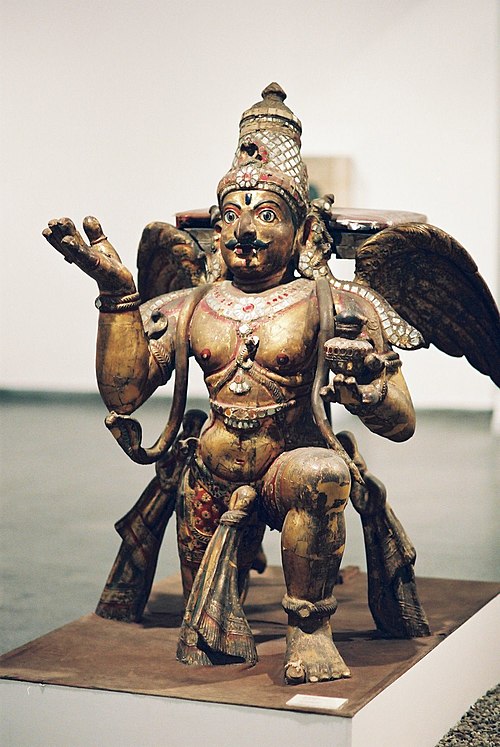
Where this kathā lives
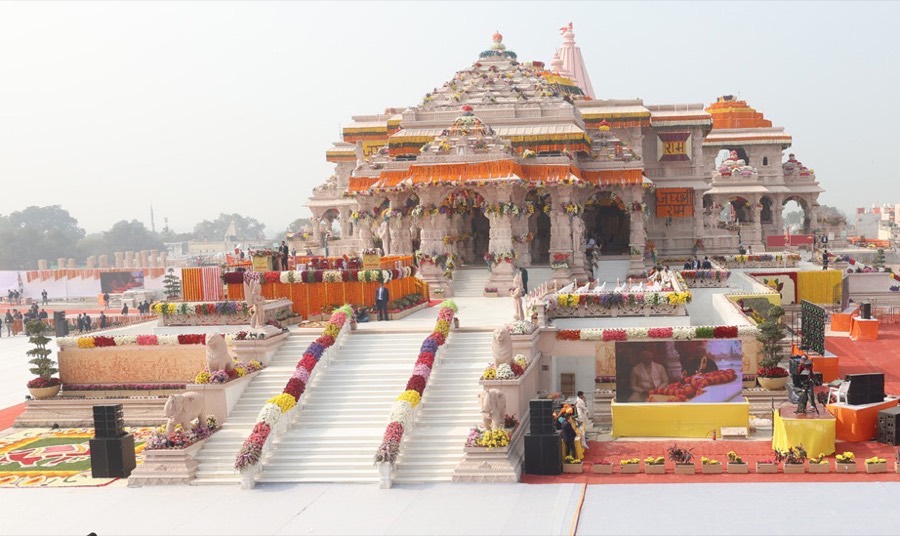
Source of this telling
Vālmīki Rāmāyaṇa — the seven kāṇḍas (Baroda critical edition)