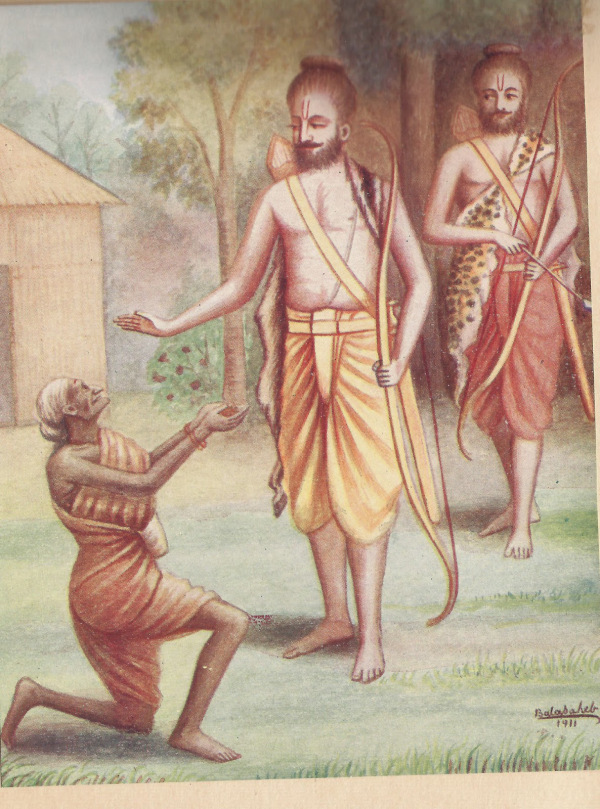
Shabari's Berries
A tribal woman waited a lifetime at the edge of the forest for the prince she had been promised. And the fruit she offered him — tasted first, to set aside the bitter ones — became one of the most argued-about offerings in Indian literature.
What the Rāmāyaṇa actually says
There is a hermitage at the western edge of Lake Pampā, in the middle of the Daṇḍaka forest, and it belongs to a woman named Shabari. Kabandha — a headless Gandharva under a curse, being released by Rāma — describes her to the prince as he dies: the sages who once lived there have passed on, but their maidservant, a long-lived one and an anchoress, can still be seen at the place 1.
Rāma and Lakṣmaṇa go. The Vālmīki text describes what they find: a hermitage wreathed in trees, and a woman who is called siddhā, accomplished; śramaṇī, a mendicant under vows; tāpasī, an ascetic; and siddha-sammatā, accepted and honoured by the accomplished ones 2. She rises, folds her palms, embraces their feet, and asks Rāma whether his vows are fulfilled 2.
Rāma speaks to her. The sages whose disciple she had been appear to her in splendour, and she, having been told by them to wait for Rāma's darśan, prepares 2. He stays. He asks about the path onward, to Mount Ṛṣyamūka and Sugrīva, and then he leaves 2.
That is the whole of it in the oldest surviving Rāmāyaṇa. There is no fruit in it. There is no tasting, no sorting, no brother's objection, no blessing pronounced over a basket.
The fruit that is not there
If you have heard this story all your life — and most people have — you heard it with the fruit in it. Shabari goes out with her walking stick, plucks berries one by one, tastes each to find whether it is sweet, throws the bitter ones away, and brings the sweet ones to Rāma 4. Lakṣmaṇa objects: she has already tasted them, they are unfit. Rāma takes them anyway.
The tasted-berry episode is not in the Vālmīki Rāmāyaṇa 3. It is not in the Rāmopākhyāna, the version of the Rāma story told inside the Mahābhārata 3. It is not in the Purāṇic Rāma narratives 3. It is not in Kamban's 12th-century Tamil Kampa Rāmāyaṇam, a text otherwise saturated with devotion and caste-transcending bhakti 3. The closest anchor for it in the Sanskrit tradition is the Padma Purāṇa 32.
It appears instead in the vernacular later tellings — the Jagamohana Rāmāyaṇa of Balarāma Dāsa in Odia, where Rāma eats only the fruits Shabari has bitten, and in a Tamil commentary tradition of the Śrī Vaiṣṇava text Śrī Vācana Bhūṣaṇam 3. From there it entered the general stock, and now it is told as Rāmāyaṇa.
I am not going to resolve which version is better. The Vālmīki story is quieter and the Purāṇic one is richer, and both have done work for centuries. But an encyclopedia that claims provenance cannot tell you the fruit story and let you believe it came from the epic. So: the waiting is Vālmīki. The tasted berries are Padma Purāṇa. The caste argument is later still.
What the waiting actually cost
Read the Vālmīki account again for the economics of it. Shabari was a maidservant of sages who have died 1. The hermitage is not hers; she is keeping it. Her instruction to wait came from them 2. She is old — long-lived enough that Kabandha, who is himself cursed and dying, can point her out to Rāma as a thing still standing 1.
The structural point is the one the later poets seized, and they seized it correctly: the Vālmīki Shabari is an accomplished ascetic, honoured by accomplished ascetics 2. In the epic's own vocabulary she is not a bystander at the edge of the story. She is a siddhā — one who has arrived. And she is waiting not for a king but for a prince passing through exile, which is to say for someone with no kingdom and no army, in bark cloth, on foot 2.
The hero arrives at the door of someone with nothing, and the text gives that arrival the weight of a milestone rather than a courtesy. That is the original version of the point, and it does not need the fruit to make it.
The fruit, and what it became
In the later telling the fruit is loaded with meaning the epic never put on it. Shabari tastes each berry so that Rāma will get only the sweet ones 4 — the act of a host who has nothing else to give and is spending her whole competence on the giving. Lakṣmaṇa's objection is the objection of purity: the food is contaminated by an inferior's mouth 4.
Rāma's answer, in the tradition that comes down with the story, is that among all the foods he has tasted, none could equal these berries, offered with such devotion 4. Lakṣmaṇa is told to taste them and then know. And the line that outlived the story — whoever offers a leaf, a flower, a fruit, or water with love, is offered something the Lord partakes in with joy 4.
The fruit thus turns. What looked like contamination becomes the offering. What looked like the disqualifying mark — the forest woman, the untouchable's touch, the half-eaten leavings — becomes the qualification. It is a reversal performed entirely inside the act of eating.
The caste argument, stated outright
The Rāma story acquired a doctrine at Shabari's hermitage that the epic does not give her. In the Rāmacaritamānasa of Tulasīdāsa, the 16th-century Awadhi retelling that reshaped North Indian devotion, Rāma gives Shabari the teaching of navadhā-bhakti, the nine modes of devotion, and states plainly that bhakti is independent of caste, lineage, and strength 5.
The ninefold list that arrives with her is worth naming, because it is the frame the story ends up carrying: association with devotees; a taste for hearing the Lord's stories; service to him; worship; praise; the repetition of his name; seeing him manifested everywhere and honouring his devotees above himself; finding fault with no one and being content with one's lot; and unreserved surrender, the highest 4.
The last of these is what Shabari is credited with. And the text says, in so many words, that what is hardest for the greatest yogis was easily attained by her 4.
It is worth being clear-eyed about the distance travelled. The Vālmīki Shabari is an accomplished ascetic honoured by ascetics 2. The Purāṇic Shabari is a forest woman whose fruit is questioned and then accepted 34. The Tulasīdāsa Shabari is a doctrinal instrument for a proposition about caste 5. Three different figures share one name. Later commentators used the composite as an idiom for social emancipation and against caste discrimination 3 — which is a use of the story, and should be labelled as such rather than mistaken for a discovery inside it.
Why this matters for how we tell things
The reason this story belongs in an encyclopedia with its provenance attached is not only that it is moving. It is that it is the cleanest available demonstration of what happens to a tale over a thousand years of retelling. The waiting is Vālmīki. The fruit is Padma. The doctrine is Tulasī. Nobody was lying at any stage. Each layer was written for its own audience, and each layer is now quoted as though it were the first.
Shabari swept the path at the edge of the Daṇḍaka forest for a lifetime 1. Whether she also tasted the berries is a question about which manuscript you are reading. Both answers are true somewhere.
Count the karanas on the gopura — then remember that someone, somewhere, is quoting the fruit scene to you as though it were in sarga 74.
Sit with this
What is offered matters less than the hand that offers it — but it is worth knowing which text you are quoting.
You have probably heard this story all your life as a story from the Rāmāyaṇa. Decide what changes now that you know it is not.
Characters in this kathā
- Shabari
- Rāma
- Lakṣmaṇa
- Kabandha
Source of this telling
Vālmīki Rāmāyaṇa, Araṇya Kāṇḍa sargas 73–74; Padma Purāṇa (the tasted berries); Tulasīdāsa, Rāmacaritamānasa
Further reading
- Vālmīki, Vālmīki Rāmāyaṇa, Araṇya Kāṇḍa, sarga 73 — Kabandha's directions
- Vālmīki, Vālmīki Rāmāyaṇa, Araṇya Kāṇḍa, sarga 74 — Rāma at Shabari's hermitage
- Jataayu, The tale of Shabari's bitten fruits: its roots and relevance
- Shabari
- Tulasīdāsa, Rāmacaritamānasa, Araṇya Kāṇḍa — the Śabari kathā
- Śrī Vācana Bhūṣaṇam of Pillai Lokāchārya, with the Ayppadi commentary