




Sacred Facts · At a Glance
- Gender
- male
Primary Scriptures
0 sourcesNo primary scriptures are catalogued for this entry yet. If you know of scriptural references we have missed, please contribute them.
Tirumala Venkateswara
Lord of the Seven Hills
Tirumala Venkateswara (Telugu: తిరుమల వేంకటేశ్వరుడు; also Balaji, Srinivasa, Perumal) is the principal form of Vishnu worshipped at the summit of Venkatadri hill in Andhra Pradesh — the single most-visited religious site in the world by pilgrim count, with daily footfall of 50,000–100,000 and annual aggregates exceeding 25 million. The temple is administered by the Tirumala Tirupati Devasthanams (TTD), a statutory body constituted in 1933 under what is now the Andhra Pradesh Charitable and Hindu Religious Institutions and Endowments Act.
Theological identity
Venkateswara is understood in Sri Vaishnava theology as Vishnu in his archa (worshippable image) form, descended to earth in Kali Yuga to make himself accessible to devotees who could not reach him in Vaikuntha. The sthala-purana (Venkatachala Mahatmya, a compilation embedded in several Puranas including Brahmanda, Padma, and Varaha) frames the biography: after a quarrel with Lakshmi at Srirangam, Vishnu descends to Venkatadri, takes debt from Kubera to fund his wedding to the local goddess Padmavati (Alamelu Manga), and promises that devotees will repay this debt at the shrine — the theological warrant for the temple's famous hundi, which receives approximately 30 tons of gold and ~Rs 1,500 crore (US $180M) in annual offerings.
The mula-vigraha
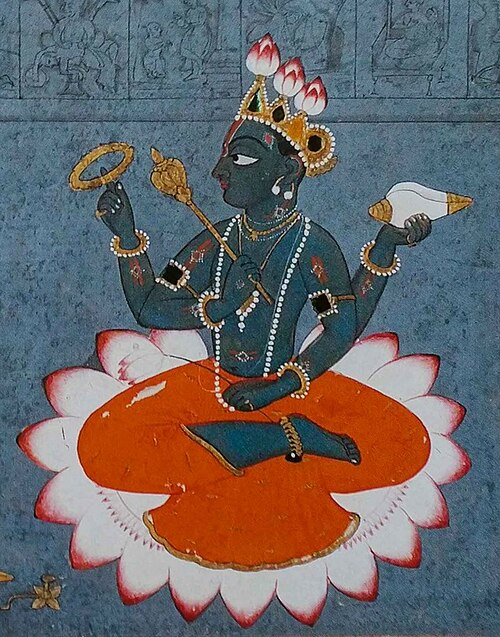
The presiding image is a ~6.5-foot black stone standing Vishnu with four arms (shankha and chakra raised; varada and kati-hasta lowered), distinctive for:
- Namam (a large white forehead mark with saffron center), re-applied daily;
- Golden crown (kirita) weighing over 3 kg;
- A carved Sudarshana Chakra on the right shoulder and Shankha on the left — disputed by sectarian traditions as evidence for Shaiva, Shakta, or Vaishnava identification of the image. The Ramanuja–Ananthalwar "disputation" of the 11th century resolved the image as Vaishnava by iconographic standards.
Historical development
Epigraphic evidence places active worship from at least the 9th century under the Pallavas, with massive endowments documented under Chola Rajendra I (11th c.) and the Vijayanagara emperors (15th–16th c.) — particularly Krishnadevaraya, whose seven visits and gold donations set the architectural scale of the present complex. Annamacharya (1408–1503) composed 32,000 padams in Telugu establishing Tirumala as a major devotional-musical center; ~14,000 of these survive on copper plates at TTD.
Ritual life
The temple maintains a six-kala puja cycle with distinctive features: Suprabhatam (predawn hymn composed by Prativadi Bhayankaram Annan in the 15th century), Thomala Seva (flower-garland adornment), Archana, and a daily Kalyanotsavam (divine wedding ritual). Weekly Abhishekam occurs on Fridays only — unusually rare for a major Vaishnava temple, preserving the mula-vigraha's carved finish. The hair-offering (mundan) at the Kalyanakatta tonsuring station processes ~40,000 pilgrims daily, generating the world's largest single source of human hair for the cosmetic and wig industries.
Why this entry matters
Tirumala Venkateswara is the Andhra Pradesh T0 anchor, the world's most-visited religious site by any metric, and the institutionally strongest case-study for the modern management of a Hindu temple. Rao & Shulman (2005) and Stein (1978) provide Tier 1 scholarship strong enough for VERIFIED promotion once Advisory Council review is complete.
Sources & provenance
- 📜Primary sourceBookS. K. Ramachandra Rao. Tirupati: The Temples and the Deity (1993)Tirumala Tirupati Devasthanams Publications; authoritative devotional-scholarly compilation
- 📜Primary sourceBook