
.jpg/500px-Indra%2C_Chief_of_the_Gods_LACMA_M.69.13.4_(1_of_5).jpg)

.jpg/500px-Rajarani_Temple_03_(cropped).jpg)
Primary Scriptures
0 sourcesNo primary scriptures are catalogued for this entry yet. If you know of scriptural references we have missed, please contribute them.
⚠️ CONTENT VERIFICATION STATUS: This draft is . All citations require validation.
Rig Veda (ऋग्वेद — Knowledge of the Verses)
Overview
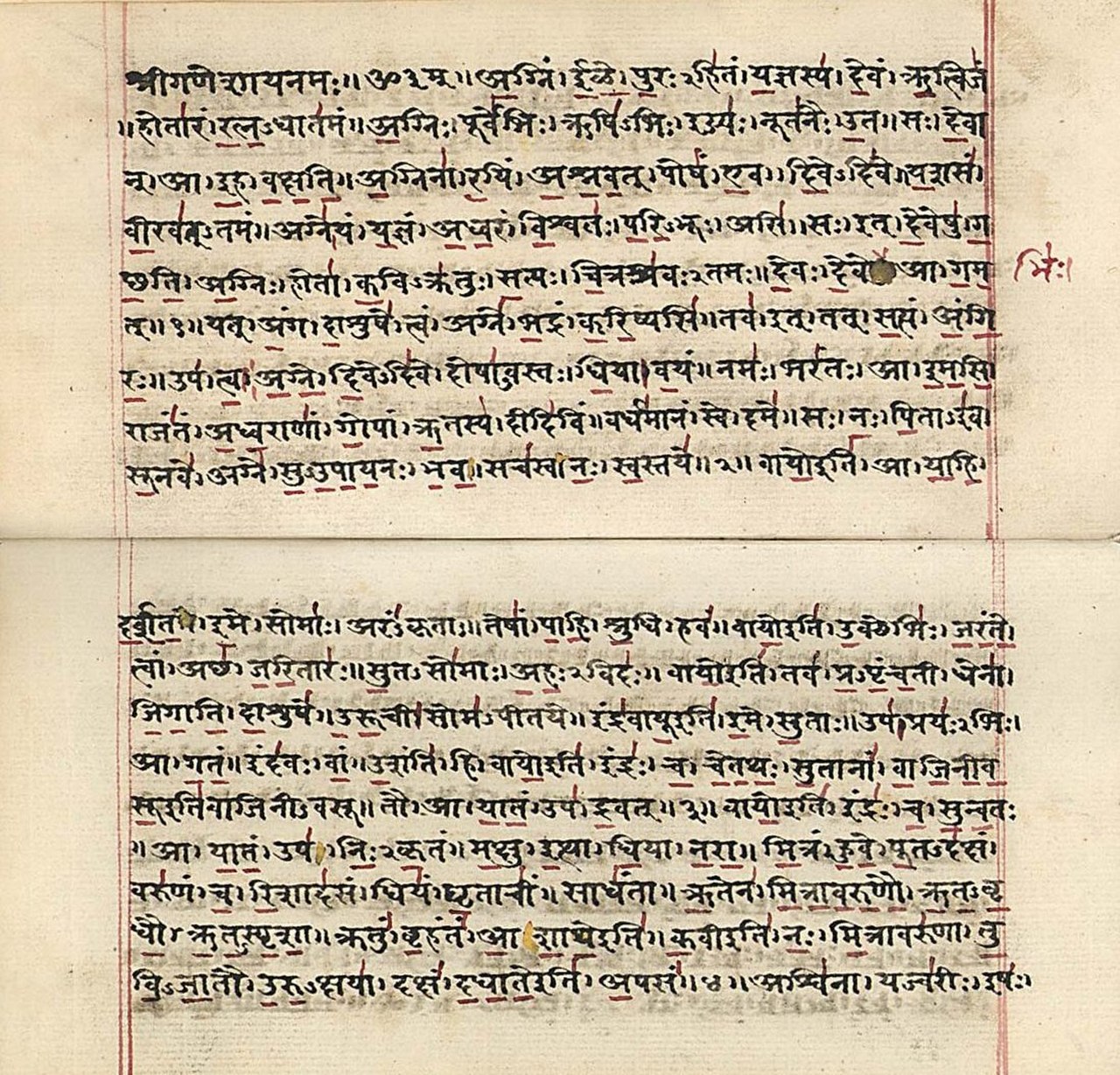
The Rig Veda is the oldest and most important of the four Vedas — the foundational texts of Hinduism. It is a collection of 1,028 hymns (suktas) comprising 10,552 verses (rcas), composed in archaic Sanskrit over several centuries. It is considered shruti ("heard" revelation) — not composed by humans but perceived by ancient seers (rishis) and transmitted orally.
The Rig Veda represents the earliest layer of Vedic religion — a polytheistic, ritualistic tradition focused on worship of natural forces (Indra, Agni, Soma, Surya, Varuna) through fire rituals (yajna). It is the source from which later Hindu philosophy, ritual, and spirituality evolved.
The text is not read as scripture in the typical sense — it is recited during Vedic rituals by trained priests (ritviks). However, select hymns are used for spiritual reflection, and its philosophy underlies all Hindu thought.
Textual Information
Original Title: Rik (ऋक्) or Rig Veda — from "ric" (to praise, to hymn)
Language: Vedic Sanskrit (older than classical Sanskrit)
Estimated Date of Composition:
- Traditional claim: Without beginning; revealed to rishis
- Scholarly range: c. 1500–1000 BCE (based on linguistic analysis and archaeological context)
Structure:
- 10 Mandalas (books)
- 1,028 Suktas (hymns)
- 10,552 Rcas (verses)
Mandala Organization
| Mandala | Content | Approximate Date |
|---|---|---|
| 2–7 | Family books (ancestral hymns) | Oldest layer |
| 8 | Common hymns (Soma, etc.) | Middle layer |
| 9 | Soma hymns | Middle layer |
| 1, 10 | Later additions | Youngest layer |
Central Themes
-
Polytheism: Multiple deities worshipped — Indra (storm), Agni (fire), Soma (ritual drink), Surya (sun), Varuna (cosmic order), etc.
-
Ritual: The yajna (fire sacrifice) as central practice — the primary way to communicate with gods
-
Soma: The divine drink — granting immortality, ecstasy, cosmic insight
-
Truth (Rta): The cosmic order underlying all things; Varuna as guardian of rta
-
Creation: Multiple creation hymns — from nothing, from water, from sacrifice
-
The One and Many: Some hymns suggest the one underlying reality behind the many gods
-
Moksha (in embryo): The concept of liberation from mortality; hymn to Purusha (cosmic man)
Famous Verses
1. Nasadiya Sukta (Hymn of Creation) — Mandala 10, Hymn 129
नासदासीन्नो सदासीत्तदानीं नासीद्रजो नो व्योमा परो यत्। किमावरीवः कुह कस्य शर्मन्नम्भः किमासीद्गहनं गभीरम्॥
Nasadasit no sadasit tadanim nasid rajo no vyoma paroyat Kimavarivah kuh kasya sharmann ambhah kimasid gahanam gabhiram
Translation: "Then there was neither non-existence nor existence; there was no realm of air, no sky beyond. What was moving? Where? Was there below — was there above? There was no one to dispense death or immortality, no sign of night or day. The One breathed, without wind, by its nature."
Significance: One of the most profound creation hymns in any literature — describing creation emerging from void/One.
2. Gayatri Mantra — Mandala 3, Hymn 62, Verse 10
ॐ भूर्भुवः स्वः तत्सवितुर्वरेण्यं भर्गो देवस्य धीमहि। धियो यो नः प्रचोदयात्॥
Om bhūr bhuvaḥ svaḥ tat savitur vareṇyaṃ bhargo devasya dhīmahi | dhiyo yo naḥ prachodayāt ||
Translation: "We meditate on the adorable light of the Divine Sun; may he inspire our intellect."
Significance: The most universal of Vedic mantras; invoked daily by initiated Hindus; originally addressed to Savitar (the sun god).
3. Purusha Sukta (Hymn to the Cosmic Man) — Mandala 10, Hymn 90
सहस्रशीर्षा पुरुषः सहस्राक्षः सहस्रपात्। स भूमिं विश्वतो वृत्वात्यतिष्ठद्दशाङ्गुलम्॥
Sahasra-shirsha Purusha sahasraksha sahasrapat Sa bhumim vishvato vritva ati-tishthat dashangulam
Translation: "A thousand-headed is the Purusha, a thousand-eyed, a thousand-footed. He covered the earth on all sides and extended beyond it ten fingers' breadth."
Significance: Describes the cosmic man (Purusha) whose sacrifice creates the world; provides origin of caste (controversial); basis for later Vedantic thought.
4. Invocation to Agni — Mandala 1, Hymn 1
अग्निमीले पुरोहितं यज्ञस्य देवमृत्विजम्। होतारं रत्नधातमम्॥
Agnim ile purohitam yajnasya devam ritvijam Hotaram ratna-dhatamam
Translation: "Agni I laud, the high priest of sacrifice, the divine officiant of the ritual."
Significance: The opening hymn of the Rig Veda; establishes Agni (fire) as the central mediating deity between humans and gods.
Principal Commentators
- Sayana (14th century): The most important commentator; his RV commentary is the standard reference
- Mahidhara (16th century): Commentator on Vajasenayi Samhita
- Modern scholars: Max Muller, Griffith, Renou — critical editions
Major Translations
| Translator | Year | Note |
|---|---|---|
| Ralph T.H. Griffith | 1896 | First English translation |
| Max Muller | 1857 | Sacred Books of the East |
| Stephanie W. Jamison | 2014 | Recent scholarly translation |
| Sanskriti Institute | 2000 | Hindi commentary |
Position in Hindu Textual Hierarchy
The Rig Veda is the oldest and most authoritative of the four Vedas:
- Shruti (revealed): The highest authority
- Vedas precede all other texts (Puranas, epics, philosophical treatises)
- Within the Vedas, the Rig Veda is the oldest layer
However, it is NOT the most widely read or used by Hindus today — that honor belongs to the Bhagavad Gita, Ramayana, and Bhagavata Purana. The Rig Veda is primarily a scholarly and ritual text.
DivineLens presents perspectives from within this tradition, curated for authenticity. For personal spiritual direction, advanced study, or questions about tradition-specific practice, we recommend finding a qualified teacher. Our Advisory Council reviews all content for theological accuracy.
Known Limitations
- Citations require verification.
- The Vedic vs. classical Sanskrit distinction is understated.
- The caste origin from Purusha Sukta is controversial.
- The ritual dimension (yajna) requires more explanation.
- The relationship to later Hindu philosophy requires more depth.
Recommended reviewers: A Sanskritist, a Vedic scholar, a historian of religions.
Sources & provenance
- 🎓Scholarly sourceBookJames G. Lochtefeld. The Illustrated Encyclopedia of Hinduism (2002)
- 🎓Scholarly sourceGazetteer