
Sthalapurana of Dwarka — The City Krishna Asked From the Sea
A king asks the ocean for land, and the ocean gives twelve yojanas — then takes the whole golden city back on the day Krishna leaves the earth.
Leaving Mathura
Even after Kamsa fell, Mathura knew no peace. Jarasandha's armies came again and again, burning granaries and breaking morale, until Krishna chose exile-with-purpose: he would move his people west, to where the land ends and the Arabian Sea begins.
Land Asked From the Ocean
On the shore, Krishna worshipped Samudra, the Ocean, and asked for twelve yojanas of ground. The Ocean consented — some tellings say gladly, remembering Varaha's debt to the deep's old rival. In a single night Vishvakarma, architect of the gods, raised Dvaraka: ramparts, avenues, palaces for sixteen thousand queens, and at its heart Krishna's own house. The city was called Dvaravati — "she of many doors" — because no gate of hers was ever shut to a guest.
The Musala Parva
Thirty-six years later, Gandhari's curse matured. At Prabhasa tirtha the Yadavas destroyed themselves with iron musala-weeds grown from a curse, as foretold. Balarama slept beneath the sea; Krishna sat alone in deer-skin in the forest, and a hunter's arrow — tipped with the lost piece of the iron mace, aimed at what looked like a sleeping eye — found his foot.
Then the Ocean rose. Wave by wave it took the golden towers back into itself, exactly as it had once given them. Arjuna evacuated the survivors, and as he led the last chariot away, the archer who had held the Gandiva through Kurukshetra could not lift a handful of ordinary arrows against common robbers. Strength, the epic says, lives only where the Lord does.
The Jagat Mandir
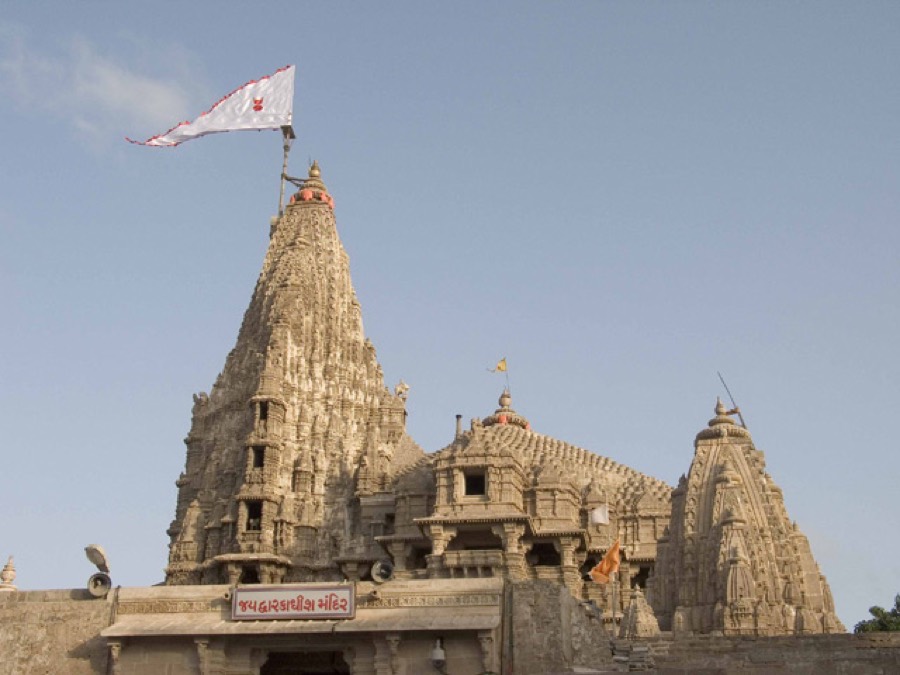
On the mound where Krishna's own house stood, the Jagat Mandir ("temple of the world") rises today — five storeys, a shikhara about 78 metres tall, supported on a hillside of dressed stone said to be two millennia old at its base. The land-side door is called Moksha Dwara, the door of liberation; the sea-side gate is Svarga Dwara, heaven's door. The great flag — changed several times each day by devotees who sponsor it like a vow — flies over water that remembers the city.
What the Sea Says
Marine archaeology off modern Dwarka has mapped submerged stone walls, harbour works, and anchor stones of historic date. Whether any layer belongs to Dvaravati herself is still argued in journals. The purana made its claim plainly: the sea gave, and the sea took back. On this coast, geology and story agree on at least that much.
Sit with this
What is taken from the sea on trust will be reclaimed by it in time; only what was lived there cannot sink.
Watch the flag change at dusk from Svarga Dwara: five times a day a new banner rises over the sea that took the city.
Characters in this kathā
Where this kathā lives
Source of this telling
Mahābhārata — Mausala Parva; Bhāgavata Purāṇa — Skandha 10–11
Further reading
- Mahabharata — Mausala Parva
- Bhagavata Purana
- Dwarkadhish Temple