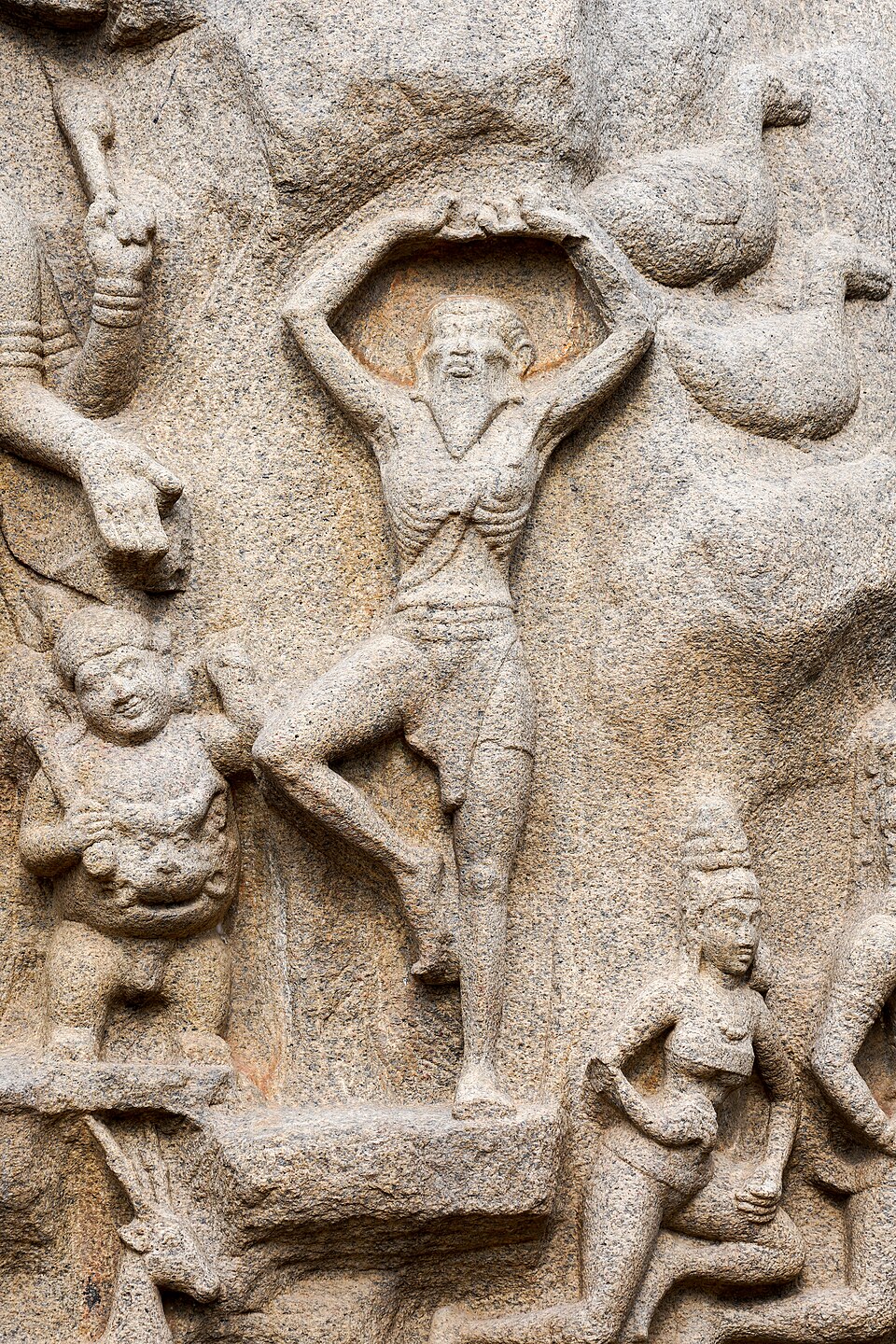
Ganga Avataran — The Descent of the Ganges
Sixty thousand princes burned to ash beside a meditating sage, and their ashes waited a thousand years for one descendant stubborn enough to bring a river down from heaven — and for a god willing to catch her in his hair.
The ashes no river would take
It starts with a ritual. King Sagara, of the Ikṣvāku line, performed the aśvamedha, the horse-sacrifice by which a king asserts lordship over the earth, and Indra — uneasy about the claim — stole the horse and hid it in Pātāla, beside a sage named Kapila who sat in penance 2. Sagara's sixty thousand sons went searching, found the horse beside the silent sage, took him for the thief, and disturbed his meditation. Kapila opened his eyes and they burned where they stood 2.
This is the part the tradition keeps. Ashes cannot be given to the fathers until they are washed in a sacred river, and no river then flowing on earth was sacred enough 2. So the task passed down. Sagara's son Aṃśumān, then his grandson Dilīpa, each inherited the obligation and each failed at it 2. The task is recorded as travelling five generations before it reached the man who would finish it 2.
The king who would not take the throne
Bhagīratha, Dilīpa's son, was told by his father on his deathbed to complete what he had failed to complete 2. He did not ascend the throne of Ayodhyā. He gave the kingdom to his ministers and went to the Himālaya to perform austerities, to invoke the goddess Gaṅgā herself 2.
The Vālmīki Rāmāyaṇa preserves the earliest account we have of what follows, and it is terse. Rāma, in Bāla Kāṇḍa, describes to Viśvāmitra how Bhagīratha brought the river down: Śiva agreed to receive the Gaṅgā on his head, and from there she was released into the lake Bindusarovara, and from the lake she flowed in seven courses 1. Bhagīratha led the way and she followed 1. That is the whole of the epic version, and it is worth noticing how much of the famous imagery it does not contain.
The Purāṇas thicken it, and they thicken it in a specific direction: by adding penances. In the Bhāgavata Purāṇa's telling, as it comes down to us, Bhagīratha undertakes a penance lasting a thousand years at Kailāsa before Śiva will receive the river 2. Gaṅgā descends, Śiva catches her in his matted hair, and she is held there — and Bhagīratha must perform a second penance before Śiva shakes his hair and lets a single drop fall upon the Indo-Gangetic plain 2.
Two penances, not one. The first wins Śiva's consent to be the cushion. The second is needed to get him to let go. Whether that is a flourish of the Purāṇic imagination or a serious piece of theology about divine cooperation, it has shaped the image: the river does not fall, it is released.
Bhāgīrathī, Jāhnavī
The river acquired two names from this story, and they record two different relationships.
Bhagīrathī is the daughter of Bhagīratha — the name Brahmā is said to have proclaimed, marking that the descent was owed to this king's effort 2. It is the name the river carries for the stretch that leaves the plains. Later tradition turned the whole episode into an idiom for an undertaking of enormous, perhaps impossible, persistence: a Bhagīratha effort.
Jāhnavī is the daughter of Jahnu, and the story behind it is the one the epic account leaves out entirely. Jahnu is a hermit-king of the Chandravamśa, son of Ajamīḍha, who abdicated in favour of his son and retired to penance 3. When the Gaṅgā, released from Śiva's locks, came flooding down and wrecked his fields and his sacrifice, Jahnu was enraged and drank the entire river 34. The devas prayed him to release her, since her mission was to liberate the ancestors of Bhagīratha, and he released her from his ear 34.
A river that comes out of a sage's ear is a river that has been swallowed whole and returned. The name Jāhnavī is a record of that.
A quarrel in heaven, and a river sent to absorb sin
There is a variant that moves the entire origin into a domestic quarrel, and it is worth knowing because it is the one that explains why India's rivers are worshipped as goddesses who are also wives.
The Devi Bhāgavata Purāṇa tells it this way. Viṣṇu had three wives: Lakṣmī, Sarasvatī and Gaṅgā. Gaṅgā exchanged affectionate glances with Viṣṇu; Lakṣmī stayed calm but Sarasvatī reproached her husband and left. Sarasvatī attacked Gaṅgā; Lakṣmī intervened and was cursed in turn to become a tree and a river; and Gaṅgā and Sarasvatī cursed each other with descent to earth as rivers 5. Viṣṇu returned, pacified them, and decreed their destinies: Lakṣmī to incarnate as the tulasī plant and the river Padmavatī, Gaṅgā as the river Bhāgīrathī and Śiva's consort, Sarasvatī as a river that absorbs human sin 5.
This is a different register of story from the sixty-thousand-ashes version, and it does not contradict it — it is a different answer to a different question. The Bhāgīratha story answers why the river is here. The quarrel story answers why a river is a goddess, and why she is a wife.
The Bengali variant, and why it matters
One more layer, from Bengal, and recorded here because it shows how far a story can travel from its epic source. In a number of Bengali accounts, Dilīpa dies without an heir. On a sage's advice two of his widows lie together, and one conceives and bears Bhagīratha 2. The child is born deformed — boneless in the Padma Purāṇa version, or a lump of flesh in the Kṛttivāsī Rāmāyaṇa — until he meets the crippled sage Aṣṭāvakra, who transforms him into a strong and beautiful youth 2.
The scholar's caution attached to this variant is worth repeating: it may first be attested in the Bengali-script recension of the Sanskrit Padma Purāṇa, and then recurs in the 15th-century Kṛttivāsī Rāmāyaṇa and later Bengali works 2. It is a recensional story, which means it belongs to a manuscript tradition and not to the pan-Indian canon — exactly the kind of claim an encyclopedia should label rather than flatten.
What the oldest account does not say
So a fair summary of the descent, sorted by source:
| Claim | Vālmīki Bāla Kāṇḍa sarga 43 | Purāṇic / later |
|---|---|---|
| Śiva receives Gaṅgā on his head | yes 1 | yes, elaborated 2 |
| Released into Bindusarovara, flows in seven courses | yes 1 | rarely mentioned |
| Bhagīratha leads the way | yes 1 | yes |
| Two penances, a thousand years each | no | yes 2 |
| Jahnu drinks the river and releases her from his ear | no | yes 34 |
| The three-wives quarrel | no | yes 5 |
| The Bengali boneless-child birth | no | yes, recensional 2 |
The epic gives you the mechanics. The Purāṇas give you the theology and the names. Nobody invented the names — but they are not in the oldest account, and an honest telling has to say so.
The claim, kept small
Bhagīratha held out for a task that had defeated four generations before him, and refused to be crowned until it was done 2. Śiva agreed to catch the river and then had to be asked again to let her go 2. Jahnu swallowed her whole and gave her back through his ear 3. The ashes of sixty thousand princes were finally washed 2.
The river that runs past Haridwar today is called, in different places, the Gaṅgā, the Bhāgīrathī and the Jāhnavī. Each name records a different person who made a decision about her: the descendant who brought her, the god who caught her, the sage who drank her.
Sit with this
A task left unfinished by five generations was finished by one who would not take the throne until it was done.
The ashes waited five generations. What are you carrying that someone handed you undone?
Characters in this kathā
Source of this telling
Vālmīki Rāmāyaṇa, Bāla Kāṇḍa sarga 43; Bhāgavata Purāṇa, Ninth Skandha; Brahma Purāṇa (Jahnu)
Further reading
- Vālmīki, Vālmīki Rāmāyaṇa, Bāla Kāṇḍa, sarga 43 — the descent of the Gaṅgā
- Bhagīratha
- Jahnu
- Brahma Purāṇa, chapter 11 — Jahnu's curse on the Gaṅgā
- Devi Bhagavata Purana, Devi Bhāgavata Purāṇa, Ninth Skandha, adhyāya 6 — the descent of Lakṣmī, Gaṅgā and Sarasvatī
- Vyāsa (traditional attribution), Bhāgavata Purāṇa, Ninth Skandha — the Bhāgīratha narrative