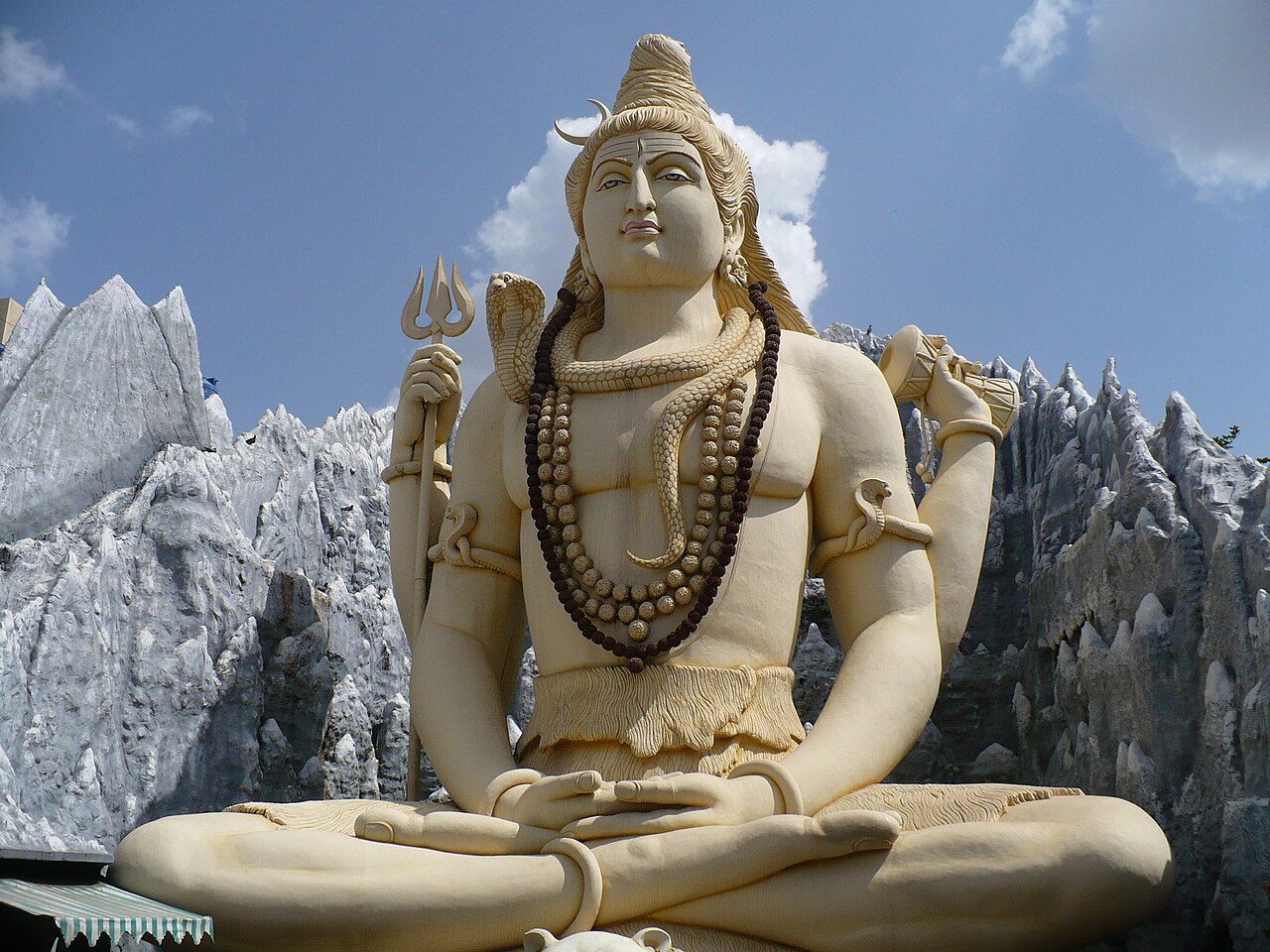


Sacred Facts · At a Glance
Mantra
Om Namaḥ Śivāya / Om Tryambakaṃ Yajāmahe Sugandhiṃ Puṣṭivardhanam Urvārukam Iva Bandhanān Mṛtyor Mukṣīya Māmṛtāt
- Gender
- male
- Vahana
- Nandi (the sacred white bull, symbol of unwavering righteousness, vigilant focus, and dharma)
- Weapon
- Triśūla (the three-pronged trident representing Icchā, Jñāna, and Kriyā Śakti) · Ḍamaru (hourglass drum of cosmic rhythm and creation) · Pināka (celestial bow) · Pāśupatāstra
- Sacred Number(s)
- 3 · 5 · 11 · 108
- Sacred Colours
- immaculate snow-white (karpūra-gaura / vibhūti white)deep poison-blue (throat: nīlakaṇṭha)ash grey
- Sacred Flowers
- bilva flower · dhatūra (Datura metel) · arka / mandāra (Calotropis gigantea) · blue lotus (nīlotpala) · aparājitā
- Sacred Trees
- bilva · vaṭa (banyan — under which Shiva sits as Dakshinamurti) · aśvattha
- Sacred Offerings
- Pañcāmṛta abhiṣeka (milk, yogurt, ghee, honey, sugar) · trifoliate bilva leaves · vibhūti (pure consecrated sacred ash) · cold Gangajal · sandalwood paste
- Sacred Animals
- bull (Nandi) · cobra (Vāsuki / Nāgābharaṇa around the throat) · deer (kṛṣṇa-mṛga held in upper left hand) · tiger (whose pelt serves as yogic seat)
- Sacred Birds
- swan (hamsa — flying upward to discover the crest of the Lingodbhava)
- Sacred Plants
- bilva (Aegle marmelos — trifoliate leaves representing the three gunas and three eyes) · rudrākṣa (Elaeocarpus ganitrus — tears of Shiva) · bhaṅg (Cannabis) · dūrvā grass
Primary Scriptures
6 sources- Śrī Rudram & Camakam (Kṛṣṇa Yajurveda, Taittirīya Saṃhitā 4.5 & 4.7)vedaComposed c. 1200–1000 BCEThe supreme Vedic litany containing the foundational revelation of the five-syllable mantra 'Namaḥ Śivāya ca Śivatarāya ca' in the central 8th Anuvaka
- Ṛgveda Saṃhitā (7.59.12 — Mahā Mṛtyuñjaya Mantra)vedaComposed c. 1500–1200 BCERevealed by Sage Vashistha: 'Tryambakaṃ yajāmahe sugandhiṃ puṣṭivardhanam urvārukam iva bandhanān mṛtyor mukṣīya māmṛtāt'
- Śvetāśvatara UpaniṣadupanishadComposed c. 600–500 BCE
Shiva
Mahadeva — The Great God, Supreme Ascetic, and Lord of the Cosmic Dance
Overview
Lord Shiva (शिव) — meaning "The Auspicious One" (śivaḥ kalyāṇa-rūpaḥ) — is one of the three principal deities of the Hindu Trimurti, alongside Brahma (creator) and Vishnu (preserver). Known as Mahādeva, Śaṅkara, Naṭarāja, Bhairava, and Dakṣiṇāmūrti, Shiva represents the transcendent consciousness that dissolves, purifies, and regenerates the cosmos.
In the Shaiva and Shakta traditions, Shiva is not merely a god of destruction, but the supreme unchanging Non-Dual Reality (Paramaśiva). He is the eternal stillness of meditation from which all dynamic cosmic movement (Śakti) arises:
$$\text{Om Namaḥ Śivāya}$$
Century-by-Century Archaeological & Epigraphical Evolution
c. 2500 BCE      c. 3rd–2nd c. BCE   c. 1st c. CE     5th c. CE        6th c. CE        760 CE           1010 CE
     │                   │                │               │                │               │                │
     ▼                   ▼                ▼               ▼                ▼               ▼                ▼
Mohenjo-daro     Gudimallam       Kushan           Imperial         Elephanta        Ellora           Thanjavur
Pashupati Seal   Anthropomorphic  Oesho Coins      Gupta Khoh       Cave 1           Cave 16          Brihadisvara
Horned Yogi      Rudra-Lingam     & Mukha-Lingas   Ekamukha Linga   Maheshamurti     Kailasanatha     81-Tonne Cupola
1. Proto-Historic & Vedic Origins (c. 2500–1000 BCE)
- The Pashupati Seal (Mohenjo-daro, c. 2500 BCE): Steatite Seal 420 displays a three-faced figure seated in Mūlabandhāsana yogic posture, wearing a horned headdress, flanked by an elephant, tiger, rhinoceros, water buffalo, and two deer beneath his seat—the archaic prototype of Shiva as Paśupati (Lord of All Creatures).
- The Mahā Mṛtyuñjaya Mantra (Rigveda 7.59.12): Revealed by Sage Vashistha, this supreme healing prayer invokes Tryambaka (the Three-Eyed Lord) to liberate mortals from the bondage of death like a ripe cucumber falling effortlessly from its stalk.
- Śrī Rudram (Taittirīya Saṃhitā 4.5 & 4.7): The central liturgy of the Krishna Yajurveda. In the 8th Anuvaka, the sacred five-syllable Panchakshari mantra is revealed:
नमः शिवाय च शिवतराय च ।
"Salutations to the Auspicious One (Śiva), and to Him who is exceedingly Auspicious (Śivatara)!"
2. The Oldest Stone Lingam: Gudimallam (c. 3rd–2nd c. BCE)
- Located in the Parashurameshwara Temple at Gudimallam (Chittoor, Andhra Pradesh), this 5-foot polished stone lingam represents the oldest surviving realistic anthropomorphic Shiva sculpture in the world.
- Carved directly upon the front of the phallic shaft is a dynamic two-armed Vedic Rudra:
- Holding a hunted ram in his right hand and a battle-axe and water vessel in his left.
- Wearing thin diaphanous drapery and no sacred thread (reflecting pre-classical ascetic norms).
- Standing firmly upon the shoulders of a crouching, pointed-eared dwarf yaksha.
3. Kushan Dynasty Coinage & Mathura Mukha-Lingas (c. 1st–3rd c. CE)
- Kushan gold dinars issued by King Vima Kadphises and Kanishka depict Oesho (Shiva) with two or four arms, clutching a trident and water pot, with the bull Nandi standing proudly behind.
- In the Mathura sandstone studios, artists created the earliest Ekamukha (one face emerging from the lingam shaft) and Caturmukha (four faces gazing in four directions) Lingas, establishing the Agamic doctrine of Shiva's five faces (Pañcanana: Sadyojata, Vamadeva, Aghora, Tatpurusha, Ishana).
4. Imperial Gupta Classical Mastery (c. 4th–6th c. CE)
- Masterpieces like the Khoh Ekamukha Linga (Madhya Pradesh, 5th c. CE) display an aristocratic, serene facial countenance emerging seamlessly from the cylinder. The third eye is carved vertically on the forehead, the matted hair is tied in an intricate jatamukuta studded with pearls and a crescent moon, radiating supreme inward contemplative bliss.
5. Deccan & Western Rock-Cut Monuments (c. 6th–8th c. CE)
- Elephanta Cave 1 (Maharashtra, 6th c. CE): The central chamber houses the colossal 20-foot three-faced bust of Maheśamūrti (Sadāśiva):
- Central Face (Tatpuruṣa): Serene, transcendent, meditative consciousness.
- Right Face (Vāmadeva / Umā): Gentle, feminine, holding a lotus, representing creative preservation.
- Left Face (Aghora / Bhairava): Fierce, with mustache, coiled serpents, and skull in his hair, representing cosmic dissolution.
- Ellora Cave 16 Kailasanatha (Maharashtra, c. 760 CE): Rashtrakuta King Krishna I carved a two-story monolithic Kailash mountain out of living basalt cliff. The celebrated Rāvaṇānugrahamūrti panel depicts Ravana attempting to shake Mount Kailash, while Shiva calmly presses down with his great toe, trapping the demon beneath the mountain until Ravana composes the Shiva Tandava Stotram.
6. Imperial Chola Lost-Wax Bronzes & Thanjavur (c. 10th–12th c. CE)
- Under Chola monarchs Rajaraja I and Rajendra I, stone and bronze art reached imperial heights:
- Brihadīśvara Temple (1010 CE): The world's first all-granite temple, soaring 216 feet, housing an immense 13-foot black granite lingam.
- The Lost-Wax Bronzes: Sthapathis cast kinetic masterpieces of Nataraja in the Ananda Tandava posture, Somaskanda groups (Shiva and Uma with infant Skanda), and Tripurantaka wielding the cosmic bow.
Canonical Scriptures & Philosophical Core
                         [ PARAMASHIVA / BRAHMAN ]
                                     ▲
                                     │
           [ PRAKĀŚA (Light of Consciousness) ]
                                     │
                                     ▼
             [ VIMARŚA (Reflective Dynamic Power / Śakti) ]
                                     │
       ┌─────────────────────────────┼─────────────────────────────┐
       ▼                             ▼                             ▼
[ SHAIVA SIDDHANTA ]       [ KASHMIR SHAIVISM ]           [ VIRA SHAIVISM ]
Tirumantiram               Shiva Sutras                   Vachana Sahitya
Pati, Pashu, Pasha         Pratyabhijna (Self-Recognition) Basaveshwara, Ishtalinga
- Shaiva Siddhānta (Tamil Tradition): Expounds the three eternal realities:
- Pati: The Supreme Lord Shiva.
- Paśu: The individual soul bound by ignorance.
- Pāśa: The threefold fetters of Āṇava (ego), Karma (action), and Māyā (illusion). Through Shiva's grace (Śaktinipāta), the soul sheds its fetters and attains the nature of Shiva.
- Kashmir Shaivism (Trika / Pratyabhijñā): A non-dual philosophy holding that the entire universe is the free self-expression (Svātantrya) of Shiva's consciousness. Liberation is the sudden, joyful recognition (Pratyabhijñā) that one's own inner consciousness is identical with Paramaśiva.
The Sacred Geography: 12 Jyotirlingas & 5 Elements
                    [ KEDARNATH (Himalayas) ]
                               ▲
                               │
[ SOMNATH (West) ] ────────────┼──────────── [ KASHI (Ganga) ]
                               │
                               ▼
                   [ RAMESHWARAM (South Ocean) ]
The 12 Sacred Jyotirlingas
- Somnāth (Gujarat) — The first pillar of light; healed the Moon God.
- Mallikārjuna (Srisailam, Andhra Pradesh) — Shiva and Parvati on the sacred hill.
- Mahākāleśvara (Ujjain, Madhya Pradesh) — Lord of Death and Time; south-facing.
- Oṃkāreśvara (Madhya Pradesh) — Island shaped like the Om syllable in the Narmada.
- Kedārnāth (Uttarakhand) — Himalayan summit of the divine bull.
- Bhīmāśaṅkara (Maharashtra) — Source of the Bhima river; vanquisher of Bhimasura.
- Kāśī Viśvanātha (Varanasi, Uttar Pradesh) — King of the universe on the holy Ganga.
- Tryambakeśvara (Nashik, Maharashtra) — Source of the Godavari; three-faced lingam.
- Baidyanāth (Deoghar, Jharkhand) — Divine physician who restored Ravana.
- Nāgeśvara (Dwarka, Gujarat) — Lord of serpents; protection from poisons.
- Rāmeśvara (Tamil Nadu) — Consecrated by Sri Rama on the sea-shore.
- Gṛṣṇeśvara (Ellora, Maharashtra) — Rebuilt by Ahilyabai Holkar adjacent to Ellora caves.
The Pañca Bhūta Sthalams (The Five Elemental Lingams)
- Prithvi (Earth): Ekambareswarar Temple, Kanchipuram (sand lingam).
- Appu (Water): Jambukeswarar Temple, Thiruvanaikaval (submerged in underground spring).
- Theyu (Fire): Annamalaiyar Temple, Tiruvannamalai (sacred beacon hill).
- Vayu (Wind): Srikalahasteeswara Temple, Srikalahasti (flame flickering without wind).
- Akasha (Ether / Space): Nataraja Temple, Chidambaram (formless space behind curtain).
Canonical Daily Practice & Recitation
Household Practice
- Pañcākṣarī Mantra Japa: Chanting 108 times using a Rudraksha mala: $$\text{Om Namaḥ Śivāya}$$
- Mahā Mṛtyuñjaya Japa: Chanted for physical health, fearlessness, and protection: $$\text{Om Tryambakaṃ Yajāmahe Sugandhiṃ Puṣṭivardhanam}$$ $$\text{Urvārukam Iva Bandhanān Mṛtyor Mukṣīya Māmṛtāt}$$
- Daily Offering: Offering clean fresh water, unbroken white rice, and trifoliate bilva leaves onto the Shiva Lingam.
Wisdom Graph: Divine Associations
MantraOm Namaḥ Śivāya / Om Tryambakaṃ Yajāmahe Sugandhiṃ Puṣṭivardhanam Urvārukam Iva Bandhanān Mṛtyor Mukṣīya Māmṛtāt
- Vāhana
- Nandi
- Sacred animals
- bull (Nandi)cobra (Vāsuki / Nāgābharaṇa around the throat)deer (kṛṣṇa-mṛga held in upper left hand)tiger (whose pelt serves as yogic seat)
- Sacred birds
- swan (hamsa — flying upward to discover the crest of the Lingodbhava)
- Sacred flowers
- bilva flowerdhatūra (Datura metel)arka / mandāra (Calotropis gigantea)blue lotus (nīlotpala)aparājitā
- Sacred plants
- bilva (Aegle marmelos — trifoliate leaves representing the three gunas and three eyes)rudrākṣa (Elaeocarpus ganitrus — tears of Shiva)bhaṅg (Cannabis)dūrvā grass
- Sacred trees
- bilvavaṭa (banyan — under which Shiva sits as Dakshinamurti)aśvattha
- Offerings
Sources & provenance
📖 6 Tertiary
- 📖Supporting referenceOtherRigveda
- 📖Supporting referenceOtherTaittiriya Samhita (Sri Rudram)
- 📖




