





Sacred Facts · At a Glance
- Gender
- male
Primary Scriptures
0 sourcesNo primary scriptures are catalogued for this entry yet. If you know of scriptural references we have missed, please contribute them.
Kashi Vishwanath
Lord of the Universe of Varanasi
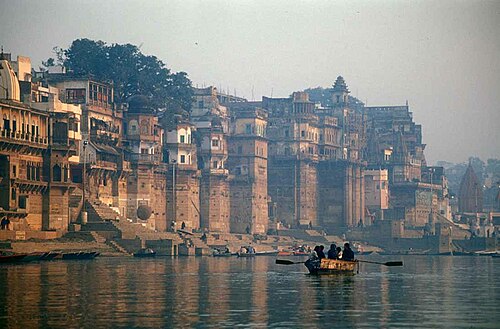
Kashi Vishwanath (Sanskrit: काशी विश्वनाथ, "Lord of the Universe of the Luminous City") is the presiding Shiva Jyotirlinga of Varanasi — the city that is itself the most layered sacred geography in the subcontinent. He is the Uttar Pradesh T0 anchor, one of the twelve Jyotirlingas, and the theological node where almost every other pilgrimage site in India has a ritual double (the "Kashi khanda" of the Skanda Purana enumerates over 300 linked shrines). Diana Eck (1983) famously characterised Kashi as "the city of light" — a place that is simultaneously a real urban settlement and a cosmological diagram.
The temple's layered history
The present Kashi Vishwanath temple is at least the fifth on approximately this site:
- A pre-medieval Vishwanath shrine attested in the Gahadavala inscriptions (c. 11th–12th c.);
- Destroyed by the armies of Qutb al-Din Aibak in 1194 CE;
- Rebuilt, destroyed in 1447;
- Rebuilt by Raja Todar Mal (Akbar's finance minister) as Man Mandir in 1585;
- Destroyed by Aurangzeb's order in 1669; the adjacent Gyanvapi Mosque incorporates part of the earlier temple wall — a site of ongoing legal and political contestation;
- Present temple built by Ahilyabai Holkar in 1780 beside the mosque; gold-plated shikhara added by Maharaja Ranjit Singh in 1835.
The Kashi Vishwanath Corridor, completed in 2021, redeveloped 5 acres around the temple connecting it directly to the Ganga at Lalita Ghat, significantly altering the dense lane-network (galis) that Eck and Parry documented in the 20th century.
Kashi theology
The theology of Kashi has several distinctive features:
- Moksha-puri: one of the seven cities said to grant moksha to those who die there. Parry (1994) documents the Manikarnika cremation ground as the institutional infrastructure of this claim.
- Avimukta ("never abandoned"): Shiva pledged in the Kashi Khanda never to leave Kashi, even during pralaya. The lingam's very name Vishwanath is a pan-sovereign title.
- Linga-center of all lingas: all other Jyotirlingas are theologically collapsed into Kashi's lingam for the pilgrim who completes the pan-Indian Jyotirlinga yatra at Kashi.
- Death-city: Kashi reverses normal Hindu pollution-purity categories — death is sanctifying here, not polluting.
Annapurna
Though Vishwanath is the presiding Shiva, the Annapurna temple adjacent to the Vishwanath sanctum is ritually inseparable: in the Kashi theology, Shiva took the name Bhikshatana (the beggar) and received alms from his consort Parvati in her Annapurna (goddess of food) form. The Annapurna temple was built by the Peshwas in the 18th century and functions as the temple complex's food-economy center.
Ritual life
Daily worship includes five arati cycles: Mangala (predawn), Bhoga (11 AM), Saptarishi (7 PM), Shringar (9 PM), and Shayan (10:30 PM closing). The Bhasma Aarti is performed not here but at the companion Ujjain Mahakaleshwar — an inter-Jyotirlinga ritual division that Eck (2012) reads as evidence of Kashi's function as the grammar of a pan-Indian sacred geography.
Why this entry matters
Kashi Vishwanath is the UP T0 anchor, a Jyotirlinga, and the dense node of Hindu pan-pilgrimage theology. Eck (1983) remains, four decades on, the single most important English-language book on any Hindu city — giving this entry unusually strong Tier 1 footing.
Wisdom Graph: Divine Associations
- Vāhana
- Nandi
Sources & provenance
- 📜Primary sourceBookDiana L. Eck. Banaras: City of Light (1983) pp. 1–427Princeton University Press; the definitive English-language study of Kashi's sacred geography
- 📜Primary sourceBook