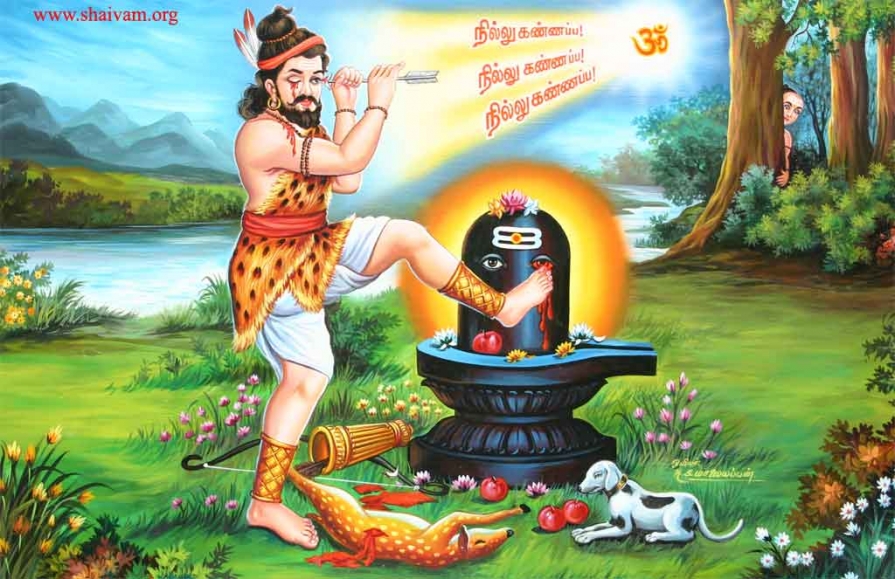
Kannappa's Eyes
A wild hunter offers Śiva the meat of his hunt — and when the Lord's eye bleeds, the hunter gives his own eye in its place. What he offered first was water carried in his mouth.
Vadumūru, and a boy who liked hunting
The fullest genealogy the record gives is from M. Rama Rao's Select Andhra Temples, which places him in a village — Vadumūru in Pottapinādu — inhabited by Chenchus, a forest people of the region 2. Its chief was Natha-nàtha; his wife was Tande; their son was Tinna, who grew into a youth skilled in archery and interested in hunting 2.
He is called Thinnan in the tradition, which is glossed as "strong, powerful" 1. He is a Telugu saint, and he belongs to all South Indian traditions — he is one of the sixty-three Nayanmars of Tamil Śaiva Siddhānta 1, whose stories were collected in the twelfth century in the Periyapurāṇam of Cēkkiḻār 1 — the canon Vidya Dehejia's study of the Tamil saints treats as the defining path-literature of that tradition 4.
That is the frame. A hunter from a specific village, belonging to a specific people, elevated into the shared pantheon of an entire linguistic tradition a thousand miles from where he was born.
The vāyu-liṅga
He found the vāyu-liṅga — the liṅga that embodies air, which is Kālahasti's element in the five-element circuit — while hunting in the forest 1. The vāyu-liṅga is still worshipped at the Śrīkālahasteesvara temple in Andhra Pradesh 1.
He came back. And then he did the thing that makes the story more than a miracle: he brought offerings from the life he actually had.
He offered water from his mouth and meat from his hunts 1. That was the first gift, and it was not an eye.
It is worth stopping on. The tradition that remembers him is a tradition of elaborate ritual with strict rules about what may be offered and by whom. He brought two things that this tradition would not accept from him: water carried in his own mouth, and the flesh of animals he had killed. And the story says the offerings were accepted because of the hunter's sincerity and pure heart 1 — not because the rules were wrong, but because they were not the point.
The eye
One day he noticed that the liṅga was bleeding from one of its eyes.
Without hesitation he plucked out one of his own eyes and placed it on the liṅga to stop the bleeding 1.
Then the other eye of the liṅga began to bleed. He prepared to offer his remaining eye. And here is the detail that turns an act of desperation into an act of care: to make sure he could place it correctly, he marked the spot with his foot 1.
A man who is about to blind himself takes the trouble to measure where the eye must go. That is not madness. That is the care of someone for whom accuracy matters even at the end.
Moved by it, Śiva appeared from the liṅga and stopped him, restored both his eyes, and granted him liberation 1.
Four languages, one story
What makes this saint unusual in the corpus is not the episode. It is the record.
His story is told in four languages and at least four centuries, and each telling is a different kind of text.
The Tamil source is Cēkkiḻār's Periyapurāṇam, the twelfth-century hagiography of the sixty-three Nayanmars 1 — the version that put him into a pan-Tamil canon.
The Telugu record runs in two streams. Dhūrjaṭi wrote the Kāḷahastīśvara Śatakamu in the sixteenth century, a hundred-verse cycle addressed to the lord of Kālahasti 1; the standard English edition is the Heifetz and Narayana Rao translation, which is the route by which most readers who do not read Telugu meet the Kālahasti corpus 5. And the Basava Purāṇam of the thirteenth century carries him into Telugu Vīraśaivism 1.
The Kannada record is Harihara's Ragale, a 12th-century set of poetic narratives 1 — and Gil Ben-Herut's Oxford study of those narratives is the most recent sustained account of what the Kannada devotional tradition made of him 3.
That is four languages, four centuries, and at least three different religious formations — Tamil Śaiva Siddhānta, Vīraśaivism, and the regional cult of a single temple — all holding one hunter.
Where he can be seen
He is not only in books. He is portrayed along with other devotees in the thousand-pillar corridor of the Meenakshi temple at Madurai 1 — the same temple, and the same kind of hall, that our corpus records as the Velli Sabhā, the silver hall, of the five dancing-halls circuit.
And the scene of his sacrifice is carved in the Shaiva temple pillar reliefs of early Vijayanagara 1. A devotional episode from a Telugu hunter's life becomes architectural sculpture two centuries later, in a different empire.
Why he is still filmed
He has been filmed at least eight times in five languages — in Tamil in 1938 as Kannappa Nayanar, in Kannada in 1954 as Bedara Kannappa with Rajkumar in the name that made the phrase a household word, in Hindi in 1955 as Śiv Bhakta, in Telugu in 1976, again in Kannada in 1988 with two generations of the Rajkumar family, and in Telugu again in 2025 1.
Eight films is a record equal to any saint in this series. The part of the story that survives translation into cinema is not the miracle. It is the moment a man with nothing acceptable to offer brings what he has, and it counts.
The claim, kept small
A Chenchu hunter from a named village, whose father was its chief, found an air-liṅga in the forest and came back with water in his mouth and meat from his kill. When the liṅga bled, he gave an eye for an eye, and marked the spot with his foot before giving the second.
Four languages and four centuries kept him. He is carved in stone at Madurai and in the Vijayanagara reliefs, and he has been filmed eight times.
Sit with this
Love offered from wild hands outweighs ritual performed by learned ones.
He offered water from his own mouth before he ever offered an eye. Ask what you would have brought first.
Characters in this kathā
- Kaṇṇappa
- Śiva
- Nāgan
- the temple priest
Source of this telling
Periyapurāṇam of Cēkkiḻār — the story of Kaṇṇappa Nāyaṉār
Further reading
- Kannappa
- M. Rama Rao, Select Andhra Temples
- Gil Ben-Herut, Śiva's Saints: The Origins of Devotion in Kannada according to Harihara's Ragale
- Vidya Dehejia, Slaves of the Lord: The Path of the Tamil Saints
- Hank Heifetz; Velcheru Narayana Rao, For the Lord of the Animals: poems from the Telugu — the Kāḷahastīśvara Śatakamu of Dhūrjaṭi