
Lumbini — The Garden an Emperor Named
In a grove in the terai, Queen Mayadevi stopped on the road to her father's house, and a child was born. For two thousand years the place was lost. Then in 1896 a stone pillar was dug out of the earth, and the inscription on it gave the grove back its name.
A stop on the road to her father's house
The name means it. In Pali, Lumbini is "the lovely," or "the beautiful garden" 7. Whether it was lovely in the way a pleasure garden is lovely, or only lovely in the way a stretch of shade on a hot road is lovely, is not recorded.
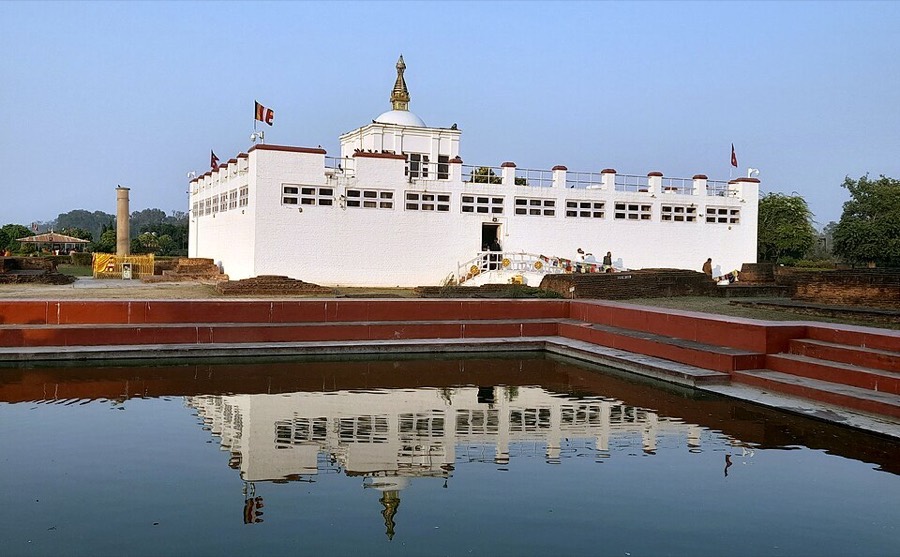
What the tradition records is a stop. Queen Mayadevi was travelling from Kapilavastu towards her father's home at Devadaha, and she paused in the Lumbini grove, and her son was born there 7. The sacred pond on the grounds today is called the Puskarni, and it is the place where she is believed to have taken her ritual cleansing before the birth, and where the newborn was first bathed 7.
That is the story. Everything else at this site is an argument about where, exactly, it happened, and who can prove it.
The date, and why I am not giving you one
The previous version of this entry stated the birth as "~623 BCE by tradition," as though the tradition had a settled view. It does not.
Four chronologies of the Buddha's life are in active scholarly circulation. The Sri Lankan long chronology gives roughly 624–544 BCE. An alternative long chronology gives 567–487. An Indian short chronology gives 448–368. And the so-called contemporary chronology gives 563–483 7. The earliest and latest of those differ by two hundred and fifty-six years. That is not a rounding error — it is a different century at either end.
So this entry does not date the birth. It says the tradition places it in Lumbini, and that the tradition's own calendar is not agreed.
1896: the stone that gave the garden back its name
Here is the fact that makes this site stranger than its guidebooks admit. The place was not known as Lumbini before the pillar was found. The name on the map came out of the ground, not off it 7.
In 1896, at Rupandehi, two men uncovered a stone pillar: Khadga Shamsher Jang Bahadur Rana, a former general of the Nepalese Army, and the archaeologist Alois Anton Führer 7. They worked from the records of the Chinese monk-pilgrims — Faxian in the early fifth century, Xuanzang in the seventh — who had described the relative positions of Lumbini, Sravasti, Kapilavastu and Rajgir 7. Later geometrical work on those accounts has concluded that Kapilavastu and Lumbini lay south of Rajgir, and rejected the northern Kosala as the Buddha's native country 7.
The pillar carries a Brahmi inscription. In S. Paranavitana's translation it reads:
When King Devanampriya Priyadarsin had been anointed twenty years, he came himself and worshipped (this spot), because the Buddha Shakyamuni was born here. (He) both caused to be made a stone bearing a horse and caused a stone pillar to be set up, (in order to show) that the Blessed One was born here. (The King) made the village of Lumbini free of taxes, and paying (only) an eighth share (of the produce). 4
Read that against a thousand later royal inscriptions and notice what it does. It is not a boast. It records an emperor's visit, the reason for it, a stone carved with a horse, a pillar, and then — at the end — a tax cut. The village marked by the stone was relieved of all but an eighth of its produce 4.
Other translations of this inscription have been published, by Hultzsch and others, and they differ in detail 15. This entry quotes one and does not claim it is the last word on the wording.
A second hand, seven centuries later
The same pillar carries a second inscription, carved much later, during the 13th or 14th century: om mani padme hum — "may Prince Ripu Malla be long victorious," dated to 1234 of the Saka era 7. A Tibetan Buddhist formula and a local prince's name, cut into a Mauryan pillar. It is evidence that the site never lost its pull — that whoever held this ground in the centuries when its history was forgotten still came here to write on the stone.
Two more Ashokan pillars stand nearby: the Nigali Sagar pillar, about twenty-two kilometres to the north-west, carries an inscription, and the Gotihawa pillar, twenty-four kilometres to the west, carries none 7.
2013, and what did or did not get dug up
In 2013 a team led by Robin Coningham excavated beneath the existing brick structures at the Mayadevi Temple and reported something that made international news: an older timber structure underneath a brick Buddhist shrine of the Ashokan period, with the layout of the brick shrine following the timber one closely enough to suggest continuity of worship on the same spot. Radiocarbon dating of charcoal from the wooden postholes, and optically stimulated luminescence dating of elements in the soil, put human activity at Lumbini at around 1000 BCE 2.
The report proposed that the site may be a Buddhist monument of the sixth century BCE 2.
Richard Gombrich, a distinguished scholar of Pali, published a dissent the same year under the title "Pseudo-discoveries at Lumbini." His reading is that the excavations revealed nothing that is Buddhist, and confirm only that the site predates the Buddha 3.
I am not qualified to settle this and I am not going to pretend otherwise. Both reports are in print and they do not agree. What can be said without taking sides is that the excavation established a sequence of building on the spot, and that the interpretation of the earliest layer is disputed.
The garden today
The Sacred Garden is the centre. It holds the Mayadevi Temple, the Ashokan pillar, the Marker Stone, the Nativity Sculpture and the Puskarni pond — the specific places rather than a general sense of the ground 1.
Around it lies the monastic zone, one square mile, split into an eastern half for the Theravada monasteries and a western half for the Mahayana and Vajrayana ones, with a long canal and a walkway running between them. The rule is absolute: only monasteries may be built. No shops, no hotels, no restaurants 7. Countries that count Buddhism among their religions have each built a temple in their own national manner, so that a walk through the zone reads as an architectural survey of Asian Buddhism — Nepalese, Indian, Japanese, Royal Thai, Chinese, German, French, Sri Lankan, South Korean, Cambodian, Austrian, Singaporean, Canadian, Vietnamese, Myanmar's golden temple 7.
And the site is not only Buddhist now. Because some Hindus regard the Buddha as an incarnation of Vishnu, thousands of Hindus come to Lumbini on pilgrimage during the full moon of the Nepali month of Baisakh — April to May — to worship Queen Mayadevi under the name Rupa Devi, mother goddess of Lumbini 7. A Hindu tradition of devotion has grown up around a Buddhist queen, at the site where her son was born.
UNESCO inscribed Lumbini on the World Heritage List in 1997, on criteria (iii) and (vi), covering 198.95 hectares with a 22.78-hectare buffer zone 6.
In 2019 Lumbini received about 1.5 million visitors 7.
The four places
The Mahaparinibbana Sutta, the long account of the Buddha's final journey, has him name four places a devout follower should commemorate as long as they live: where he was born, where he attained enlightenment, where he turned the wheel of the law, and where he entered total unbinding 7. The Sutta Nipāta, more briefly, says he was born in a village of the Sákyans in the Lumbineyya Janapada 7.
Birth is here. Enlightenment is Bodh Gaya. The wheel is Sarnath. The end of the road is Kushinagar, now a sister city of Lumbini since 2022 7.
Three of those four once existed here as entries of about two hundred words each. This is the second of the four to be rebuilt.
Sit with this
The greatest journeys sometimes begin where a traveller merely stopped to rest.
Sit by the Puskarni pool at first light, then read the pillar inscription from the marker board rather than from a guidebook.
Characters in this kathā
- Queen Mayadevi
- Siddhartha Gautama
- Ashoka
- Khadga Shamsher Jang Bahadur Rana
- Alois Anton Führer
Where this kathā lives
Source of this telling
Ashokan Rupandehi pillar inscription (Paranavitana, Hultzsch); Mahaparinibbana Sutta (DN 16); Faxian and Xuanzang's travel accounts
Further reading
- Kai Weise (ed.), The Sacred Garden of Lumbini — Perceptions of Buddha's Birthplace, 2013
- R. A. E. Coningham, K. P. Acharya, K. M. Strickland, C. E. Davis, M. J. Manuel, I. A. Simpson, K. Gilliland, J. Tremblay, F. C. Kinnaird, D. C. W. Sanderson, The earliest Buddhist shrine: excavating the birthplace of the Buddha, Lumbini (Nepal), 2013
- Richard Gombrich, Pseudo-discoveries at Lumbini, 2013
- S. Paranavitana, Rupandehi Pillar Inscription of Asoka, 1962
- E. Hultzsch, Inscriptions of Asoka, 1925
- UNESCO World Heritage Centre, Lumbini, the Birthplace of the Lord Buddha — World Heritage List 666
- Lumbini