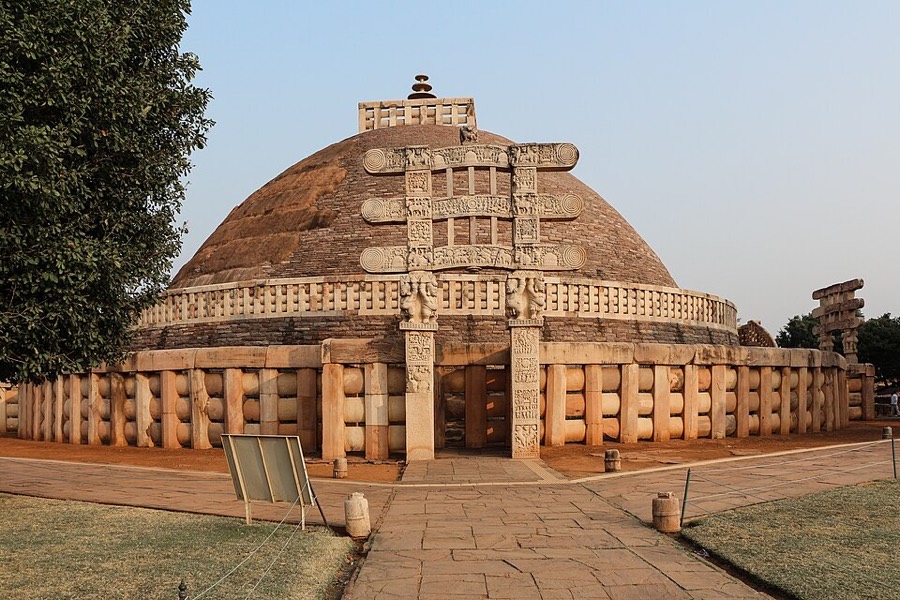
Sthalapurana of Sanchi — The Relic That Never Slept
Ashoka opens the Buddha's eight relic-claims and sends a portion to a hill above Vidisha — where the stone dome he raised has kept its vigil for twenty-three centuries without one night of abandonment.
Eight Portions of Light
When the Buddha passed into Mahaparinirvana at Kushinara, eight clans claimed the remains. A brahmin named Drona settled it with the oldest arbitration on record: strife is unworthy of the Teacher — eight portions, eight stupas. Three centuries later Emperor Ashoka, having turned from conquest to dhamma, opened those eight and redistributed the relics across 84,000 shrines of his empire. One portion came to the hill of Sanchi above Vidisha — fittingly, for his first wife Devi was a merchant's daughter of that city.
A Dome Enlarged Twice
What Ashoka raised was a modest brick hemisphere, half buried by the time the Sungas took over central India. They sheathed and enlarged it into the Great Stupa we see — roughly twice the original girth, dressed in sandstone. Under the Satavahanas, masons raised the four toranas: freestanding gateways whose architraves read like carved scripture — Maya's dream of the white elephant, the great departure, the temptation under the tree, monkeys offering honey.
The Faith Without a Face
Nowhere in all this sculpture does the Buddha appear as a man. He is a pair of footprints, an empty throne beneath the Bodhi tree, a wheel, a riderless horse leaving a palace. This aniconic grammar was not poverty but confidence: the teaching mattered more than the teacher's likeness. Only later — after Greek-influenced Gandhara and Mathura had taught India portraiture — did the Buddha take human form elsewhere.
Never Deserted
Here is Sanchi's quiet miracle: while Buddhism faded across most of India, this hill was never abandoned or forgotten. Local veneration kept the monuments intact through centuries when other sites fell to quarry and jungle. British officers "discovered" it in 1818; the village had always known. Restoration of the toppled toranas was completed by 1889, and relics returned from British museums were re-enshrined within Stupa 1 in modern times — the circle of the Mauryan gift finally closed. UNESCO inscribed the complex in 1989.
Sit with this
A faith so sure of itself needed no portrait — the absence was the presence.
Climb to the terrace at golden hour and read the southern torana left to right — it is a Jataka comic strip in stone.
Characters in this kathā
- Emperor Aśoka
- Devi (Vidiśā)
- the Sātavāhana carvers
Where this kathā lives
Source of this telling
Mahāparinibbāna Sutta (relic division); Aśokan inscriptions