Historical Period3c BCE
3rd c. BCE (Ashoka); expanded 2nd c. BCE (Śunga); toranas 1st c. BCE
3000 BCE3rd century BCEPresent
Sacred Facts · At a Glance
- Vahana
The Mound of the Dhamma — Oldest Buddhist Structure in the World
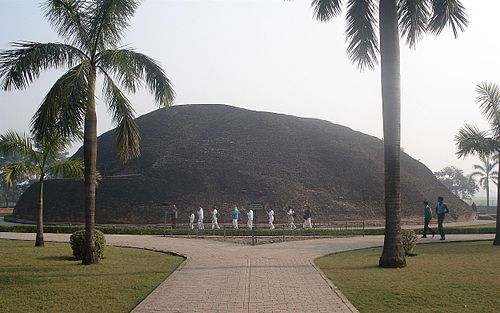
In Sanchi, Madhya Pradesh, there stands Sanchi — The Great Stupa — the Great Stupa at Sanchi is the oldest Buddhist monument in the world — a hemispherical mound originally built by Ashoka in the 3rd century BCE, expanded in the 2nd century BCE, and adorned with four magnificently carved gateways (toranas) that are among the finest Buddhist art ever produced.
Buddhist (Gupta/local)
Dravidian vimana over the sanctum — stupa-influenced with brick tower
Garbhagriha — Stupa-influenced with brick tower
brick
The Great Stupa at Sanchi is the oldest Buddhist monument in the world — a hemispherical mound originally built by Ashoka in the 3rd century BCE, expanded in the 2nd century BCE, and adorned with four
An architectural reading of Sanchi — The Great Stupa — a top-down plan derived from the temple's recorded data.
The colours, creatures, and offerings that mark this site.
The Sanchi toranas illustrate over 20 Jatakas — making them the most complete surviving narrative Buddhist art from ancient India
An editorial reading of the site, woven from its architectural, historical, and scriptural data.
In Sanchi, Madhya Pradesh, Sanchi — The Great Stupa — a 3rd c. bce (ashoka); expanded 2nd c. bce (śunga); toranas 1st c. bce site — the Great Stupa at Sanchi is the oldest Buddhist monument in the world — a hemispherical mound originally built by Ashoka in the 3rd century BCE, expanded in the 2nd century BCE, and adorned with four magnificently carved gateways (toranas) that are among the finest Buddhist art ever produced.
The site is associated with the patronage of Ashoka Maurya (3rd c. BCE — original stupa), Pushyamitra Śunga (2nd c. BCE — expansion) and Satavahana dynasty (1st c. BCE — torana gates). The earliest event recorded here is ashoka's construction (c. 260 bce). Through the centuries, the temple witnessed marshall's restoration (1912–1919). After the Kalinga War, Ashoka built the original stupa at Sanchi — one of 84,000 stupas tradition credits him with constructing across his empire.
Built in the Built in the Buddhist (Gupta/local) tradition, the temple's 1 gopurams rise 12 metres into the sky the garbhagriha holds garbhagriha — stupa-influenced with brick tower . The Great Stupa at Sanchi is the oldest Buddhist monument in the world — a hemispherical mound originally built by Ashoka in the 3rd century BCE, expanded in the 2nd century BCE, and adorned with four
Ashoka's construction (c. 260 BCE)
01Walk the pradakshina path. Note the earliest event recorded here — ashoka's construction (c. 260 bce).
02Look up. The vimana above the sanctum is the temple's vertical sermon — each tier a step toward the divine.
03Return during Vesak / Buddha Purnima (May), when the temple wears its festival form.
04The tradition here is buddhist. Sit. Listen. The darshan is its own teaching.
Other sites derived from shared frontmatter data — tradition, era, region, or built form.

Buddhist (Gupta/local)

Buddhist (Gupta/local)

Buddhist (Gupta/local)

Buddhist (Gupta/local)

Buddhist (Gupta/local)
The telling that made this ground sacred — one sitting, one face.
The Great Stupa at Sanchi stands on a hilltop in central India — a hemispherical mound of brick and stone originally built by Ashoka in the 3rd century BCE. It is the oldest Buddhist structure in the world and one of the most important — not because it holds a relic of the Buddha (it may or may not), but because it is the earliest surviving expression of Buddhist sacred architecture.
The stupa form — a hemispherical mound representing the Buddha's parinirvana — was the original Buddhist "temple". There were no images of the Buddha at Sanchi; the earliest Indian Buddhist art represented the Buddha only through symbols (the Bodhi tree, the Wheel, the empty throne, the stupa itself). This aniconic tradition is one of the most distinctive features of early Buddhist art.
The toranas (gateways) are the glory of Sanchi. Four of them — North, South, East, West — stand at the cardinal points of the railing. Each is carved with intricate narrative panels:
The yakshi on the eastern torana — a woman clinging to a mango tree, her body in a perfect tribhanga — is one of the most reproduced images in Indian art.
At Sanchi, the Buddha is never depicted in human form. Instead, he is represented by symbols:
This aniconic tradition, which gradually gave way to anthropomorphic Buddha images under the Kushans (1st–2nd c. CE), is one of the most important unresolved questions in Buddhist art history: was the Buddha deliberately not depicted, or had the representational convention not yet been invented?

.jpg/500px-Ajanta_(63).jpg)