Historical Period5c CE
528 BCE (first sermon); Ashokan pillar c. 250 BCE; Dhamek Stupa enlarged 5th c. CE
3000 BCE5th century CEPresent
Sacred Facts · At a Glance
- Vahana
Isipatana — Where the Buddha Set the Wheel of Dhamma in Motion
In Sarnath, Uttar Pradesh, there stands Sarnath — The Deer Park of the First Sermon — sarnath is the site of the Buddha's first sermon (Dharmacakra-pravartana) — where he taught the Four Noble Truths and the Eightfold Path to his five former companions in the Deer Park. It is one of the four holiest Buddhist pilgrimage sites, along with Lumbini, Bodh Gaya, and Kushinara.
Buddhist (Gupta/local)
Dravidian vimana over the sanctum — stupa-influenced with brick tower
Garbhagriha — Stupa-influenced with brick tower
brick
Sarnath is the site of the Buddha's first sermon (Dharmacakra-pravartana) — where he taught the Four Noble Truths and the Eightfold Path to his five former companions in the Deer Park
An architectural reading of Sarnath — The Deer Park of the First Sermon — a top-down plan derived from the temple's recorded data.
The colours, creatures, and offerings that mark this site.
The Buddha's first sermon — the Four Noble Truths and the Eightfold Path
The Buddha's second sermon at Sarnath, after which all five listeners became arahants
An editorial reading of the site, woven from its architectural, historical, and scriptural data.
In Sarnath, Uttar Pradesh, Sarnath — The Deer Park of the First Sermon — a 528 bce (first sermon); ashokan pillar c. 250 bce; dhamek stupa enlarged 5th c. ce site — sarnath is the site of the Buddha's first sermon (Dharmacakra-pravartana) — where he taught the Four Noble Truths and the Eightfold Path to his five former companions in the Deer Park. It is one of the four holiest Buddhist pilgrimage sites, along with Lumbini, Bodh Gaya, and Kushinara.
The site is associated with the patronage of Ashoka Maurya (3rd c. BCE — pillar and stupa) and Kumara Gupta I (5th c. CE — enlarged Dhamek Stupa). The earliest event recorded here is first sermon (c. 528 bce). Through the centuries, the temple witnessed cunningham's excavation (1835–1904). The Buddha taught the Dhammacakkappavattana Sutta — Setting the Wheel of Dhamma in Motion — to five ascetics in the Deer Park; this is the founding moment of Buddhism as a teaching tradition.
Built in the Built in the Buddhist (Gupta/local) tradition, the temple's 1 gopurams rise 12 metres into the sky the garbhagriha holds garbhagriha — stupa-influenced with brick tower . Sarnath is the site of the Buddha's first sermon (Dharmacakra-pravartana) — where he taught the Four Noble Truths and the Eightfold Path to his five former companions in the Deer Park
First Sermon (c. 528 BCE)
01Walk the pradakshina path. Note the earliest event recorded here — first sermon (c. 528 bce).
02Look up. The vimana above the sanctum is the temple's vertical sermon — each tier a step toward the divine.
03Return during Vesak / Buddha Purnima (May), when the temple wears its festival form.
04The tradition here is buddhist. Sit. Listen. The darshan is its own teaching.
Other sites derived from shared frontmatter data — tradition, era, region, or built form.

Ayodhya, Uttar Pradesh
Husainabad, Old Lucknow, Lucknow, Uttar Pradesh
Varanasi, Varanasi, Uttar Pradesh

Kushinagar, Kushinagar, Uttar Pradesh

Naimisaranya, Sitapur, Uttar Pradesh

Fatehpur Sikri, Agra, Uttar Pradesh

Buddhist (Gupta/local)
Buddhist (Gupta/local)

Buddhist (Gupta/local)

Buddhist (Gupta/local)

Buddhist (Gupta/local)
The telling that made this ground sacred — one sitting, one face.
Sarnath — ancient Isipatana — is the site of the Buddha's first sermon, delivered in the Deer Park to five ascetics who had been his companions during his years of extreme austerities. The sermon, known as the Dhammacakkappavattana Sutta ("Setting the Wheel of Dhamma in Motion"), established the Four Noble Truths and the Eightfold Path — the core framework of all Buddhist teaching.
The Buddha chose Sarnath deliberately: it was on a major trade route, near the great city of Varanasi, in a deer park where animals were protected. The setting embodied his teaching — the Middle Way between the palace (luxury) and the forest (extreme asceticism).
In the 3rd century BCE, Ashoka erected a polished sandstone pillar at Sarnath. Its capital — four lions standing back-to-back, surmounting a drum with four animals (elephant, bull, horse, galloping deer) separated by four Dhamma wheels — is the most important piece of Indian sculpture ever found.
In 1950, the lion capital was adopted as India's national emblem; the Dhamma wheel beneath it became the wheel on India's flag. The Ashokan lions of Sarnath now appear on every Indian coin, every government building, every passport — the Buddhist emperor's symbol of righteous rule, repurposed for a secular republic.
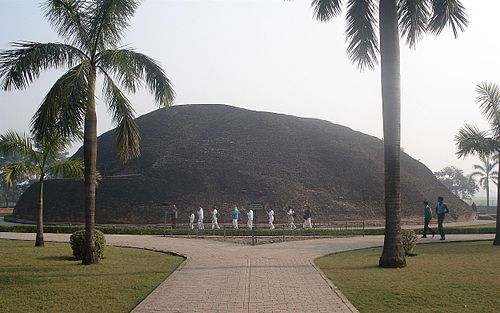
The Dhamek Stupa — a massive cylindrical brick-and-stone structure 43.6 m high and 28 m in diameter — marks the traditional spot of the first sermon. Its lower portion is Ashokan; the upper portion was enlarged in the 5th century CE under Kumara Gupta I. The stupa's delicately carved stone panels — geometric patterns, floral designs, birds, and human figures — belong to the Gupta period, the golden age of Indian art.
Like Sanchi, the earliest Buddhist art at Sarnath is aniconic — the Buddha is represented by symbols (the wheel, the deer, the empty throne, the Bodhi tree). By the Gupta period (4th–6th c. CE), Sarnath had become the greatest centre of Buddha-image production in India; the Sarnath school produced the finest Buddha images ever made — serene, meditative, with the distinctive transparent wet drapery and the Dhammacakra-mudrā (teaching gesture).

.jpg/500px-Ajanta_(63).jpg)