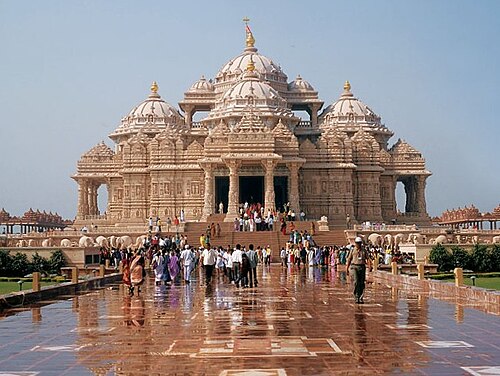
Khajuraho — The Temples of the Chandelas
KhajurahoMadhya Pradesh
950–1050 CE (Chandela dynasty)
earth
A Temple Record

Khajuraho — The Temples of the Chandelas

Khajurāho — Where Stone Sings of the Sacred and the Sensual

Sanatana Dharma
Enter the Record
I.Overview

A Sacred Site

In Khajuraho, Madhya Pradesh, there stands Khajuraho — The Temples of the Chandelas — the Khajuraho Group of Monuments — 25 surviving temples from an original 85, built by the Chandela dynasty between 950 and 1050 CE — is the most celebrated temple complex in India for its erotic sculpture. But the erotic panels occupy less than 10% of the total carving; the vast majority depicts religious life, courtly processions, musicians, dancers, and the pantheon of Hindu deities.

II.Architecture

The Built Form

Nagara (Central Indian / Chandela)

31m
Height
0
20
Hectares

Vimana / Gopuram

Curvilinear śikharas (spires) with amalaka (ribbed disc) finials — the Kandariya Mahadeva spire rises 31m with 840 carved figures

Sanctum Sanctorum

Square garbhagriha beneath the tallest śikhara, aligned on a vāstu-puruṣa-maṇḍala (sacred geometric grid)

Mandapas · Halls

  1. Jagamohana (entrance porch)

    Hall

  2. Maha Mandapa (great hall)

    Hall

  3. Antarala (vestibule)

    Hall

Sacred Tank

Shivsagar Tank (sacred reservoir near the Vishvanatha temple)

Enclosing Wall

25 surviving temples in 3 groups (Western, Eastern, Southern) across a 6km radius

Construction Material

Sandstone (buff and pink), assembled without mortar using interlocking joints

Less than 10% of carvings are erotic — the majority depict deities, musicians, dancers, and daily life; each temple follows precise Vāstu-śilpa proportional geometry

§Plan View

An architectural reading of Khajuraho — The Temples of the Chandelas — a top-down plan derived from the temple's recorded data.

Sacred TankJagamohana (entr…Maha Mandapa (gr…Antarala (vestib…SanctumVimana 31mN
Legend
Vimana & Sanctum
Mandapas (3)
Sacred Tank
Enclosing Wall
III.Timeline

Sacred Timeline

  1. Kandariya Mahadeva completion (c. 1030 CE)

    The largest and finest Khajuraho temple — 31 m high, with 840 carved figures — was built under Vidyadhara Chandela at the height of Chandela power; its śikhara (spire) is the tallest in central India

  2. Chandela decline (12th–13th c.)

    The Delhi Sultanate's expansion pushed the Chandelas east; Khajuraho was abandoned and the temples were gradually swallowed by forest — forgotten until T.S. Burt's rediscovery in 1838

  3. Burt's rediscovery (1838)

    Captain T.S. Burt of the Bengal Engineers found the temples overgrown in dense forest; his account introduced Khajuraho to the Western world — and fixed its reputation as an 'erotic' temple complex

  4. Khajuraho Dance Festival (1975–present)

    The Madhya Pradesh government established an annual classical dance festival against the backdrop of the Chitragupta and Vishvanatha temples — transforming a remote archaeological site into a living cultural venue

IV.Elements

Sacred Elements

The colours, creatures, and offerings that mark this site.

Sacred Colours

saffron
white
gold

Sacred Flowers

lotus (carved on every ceiling and base)mandāra (carved on walls)

Sacred Creatures

bull (Nandi in Vishvanatha temple)lion (vāhana of Durga in Devi Jagadambi temple)elephant (processional carvings)makara ( mythical aquatic beast on doorways)

Sacred Trees

mango (carved panels)kalpavṛkṣa (wish-fulfilling tree on lintels)Bodhi tree (Buddhist panel in Chausath Yogini)

Sacred Offerings

bilva-patra (Śiva temples)lotus flowers (Viṣṇu temples)sandal pasteincenseāratī

Divine Mount

Nandi (bull — Śiva's mount, in the Vishvanatha and Kandariya Mahadeva temples)
V.Patrons

Royal Patrons

  1. Yashovarman Chandela (c. 925–950 — Lakshmana Temple)

  2. Dhanga Chandela (c. 950–1002 — Vishvanatha Temple)

  3. Vidyadhara Chandela (c. 1000–1035 — Kandariya Mahadeva Temple)

VI.Texts

Sacred Texts

  1. Vāstu and Śilpa texts (Chandela patronage)

    Type: architectural

    Khajuraho follows the Vāstu-śilpa tradition — each temple is laid out on a precise geometric grid (vāstu-puruṣa-maṇḍala) with proportional relationships between base, wall, and spire

VII.Trade

Trade Routes

  1. Dakshinapatha–Kalindra corridor — Khajuraho sits at the border of the northern (Uttarapatha) and southern (Dakshinapatha) trade routes; the Chandelas controlled the passage from the Gangetic plain into the Deccan

  2. Kalpi–Khajuraho–Panna axis — the Chandela kingdom controlled the Ken and Betwa river valleys; Khajuraho was their ceremonial capital, Panna their diamond mines, and Kalpi their Yamuna-river port

  3. Diamond trade — Panna diamonds (the same mines that produced the Koh-i-Noor's original stone) funded the Chandela temple-building programme

VIII.Festivals

Festivals & Celebrations

  1. Shivaratri (Feb–Mar)

  2. Khajuraho Dance Festival (Feb — state-organised since 1975)

X.Sacred Story

A Temple Record

An editorial reading of the site, woven from its architectural, historical, and scriptural data.

In Khajuraho, Madhya Pradesh, Khajuraho — The Temples of the Chandelas — a 950–1050 ce (chandela dynasty) site — the Khajuraho Group of Monuments — 25 surviving temples from an original 85, built by the Chandela dynasty between 950 and 1050 CE — is the most celebrated temple complex in India for its erotic sculpture. But the erotic panels occupy less than 10% of the total carving; the vast majority depicts religious life, courtly processions, musicians, dancers, and the pantheon of Hindu deities.

§Historical Arc

The site is associated with the patronage of Yashovarman Chandela (c. 925–950 — Lakshmana Temple), Dhanga Chandela (c. 950–1002 — Vishvanatha Temple) and Vidyadhara Chandela (c. 1000–1035 — Kandariya Mahadeva Temple). The earliest event recorded here is kandariya mahadeva completion (c. 1030 ce). Through the centuries, the temple witnessed khajuraho dance festival (1975–present). The largest and finest Khajuraho temple — 31 m high, with 840 carved figures — was built under Vidyadhara Chandela at the height of Chandela power; its śikhara (spire) is the tallest in central India.

§Reading the Built Form

Built in the Built in the Nagara (Central Indian / Chandela) tradition, the central vimana ascends 31 metres the garbhagriha holds square garbhagriha beneath the tallest śikhara, aligned on a vāstu-puruṣa-maṇḍala (sacred geometric grid) with halls named Jagamohana (entrance porch), Maha Mandapa (great hall) and 1 more . Less than 10% of carvings are erotic — the majority depict deities, musicians, dancers, and daily life; each temple follows precise Vāstu-śilpa proportional geometry

Kandariya Mahadeva completion (c. 1030 CE)
§A Visitor's Approach

01Walk the pradakshina path. Note the earliest event recorded here — kandariya mahadeva completion (c. 1030 ce).

02Look up. The vimana above the sanctum is the temple's vertical sermon — each tier a step toward the divine.

03Return during Shivaratri (Feb–Mar), when the temple wears its festival form.

04The tradition here is sanatana dharma. Sit. Listen. The darshan is its own teaching.

§Practical Notes

Khajuraho — The Temples of the Chandelas

Where Stone Sings of the Sacred and the Sensual

The Khajuraho Group of Monuments — 25 surviving temples from an original 85, built by the Chandela dynasty between 950 and 1050 CE — is the most celebrated temple complex in India, and one of the most misunderstood.

The erotic sculpture for which Khajuraho is world-famous occupies less than 10% of the total carved surface. The vast majority depicts:

  • Religious processions and rituals
  • Court musicians and dancers
  • The full Hindu pantheon — Śiva, Viṣṇu, Devī, Sūrya, Ganeśa
  • Battle scenes, hunting parties, and royal life
  • Flora and fauna of the Bundelkhand forest

The erotic panels — depicting maithuna (sexual union), oral sex, group sex, and bestiality — are concentrated on the exterior wall-band between the base and the main frieze, a transitional zone that in Indian temple architecture represents the realm of kāma (desire) between the bhūloka (earthly realm, base) and the divyaloka (divine realm, spire). The message: desire is a stage on the path to liberation.

The Three Groups

  • Western Group — Śaiva: Kandariya Mahadeva, Vishvanatha, Matangesvara; Vaiṣṇava: Chitragupta (Sūrya), Varaha
  • Eastern Group — Jaina: Parshvanatha, Adinatha, Shantinatha; Hindu: Vamana, Javari, Brahma
  • Southern Group — Duladeo, Chaturbhuj

The Kandariya Mahadeva (c. 1030) — 31 m high, 840 carved figures, a spire that rises like a mountain — is the greatest Chandela temple and one of the finest Hindu temples ever built.

The Chandela Diamond Trade

The Chandelas funded their temple-building programme through the Panna diamond mines — the same mines that produced the original Koh-i-Noor. Khajuraho was not a random location; it sat at the border of the northern and southern trade routes, where diamond, iron, and forest products from the Vindhyas met the textile and spice caravans of the Gangetic plain.

Standard Disclaimer

⚠️ This entry is REVIEWED — Advisory Council review pending.

Wisdom Graph: Divine Associations

Vāhana
Nandi (bull — Śiva's mount, in the Vishvanatha and Kandariya Mahadeva temples)
Sacred animals
bull (Nandi in Vishvanatha temple)lion (vāhana of Durga in Devi Jagadambi temple)elephant (processional carvings)makara ( mythical aquatic beast on doorways)
Sacred flowers
lotus (carved on every ceiling and base)mandāra (carved on walls)
Sacred trees
mango (carved panels)kalpavṛkṣa (wish-fulfilling tree on lintels)Bodhi tree (Buddhist panel in Chausath Yogini)
Offerings
bilva-patra (Śiva temples)lotus flowers (Viṣṇu temples)sandal pasteincenseāratī
Sacred colours
saffronwhitegold

📜 Primary Scriptural Sources

  • Vāstu and Śilpa texts (Chandela patronage)architectural
    Khajuraho follows the Vāstu-śilpa tradition — each temple is laid out on a precise geometric grid (vāstu-puruṣa-maṇḍala) with proportional relationships between base, wall, and spire