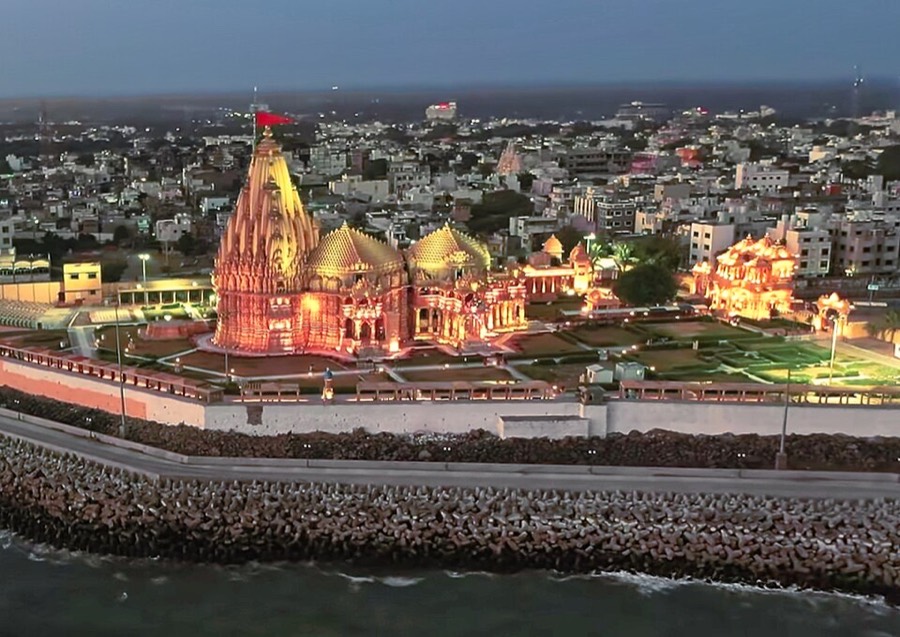
Sthalapurana of Somnath — The First Light of Shiva
The name means lord of the moon and it is the first of the twelve jyotirlingas — but the temple is not in the ancient texts, and the first structure the spade would confirm is ninth century.
What the name means
Somānātha is Soma and nātha — lord of the moon 1. The site is also called Prabhāsa, "place of splendour", and it sits in Prabhas Patan at Veraval, on the Saurashtra coast of Gujarat 1.
It is the first among the twelve jyotirlinga shrines of Śiva 1 — and the finding aid is careful about what that means, because the list and the site are not the same age.
What the texts say, and when they said it
This is the part that makes the entry worth reading, and the inherited body did not have it.
The Somnātha temple itself is not mentioned in ancient Sanskrit texts of Hinduism. What those texts mention is the Prabhāsa tīrtha. The Mahābhārata — in chapters 109, 118 and 119 of the third book, the Vana Parva — and the Bhāgavata Purāṇa at sections 10.45 and 10.78 both state Prabhāsa to be a tīrtha on the coastline of Saurashtra 1. Alf Hiltebeitel argues that the appropriate context for the Mahābhārata's legends is the Vedic mythology it borrowed and re-adapted: the Brāhmaṇa layer of Vedic literature already mentions a tīrtha related to the Sarasvatī river, and since the river was nowhere to be seen by the time the Mahābhārata was compiled, the Sarasvatī legend was modified — it vanishes underground and re-emerges at holy sites for saṅgam. The Mahābhārata then integrates that legend with the Prabhāsa tīrtha, which the critical editions place "by the sea, near Dvārakā" 1.
So the Sarasvatī is not a river that meets the sea at Somnāth. The Sarasvatī is a Vedic legend that the Mahābhārata attached to this tīrtha, a place already important as a pilgrimage site by the time the Vana Parva and Śalya Parva were compiled. Catherine Ludvik concurs, reading the change as a shift from Brahmin-centred sacrificial ritual to tīrtha ritual available to everyone 1. The Mahābhārata describes Prabhāsa as a site where Arjuna and Balarāma go on tīrtha, and where Kṛṣṇa chooses to go and spend his final days, and dies 1.
And the lists of twelve jyotirlingas are late. Somnātha tops the list in the Jñānasaṁhitā, chapter 13 of the Śiva Purāṇa — the oldest known text with a list of jyotirlingas — alongside the Vāraṇasī Māhātmya in the Skanda Purāṇa, the Śatarudra Saṁhitā and the Kothirudra Saṁhitā. These have generally been dated between the 10th and 12th centuries 1.
What the spade says
Against the texts, the archaeology, and the finding aid is candid.
The date of the earliest Somnātha temple remains uncertain, with estimates ranging from the early centuries of the first millennium to about the 9th century CE. Various texts mention a tīrtha at Prabhas Patan, but archaeology has not found traces of an early temple, though there was a settlement there 1.
The floor plan and ruins of a pre-1000 CE temple were unearthed in excavations led by B. K. Thapar. The excavations showed the foundations of a 10th-century temple, notable broken parts, and the details of a major and well-decorated version of a temple; Madhusudan Dhaky believes it to be the one destroyed by Mahmud of Ghazni. Thapar, the archaeologist who carried out the excavation, stated that there was definitely a temple structure at Somnāth-Patan in the 9th century, but none before 1.
The settlement, though, is far older than the temple. The site was occupied during the Indus Valley Civilisation, 2000–1200 BCE, one of very few sites in the Junagadh district to be so occupied. After abandonment in 1200 BCE it was reoccupied in 400 BCE and continued into the historical period 1.
A tīrtha with a two-thousand-year head start on its temple, and a temple whose first secure structure is ninth century. That is the honest shape of this site, and it does not weaken the devotion.
Why the world knew the name
The 11th-century Persian historian Al-Biruni gives the reason, and it is not the one a devotional history would give. Somnāth became famous because "it was the harbour for seafaring people and a station for those who went to and fro between Sufala in the country of Zanj (east Africa) and China" 1.
Literature and epigraphical evidence suggest the medieval Veraval port traded actively with the Middle East and Southeast Asia. Veraval is east of the port, one of three ancient trading ports in Gujarat from which Indian merchants departed. Combined with its standing as a pilgrimage site, this brought wealth and fame to the city and to the temple 1.
A shrine at the far western edge of India, whose international reputation came from a harbour. That wealth is also why the finding aid's demolition list is as long as it is.
Destroyed five times, rebuilt three
The finding aid gives the record as dates rather than as a narrative, and the dates are the argument.
Demolished in 1026 by Mahmud of Ghazni; in 1299 by Ulugh Khan; in 1395 by Muzaffar Shah I; in 1706 by Aurangzeb. Reconstructed in 1169 by Kumārapāla of the Chaulukya dynasty; in 1308 by Mahipāla I of the Chudasama dynasty; and in 1950 by the Somnāth Trust, which is the present structure 1.
Note what that sequence shows that a prose account does not: the temple was rebuilt in 1169, then destroyed again in 1299; rebuilt in 1308, destroyed in 1395 and again in 1706; and rebuilt once more in the twentieth century. Destruction and reconstruction alternate, and the finding aid's list puts them side by side.
In the late 19th and early 20th centuries, colonial-era historians and archaeologists studied the ruins because they showed a historic Hindu temple that had been turning into an Islamic mosque. After independence those ruins were demolished, the mosque on the site was shifted a few kilometres away using construction vehicles, and the present temple was reconstructed in the Māru-Gurjara style 1.
1950–51, and the date on the stone
The reconstruction began under the orders of India's first Deputy Prime Minister, Vallabhbhai Patel, and was completed in May 1951. The ruins were pulled down in October 1950. The new structure was built by the traditional Sōmpurā temple-builders of Gujarat 1.
And on 11 May 1951, Rajendra Prasad, the President of India, performed the installation ceremony for the temple, at the invitation of K. M. Munshi 1.
The inherited entry attributed to Patel the vow that the shrine would now stand "not on hoarded gold but on the faith of the people". That is a paraphrase of a famous line, but no source in this entry's list says it, and it has been removed rather than repeated. What the finding aid does give is the president's name, the date, and the man who invited him.
Two other inherited details have been removed for the same reason. The claim that the present shikhara "carries no load-bearing steel" and relies on interlocked stonework, and the claim that the temple "rises about 400 feet above sea level", appear nowhere in the finding aid.
The claim, kept small
A name meaning lord of the moon, and a tīrtha on the Saurashtra coast that the Mahābhārata places near Dvārakā, where Kṛṣṇa spent his last days. The temple is not in the ancient texts; the tīrtha is. The list of twelve that puts Somnātha first was written between the tenth and twelfth centuries.
The settlement goes back to the Indus. The first temple the spade would confirm is ninth century, and the archaeologist who dug it said so: a temple structure in the 9th century, none before.
It became world-famous as a harbour between East Africa and China. It was demolished in 1026, 1299, 1395 and 1706, and rebuilt in 1169, 1308 and 1950. The present building was finished in May 1951, and the President of India installed the deity in it on 11 May 1951.
Sit with this
What wanes is not lost; devotion renews even the light of heaven.
The shrine was demolished in 1026, 1299, 1395 and 1706, and rebuilt in 1169, 1308 and 1950. Which of those dates belongs to the temple, and which to the people who kept rebuilding it?
Characters in this kathā
- Soma (Chandra)
- Shiva
- Daksha
- Prajāpati sages
Where this kathā lives
Source of this telling
Skanda Purāṇa — Prabhāsa Khaṇḍa (sthalapurāṇa)