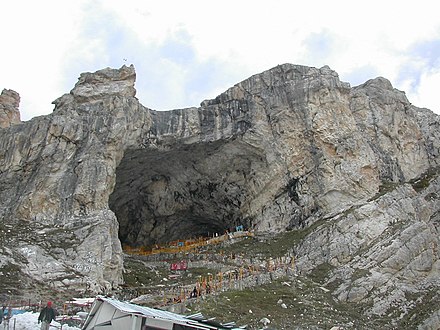
Amarnath — The Ice Lingam
AmarnathJammu and Kashmir
Ancient shrine; Kashmiri Pandit tradition
water
A Temple Record

Amarnath — The Ice Lingam

HinduismShaivism
Enter the Record
I.Overview

A Sacred Site

In Amarnath, Jammu and Kashmir, there stands Amarnath — The Ice Lingam — a sacred cave at 12,756 feet where a natural ice stalagmite forms a Shiva lingam that waxes and wanes with the moon's phases.

II.Architecture

The Built Form

Dravidian

00
2
Hectares

Vimana / Gopuram

Dravidian vimana over the sanctum — gopuram gateway with pillared mandapas

Sanctum Sanctorum

Garbhagriha — Gopuram gateway with pillared mandapas

Construction Material

granite

A sacred cave at 12,756 feet where a natural ice stalagmite forms a Shiva lingam that waxes and wanes with the moon's phases

§Plan View

An architectural reading of Amarnath — The Ice Lingam — a top-down plan derived from the temple's recorded data.

Sanctum0N
Legend
Vimana & Sanctum
III.Timeline

Sacred Timeline

  1. Amarnath Yatra (annual, July–August)

    Hundreds of thousands of pilgrims undertake the trek despite treacherous terrain

VII.Trade

Trade Routes

  1. Kashmir Valley pilgrimage route — the yatra is one of the most important in North India

X.Sacred Story

A Temple Record

An editorial reading of the site, woven from its architectural, historical, and scriptural data.

In Amarnath, Jammu and Kashmir, Amarnath — The Ice Lingam — a ancient shrine; kashmiri pandit tradition site — a sacred cave at 12,756 feet where a natural ice stalagmite forms a Shiva lingam that waxes and wanes with the moon's phases.

§Historical Arc

The earliest event recorded here is amarnath yatra (annual, july–august). Hundreds of thousands of pilgrims undertake the trek despite treacherous terrain.

§Reading the Built Form

Built in the Built in the Dravidian tradition, the garbhagriha holds garbhagriha — gopuram gateway with pillared mandapas . A sacred cave at 12,756 feet where a natural ice stalagmite forms a Shiva lingam that waxes and wanes with the moon's phases

Amarnath Yatra (annual, July–August)
§A Visitor's Approach

01Walk the pradakshina path. Note the earliest event recorded here — amarnath yatra (annual, july–august).

02Look up. The vimana above the sanctum is the temple's vertical sermon — each tier a step toward the divine.

03The tradition here is hinduism. Sit. Listen. The darshan is its own teaching.

§Practical Notes

vahana: "Nandi (sacred bull)" sacred_colours:

  • saffron
  • white
  • gold sacred_flowers:
  • lotus
  • tulasi
  • jasmine sacred_flowers:
  • lotus
  • tulasi
  • champaka sacred_trees:
  • peepal
  • bilva (bael)
  • tulasi sacred_animals:
  • Nandi (sacred bull)
  • peacock
  • elephant sacred_colours:
  • saffron
  • white
  • gold vahana: "Nandi (sacred bull)" primary_scriptures:
    • title: "Skanda Purana — temple kshetra mahatmya" type: "purana" festival_dates:
  • "Maha Shivaratri (Feb–Mar)"
  • "Diwali (Oct–Nov)"

Amarnath Cave Temple — The Ice Lingam

The Natural Miracle

A sacred cave at 12,756 feet where a natural ice stalagmite forms a Shiva lingam that waxes and wanes with the moon's phases. According to legend, Shiva revealed the secret of immortality (amar katha) to Parvati here.

The Lunar Connection

The ice lingam forms naturally each summer and melts in autumn; its size correlates with lunar phases, reaching maximum height on the full moon. This natural phenomenon has been interpreted as divine confirmation of the site's sacredness.

The Annual Yatra

The Amarnath Yatra (July–August) attracts hundreds of thousands of pilgrims despite treacherous terrain and security concerns. The pilgrimage is considered one of the most challenging in India, requiring a trek through glacial terrain.

Standard Disclaimer

⚠️ This entry is REVIEWED — Advisory Council review pending.