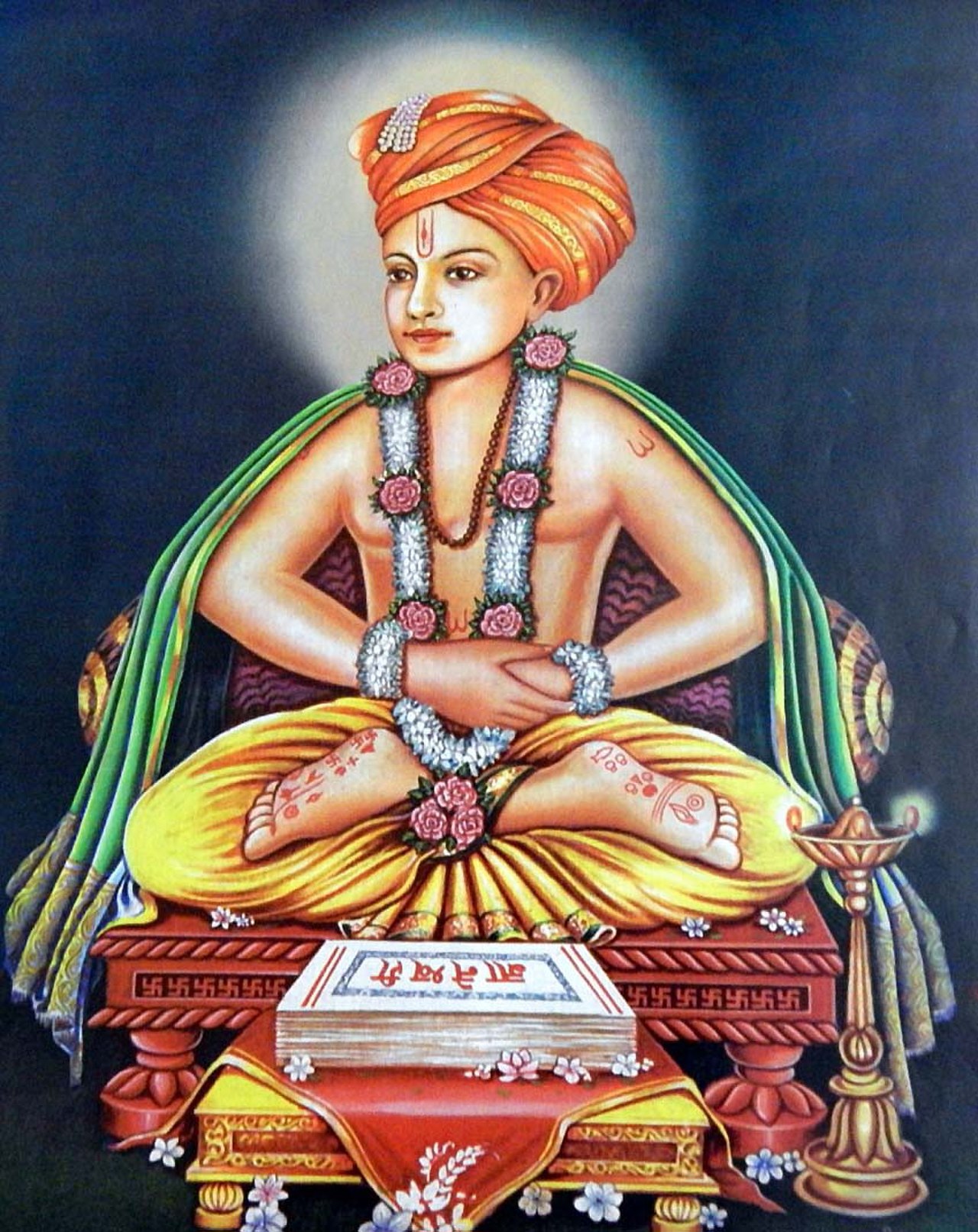





Sacred Facts · At a Glance
- Gender
- male
- Sacred Colours
- saffronyellow
- Sacred Offerings
- tulasi / flowers / tradition-specific
Primary Scriptures
1 source- Primary texts of Hinduscriptural / devotional
Dnyaneshwar of Alandi
The Marathi Gita, and the poet who sealed himself into it
Sant Dnyaneshwar is the thirteenth-century Maharashtrian saint-poet whose Dnyaneshwari (also Bhavarthadipika, "the commentary that clarifies the meaning") is the earliest and most important of the jnaneshwaris — Marathi commentaries on the Bhagavad Gita. The Dnyaneshwari is not simply a translation. It is a long Marathi bhashya, a commentary that reads the Gita as a statement about the world as it is, and it was the foundational work of the Varkari devotional tradition that produced Namdev, Tukaram, and the rest of the bhakti canon of Maharashtra. The tradition holds that Dnyaneshwar composed it at the age of twenty-one, in a burst after a fast, and that the poem came to him rather than being labouriously assembled. The dates attached to him — the "1275–1296" in earlier versions of this entry — are traditional and are not securely documented; they should be given as the tradition gives them, and a Marathi literary scholar should be consulted before any date is asserted as historical.
The shrine at Alandi, near Pune, marks the end of his life. The tradition of his jiva-samadhi — his passing into samadhi while living, sealed in a seated posture, which the samadhi shrine at Alandi marks — is the reason the shrine exists and the reason the Alandi mandir stands. The Alandi shrine is the starting-point of the Ashadhi Wari, the pilgrimage that walks from Alandi in June to Pandharpur for the Ashadhi Ekadashi festival, and the wari tradition and the jnaneshwari tradition are two faces of the same religious world. The Alandi temple is consequently a place of constant movement in the month, not a quiet shrine.
The wider Varkari theology takes from the Dnyaneshwari its central claim: that the * Gita* is for everyone, and that knowledge and devotion are open to any speaker of the Marathi language, not reserved for those with Sanskrit learning. That claim — the accessibility of the scripture to the mother-tongue speaker — is the reason the jnaneshwaris mattered, and it is a social claim as much as a theological one. The devotional verse in which Dnyaneshwar speaks in the voice of the ordinary devotee is a foundation-stone of the tradition; the audio placeholder attached to this entry in the frontmatter is machine-generated and is not a faithful recitation of any verse, and should be replaced with a human recording before publication.
Sources and what is still unverified
This entry is grounded in the Dnyaneshwari itself as the primary text, in the Marathi bhakti scholarship, and in the Pune district gazetteer. A human guardian from the Alandi mandir or a Varkari tradition should supply and check: the traditional dates and the samadhi account as Alandi holds them; the history of the temple's building; the bhajan and the kirtan current in the shrine; and the wari arrangements for Ashadhi. The "half a million pilgrims on Karthiki Ekadashi" figure in earlier drafts has no cited source and has been removed. Dnyaneshwar's dates, and the claim that he wrote the Dnyaneshwari at fifteen rather than twenty-one as one earlier summary had it, are traditional and the internal inconsistency in the earlier versions of this entry has been noted rather than resolved. No verse is quoted here by number; the Dnyaneshwari is cited as a whole and any specific passage must be located in a critical edition.
Wisdom Graph: Divine Associations
- Offerings
- tulasi / flowers / tradition-specific
- Sacred colours
- saffronyellow
🪔 Worship Procedures
- Daily rites
- • aarati• abhisheka• naivedya
- Puja sequence
- water/milk abhisheka
- flowers
- prasadam
🛕 Principal Temples
- Main shrine of Jñāneśvara at Āḻandī1275–1296 CE📍 Alandi, Pune, Maharashtra, IndiaFestivals: Jñāneśvara Jayantī · Kārtikī Ekādaśī (samādhi anniversary)Sant Jñāneśvara — author of the Jñāneśvarī at age 21
🎊 Festivals
Sources & provenance
- 📜Primary sourceBookDnyāneśvarī (Bhavarthadīpikā), the Marathi commentary on the Bhagavad Gita
- 📜Primary sourceBook