The Carpenter Slave Who Built a Palace in Heaven — Thomas and King Gondophares
The Syriac Acts of Thomas in plain words: lots at Jerusalem, sale to a merchant, King Gondophares's palace spent on the poor, brother Gad's return from heaven, the second king's spears — and the road south to Mylapore.
1. The Lot Falls on Thomas
After Jesus rose, the apostles met at Jerusalem and drew lots for the nations. India fell to Thomas — Judas Thomas, "the Twin." Thomas refused: a Hebrew cannot preach to Indians, he said. That night the Lord told him to go. He still hung back.
So the Lord settled it strangely. A merchant named Abbanes had come from India — sent by King Gundaphorus (Gondophares) to buy a carpenter. Jesus walked into the market at noon, pointed at Thomas in the distance, and sold him for three pieces of silver, writing the deed Himself: "I, Jesus, the son of Joseph the carpenter, acknowledge that I have sold my slave, Judas by name, unto thee Abbanes."
"Is this thy master?" Abbanes asked. "Yea, he is my Lord," said Thomas — and picked up the merchant's bags and carried them to the ship. Asked his craft, he answered: ploughs, yokes, boats, masts — "and in stone, pillars and temples and courthouses for kings."
2. The Palace in Heaven
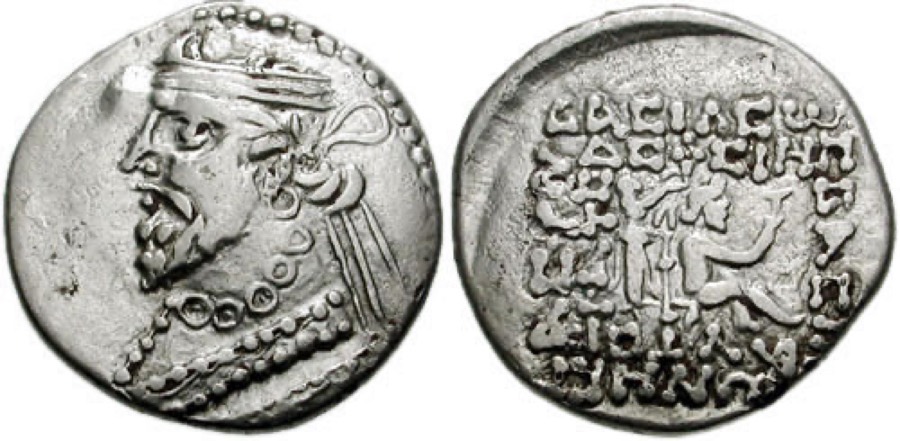
King Gondophares — a real king: his coins survive, and a stone inscription at Takht-i-Bahi dates his 26th regnal year to 46 CE, so he ruled about 20–46 CE, exactly Thomas's lifetime — gave the carpenter money and ordered a royal palace.
Thomas drew plans, took the gold, and gave every coin to the poor and the sick. Months passed. "Hast thou built me the palace?" asked the king. "Yea," said Thomas. "Then let us go and see it." "Thou canst not see it now," said Thomas, "but when thou departest this life, then thou shalt see it."
The king threw him and Abbanes into prison and planned to flay them alive. That night the king's brother Gad fell sick — and died of grief and rage.
3. Gad Comes Back
Angels carried Gad's soul up and showed him the dwellings of heaven. Near one shining building Gad begged: let me live in its lowest room. "Thou canst not," said the angels. "This is the palace which that Christian built for thy brother."
"Let me go and buy it from him!" cried Gad. They released his soul — and as they laid grave-clothes on him, he sat up alive and sent for the king: "Sell me that palace in the heavens!"
"Whence should I have a palace in the heavens?" said the king — and understood. He ran to the prison himself, freed Thomas, and fell at his feet: "Pray for me, that I may become a worthy inhabiter of that dwelling." King and brother were baptised. (Scholars note: some argue the Acts' king may be a later namesake of Gondophares I — the coins prove the name, the book gives the story; both are recorded here.)
4. The Second King and the Spears
Thomas travelled on to the court of King Mazdai (Misdaeus). There he converted the queen Tertia, the prince Vazan, and Mygdonia, wife of the king's kinsman — women who then refused their husbands, choosing consecrated lives. The furious king tortured Thomas (hot irons — quenched by a miraculous flood), then led him outside the city to a hill. Four soldiers ran him through with spears — and Thomas, says the book, called it fitting: of four elements he was made. He was buried in the royal tombs. His bones, the book notes, were later carried "to the West" — the seed of the Edessa shrine. Even Mazdai, healed at last by dust from the grave, believed.
5. South to Mylapore
Here the Syriac book ends — in the northwest. The Indian church carries the story south: landing at Muziris in 52 CE, seven churches across Kerala, preaching down the Coromandel coast, and the spear at Mylapore in 72 CE, where San Thome Basilica keeps the tomb. Two memories, one apostle: the book of Edessa and the songs of Malabar.
How We Know — the Syriac Shelf
- Acts of Thomas — Syriac, Edessa, before 240 AD (13 Acts + Martyrdom; the Hymn of the Pearl rides inside some copies). Romance, not biography — except King Gundaphar, whom coins prove real.
- Ephrem the Syrian (c. 306–373, Edessa) — sings the apostle "slain in India," his bones brought to Edessa by a merchant; heaven-palace and all.
- Syriac calendar — "3 July: St. Thomas, pierced with a lance in India. His body is at Edessa, brought by the merchant Khabin." (July 3 is still Dukhrana.)
- Chronicle of Edessa — 394 AD: the coffin laid in "his great temple"; pilgrim Egeria (384) prayed there, "body laid entire."
- Ramban Pattu — the Malayalam folk-song carrying the southern half: Muziris, the churches, Mylapore.
Sit with this
What is given to the poor is built in heaven.
Read one chapter a night for five nights — then visit San Thome's tomb crypt and read the last line aloud.
Characters in this kathā
- St. Thomas
- Abbanes the merchant
- King Gondophares (Gudnaphar)
- Gad
- King Mazdai
- Mygdonia
- Tertia
- Vazan
Source of this telling
Acts of Thomas (Syriac, Edessa, c. 220–240); M. R. James translation; Ephrem's hymns; Chronicle of Edessa; Ramban Pattu (Malayalam tradition)