Sacred Facts · At a Glance
- Element
- fire
Primary Scriptures
0 sourcesNo primary scriptures are catalogued for this entry yet. If you know of scriptural references we have missed, please contribute them.
Mithraism
Overview
In brief
Mithraism (the Mithraic Mysteries) was a mystery religion of the Roman Empire — a secret, initiatory cult centred on the god Mithras. It flourished between the 1st and 4th centuries CE, especially among Roman soldiers, merchants, and imperial officials, and its underground temples (mithraea) have been found from Britain to Syria, and from the Rhine to North Africa.
The cult's central image is the tauroctony: Mithras, a young god in a Phrygian cap, slaying a bull in a cave, accompanied by a dog, a snake, a scorpion, a raven, and the twin torchbearers Cautes and Cautopates. This single scene — repeated in hundreds of reliefs across the empire — is the signature of the faith.
Key features:
- A mystery cult — its teachings were revealed only to initiates
- Seven grades of initiation — from Raven to Father
- The cave temple — Mithraea were small, underground, cave-like rooms
- The bull-slaying — the central myth, understood as an act of cosmic salvation
- Astrology — the cult was deeply linked to the stars and planets
In more detail
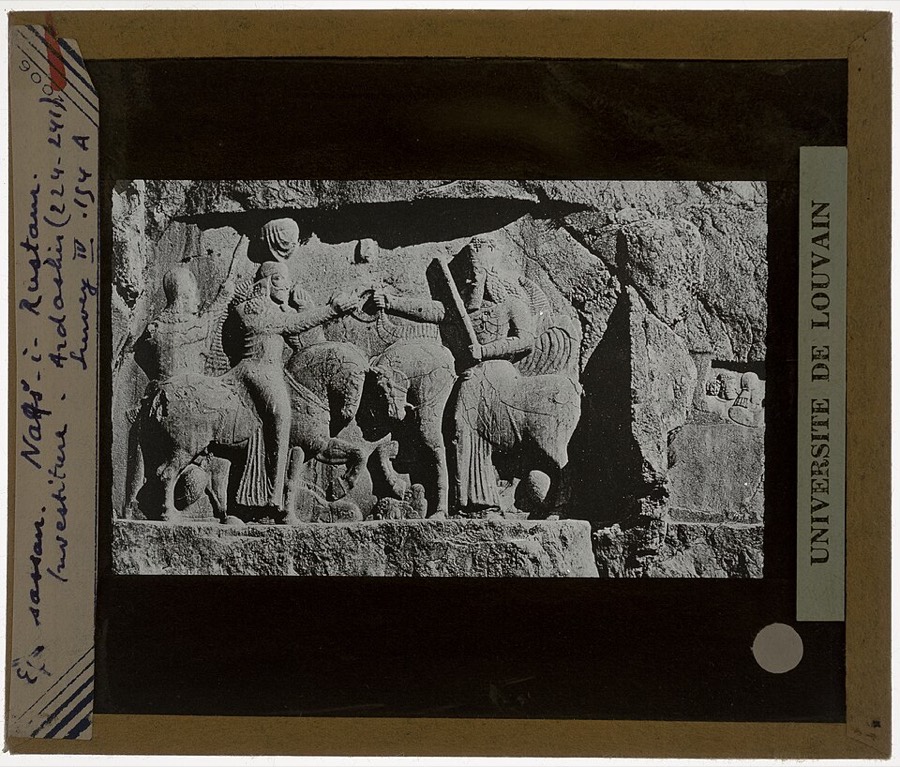
Origins — the Iranian connection: The name "Mithras" derives from Mithra, the ancient Indo-Iranian god of covenant, light, and the sun, who appears already in the Rig Veda (as Mitra) and the Avesta (as Mithra), and who remained a major deity of Zoroastrian and later Persian religion. The Roman cult, however, transformed this figure: Mithras became a Mediterranean mystery god, and the continuity between the Iranian Mithra and the Roman Mithras is debated among scholars — some see deep continuity, others a largely new creation that borrowed only the name.
The myth: According to the scenes carved in the mithraea, Mithras was born from a rock (petra genetrix), wearing his Phrygian cap and holding a torch and a dagger. He hunted and captured the bull, dragged it into a cave, and slew it — and from the bull's body sprang the corn and the vine (wheat and wine), the sustenance of humanity. He then feasted with the god Sol (the Sun) and ascended to heaven in a chariot. The bull-slaying was understood as a cosmic act: the sacrifice that ordered the world, released life, and established the celestial order.
The grades of initiation: The cult had seven grades, each under the protection of a planet:
- Corax (Raven — Mercury)
- Nymphus (Bridegroom — Venus)
- Miles (Soldier — Mars)
- Leo (Lion — Jupiter)
- Perses (Persian — the Moon)
- Heliodromus (Courier of the Sun — the Sun)
- Pater (Father — Saturn)
The highest grade, Pater, led the local community. Initiation involved trials, banquets, and the ritual sharing of bread and wine — practices that early Christian writers noted with alarm as a diabolical parody of the Eucharist.
The mithraeum: The cult met in small, rectangular, cave-like rooms, often built underground or into natural caves, with benches along the walls where initiates reclined at the sacred banquet. The tauroctony relief stood at the far end, often framed by the signs of the zodiac. The most famous surviving mithraeum is the one beneath San Clemente in Rome; others are preserved at Carnuntum (Austria), London (Walbrook), and Santa Prisca (Rome).
Who were the initiates? The cult was exclusively male and drew its members overwhelmingly from the army and the imperial bureaucracy — soldiers on the frontiers (Britain, the Rhine, the Danube) and officials in Rome and Ostia. Women were excluded; the cult's "brotherhood" was a male bond of loyalty.
The Cult and the Empire
In brief
Why did Mithraism succeed? For two centuries, the cult offered Roman soldiers and officials:
- Initiation and belonging — a secret society with ranks, trials, and brotherhood
- Moral discipline — courage, loyalty, and self-control, the soldier's virtues
- Cosmic meaning — the assurance that the universe was ordered by a divine act, and that the initiate was aligned with the stars
- A portable religion — the cave temple could be built anywhere the legions went
The rivals: Mithraism and early Christianity grew up in the same world, competed for the same urban and military populations, and shared striking features — a saviour god, a sacred meal, moral demands, and a community of initiates. This rivalry (and the similarities) fascinated later writers; the two religions' relationship is one of the most studied questions in late-antique history.
Mithraism Today
In brief
Mithraism declined and died with the Christianization of the Roman Empire in the late 4th–5th centuries CE. Its temples were abandoned, buried, or converted into churches — as at San Clemente in Rome, where a mithraeum lies beneath a basilica. By the early Middle Ages the cult was extinct as a living faith.
The modern afterlife:
- Rediscovery — hundreds of mithraea and thousands of monuments have been excavated since the Renaissance; the discipline of Mithraic studies (with its journal and conferences) is thriving
- The London Mithraeum — the famous temple found during postwar rebuilding (1954) is now displayed beneath the city, a major visitor site
- Astrological scholarship — since the 1970s, scholars (notably Roger Beck and David Ulansey) have argued that the tauroctony encodes the astronomical knowledge of the age — the precession of the equinoxes, the constellations — making Mithraism a religion of the stars
- Modern reconstruction — small neopagan and revivalist groups have reconstructed Mithraic-style practices, but these are modern creations with no unbroken link to the ancient cult
In India, the ancient Iranian heritage of Mithra/Mitra is remembered through the Vedic Mitra (the god of covenant, paired with Varuna in the Rig Veda) and the Zoroastrian tradition of the Parsis, keeping alive, on Indian soil, the ancient family of gods from which the Roman Mithras sprang.
Known Limitations
- Mithraism left no sacred texts; all knowledge comes from archaeology and later hostile Christian writers.
- The meaning of the tauroctony is debated (allegory of the soul, astronomical code, or both).
- The Iranian origins and the relation to the Vedic Mitra are contested among scholars.
- The grades, rituals, and initiatory content are only partially known.
- Modern Mithraic reconstruction movements are not continuous with the ancient cult.
Recommended reviewers: A scholar of Roman religion, a specialist in Mithraic archaeology, a historian of the ancient Near East.
Standard Disclaimer
Sources & provenance
- 🎓Scholarly sourceBookRoger Beck. The Mysteries of Mithras: A New Account of Their Genesis (2006)
- 🎓Scholarly sourceBookM. J. Vermaseren. Mithras: The Secret God (1963)
- 📖Supporting referenceWikipediaMithraism — Wikipedia