



.jpg/500px-Hamandir_Sahib_(Golden_Temple).jpg)
Sacred Facts · At a Glance
- Gender
- transcendent
Primary Scriptures
0 sourcesNo primary scriptures are catalogued for this entry yet. If you know of scriptural references we have missed, please contribute them.
Anandpur Sahib
A gurdwara, a takht, and a town
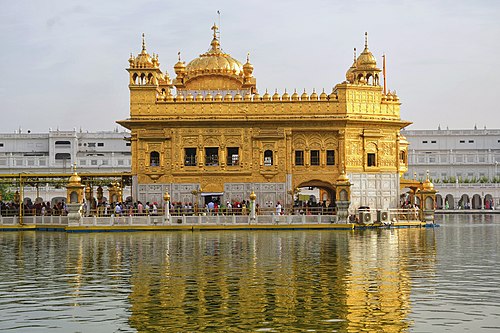
Anandpur Sahib is a town on the Sutlej in what is now Rupnagar district, Punjab, and it is a gurdwara before it is a monument: a place where the Guru Granth Sahib is installed and where the langar runs for anyone who comes. It is also one of the five Takhts. Both facts matter, because the pilgrimage here is not primarily a visit to a building. It is participation in institutions that still operate: Kesgarh Sahib, where the Khalsa was inaugurated; daily kirtan and scripture recitation; a common kitchen that feeds without reference to caste or sect; and the Hola Mohalla, the martial and civic festival Guru Gobind Singh founded on the model of the Vaisakhi gathering. This file is filed as a deity entry. It is a place, a congregation and a historical claim, and the corpus may want it filed accordingly.
The town's weight is a convergence. Guru Hargobind had founded Kiratpur Sahib upstream; Guru Tegh Bahadur established Anandpur Sahib; Guru Gobind Singh made it the seat of a community carrying a martial and political charge as well as a devotional one. From 1704 the town was besieged, most consequentially by Ahmad Shah Abdali, whose assault of 1707 ended with the death of the two younger sahibzadas of Guru Gobind Singh. The memory of that siege, and of the Hola Mohalla parade that answers it, is why the site functions in Sikh memory as a place of sacrifice as well as of institution-building — which is the honest reason it sits on the Takht list and not merely on a tourist itinerary.
Careful on this entry's record. The sources named a work by Max Müller dated 1868, and a "History of the Sikhs" attributed to K. S. Singh in 1980. Neither attribution is reliable as it stands: the first looks like a misattribution of Müller's comparative lectures on Indian religion, the second appears to conflate Khushwant Singh's two-volume history with several distinct scholars named K. S. Singh. Both have been replaced below with works that can be identified. The timeline's claim that Anandpur Sahib was "the second Sikh township after Kiratpur" is a reading rather than a fact, and should be sourced or dropped.
Sources and what is still unverified
A guardian should check Guru Tegh Bahadur's land acquisition and the founding of the town, where 1664 and 1665 both appear in the literature on different definitions of "founded"; the date and circumstances of the 1707 siege and the deaths of the sahibzadas; and the institutional history and present governance of Kesgarh Takht. The Hola Mohalla's dates and scale change annually, and the shrine board's own notice governs them.
Also unverified and specific to this pass: the timeline in the frontmatter was compiled rather than sourced, and it repeats a five-century ordering of Sikh history that should be checked line by line; the previous file recorded a reviewer and a review date against a body of a few lines, and that status has been lowered to because no human has read the present text. A Sikh historian should also say whether the Takht claim needs distinguishing between the seat of authority and the seat of installation of the Guru Granth Sahib.
Sources & provenance
- 📜Supporting referenceBookThe Guru Granth SahibPrimary liturgical text of the Sikh tradition; internal citation by hymn is possible
- 🎓Supporting referenceBook