_in_1868.jpg/1280px-Bah%C3%A1'u'll%C3%A1h_(M%C3%ADrz%C3%A1_%E1%B8%A4usayn-%60Al%C3%AD_N%C3%BAr%C3%AD)_in_1868.jpg)
Primary Scriptures
0 sourcesNo primary scriptures are catalogued for this entry yet. If you know of scriptural references we have missed, please contribute them.
Baháʼu'lláh
Note on "deity" classification: In Baháʼí theology, Baháʼu'lláh is not God but a Manifestation of God — a divine educator through whom God's will and attributes are revealed. The Baháʼí Faith is strictly monotheistic. This entry uses the "deity" category of ELGODS as an umbrella for venerated divine-revelatory figures; readers should understand that Baháʼís worship God alone and revere (not worship) the Manifestations.
Section 1: Overview
[BEGINNER]
Baháʼu'lláh (born Mírzá Ḥusayn-ʻAlí Núrí, 1817–1892) is the prophet-founder of the Baháʼí Faith, the world's youngest major independent religion. He was a Persian nobleman from a distinguished Tehran family who, in 1844, became a follower of the Báb — a young Iranian reformer whose movement (Bábism) was violently suppressed by Qajar authorities.
After the Báb's execution in 1850, Baháʼu'lláh emerged as the most prominent surviving Bábí leader. Imprisoned in Tehran's notorious Síyáh-Chál ("Black Pit") dungeon in 1852, he reports a revelatory experience — he later identified this as the moment he recognised his mission as the one promised by the Báb ("Him whom God shall make manifest").
He spent the rest of his life in successive exiles imposed first by Iran and then by the Ottoman Empire: Baghdad (1853–1863), Istanbul, Edirne, and finally the prison-city of Acre (Akka) in Ottoman Palestine from 1868 until his death in 1892. His tomb at Bahji, just north of Acre, is the qiblih of the Baháʼí Faith — the point toward which Baháʼís turn for daily obligatory prayer.
[INTERMEDIATE]
Baháʼu'lláh's teachings, presented in more than a hundred volumes of writing, emphasise:
- Oneness of God: strict monotheism
- Oneness of religion: all the major world religions are stages in a single progressive revelation; Moses, Zoroaster, Krishna, Buddha, Christ, Muhammad, the Báb, and Baháʼu'lláh are all Manifestations of the same God
- Oneness of humanity: abolition of all forms of racial, national, and class prejudice
- Equality of women and men
- Elimination of extremes of wealth and poverty
- Universal compulsory education
- Independent investigation of truth
- Harmony of science and religion
- A world commonwealth with an international auxiliary language and global governance
His principal works include the Kitáb-i-Aqdas (Most Holy Book, 1873) — the central book of Baháʼí law — the Kitáb-i-Íqán (Book of Certitude, 1861), the Hidden Words, and the Seven Valleys.
Baháʼís observe the Nineteen Day Feast (corresponding to their 19-month calendar), and major annual holy days include the Ridván festival (April 21 – May 2), commemorating his 1863 declaration of his mission in the Ridván Garden outside Baghdad.
Section 2: Devotion
Out of profound respect, Baháʼís do not publicly display photographs of Baháʼu'lláh (two photographs exist, but are kept in the Baháʼí archives and shown only in pilgrim-receiving contexts). His shrine at Bahji receives pilgrims of all backgrounds.
Section 3: Relationships
- The Báb (Siyyid ʻAlí-Muhammad Shírází, 1819–1850) — his forerunner, executed in Tabriz
- ʻAbduʼl-Bahá (1844–1921) — his eldest son and appointed interpreter of his teachings
- Shoghi Effendi (1897–1957) — great-grandson, Guardian of the Faith
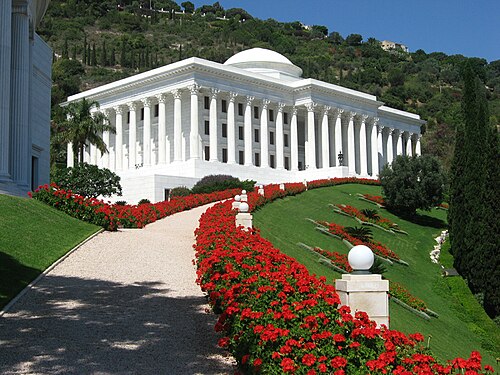
- Universal House of Justice — the elected international governing body established 1963, headquartered in Haifa, Israel
Section 4: Key facts
- Tradition: Baháʼí Faith (strict monotheism; youngest major independent world religion)
- Role: Manifestation of God; prophet-founder
- Lifespan: 12 November 1817 – 29 May 1892
- Place of exile and burial: Acre / Bahji, Palestine (now Israel)
- Principal text: Kitáb-i-Aqdas (Most Holy Book, 1873)
- Community size: Estimated 5–8 million globally
- Direction of prayer (qiblih): Shrine of Baháʼu'lláh at Bahji