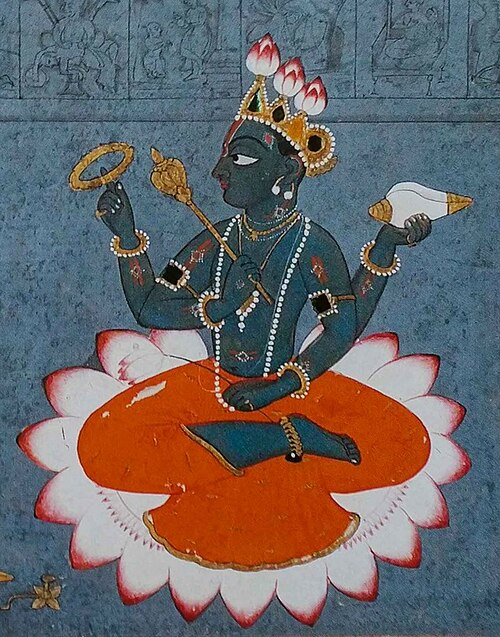
📷 Navaneethpp · [CC BY-SA 4.0](https://creativecommons.org/licenses/by-sa/4.0)
Deities
Budatt Āḻvār (Tamil: பூதத்தாழ்வார்) is the second of the 12 Āḻvār saints, traditionally dated to the 7th century CE. His name derives from *būta* — a spirit or elemental being — suggesting he may have had non-Brahmin or folk origins.
Budatt Āḻvār (Tamil: பூதத்தாழ்வார்) is the second of the 12 Āḻvār saints, traditionally dated to the 7th century CE. His name derives from būta — a spirit or elemental being — suggesting he may have had non-Brahmin or folk origins. He was born near Mahabalipuram (Thirukadalmallai), the great Pallava port city.
His sole work, the Irandam Tiruvandadi ("Second Sacred Decad"), consists of 100 verses envisioning Vishnu as a kalpaka-vriksha — the wish-fulfilling tree of Hindu mythology. Just as this celestial tree grants whatever a devotee desires, Vishnu gives not just material blessings but the ultimate boon: mokṣa (liberation).
Budatt Āḻvār's verses are linked to the Sthalasayana Perumal temple at Mahabalipuram — one of the 108 Divya Desams. Here Vishnu reclines on the shore of the Bay of Bengal, his pose mirroring the cosmic ocean on which he rests between world cycles. The Pallava kings who built Mahabalipuram's famous rock-cut temples were likely contemporaries or patrons of Budatt.
"O Lord reclining on the ocean-shore, you are the tree that grants even what we cannot articulate."
Budatt established the generosity theology of the Āḻvārs: Vishnu is not merely powerful but abundantly giving. This anticipates the later Pushti Marga (Path of Grace) tradition. The wish-fulfilling tree metaphor would be developed by later Āḻvārs, especially Periyāḻvār and Tirumaṅgai, but Budatt planted the seed.
Budatt's 100 verses are recited immediately after Poigai's in every Divya Prabandham recitation. Together, the first three Āḻvārs (Poigai, Budatt, Pey) form the Mudal Āḻvārs — the "First Saints" whose combined 300 verses open the Tamil Veda.