Historical PeriodEra
Oral tradition / medieval-modern
3000 BCEOral tradition / medieval-modernPresent
Sacred Facts · At a Glance
Mantra
Haridwar — the first of the 7 Sapta-Moksha-Purīs
Har Ki Pauri is the ghat at Haridwar at which Vishnu is said to have left his footprint. The name means "the Lord's footprint," and the shrine is a footprint carved in stone at the ghat's edge, protected by a chhatri and the railing of the har-ki-pauri itself. Haridwar is one of the Sapta Moksha Puris — the seven places in which, in the received view, death is held to carry a soul more easily toward liberation. The others usually given are Ayodhya, Mathura, Prayag (Allahabad), Kashi (Varanasi), Mahabaleshwar, and Kanchi, and the list varies slightly between sources and is not itself a settled canonical seven; the grouping is a later systematisation of a set of pilgrimage sites rather than a single ancient text's list.
The wider Haridwar complex is much larger than the footprint shrine. The Brahma Kund — the pool at the ghat — is the place associated with the amrita legend, in which the celestial amrit was poured out when the demon Banasura lost the contest with Vishnu, and a drop of it fell here. Banasura and the amrita are local Haridwar lore rather than a scene in the Mahabharata proper, and should be given as such. The Haridwar temple complex is also built around the deity Brahma, whose shrine stands at the top of the ghat, which is the local explanation of the name Haridwar — the city of Hari and of Brahma together. The Mansa Devi and Chandi Devi temples on the surrounding hills are the "upper Haridwar" shrines.
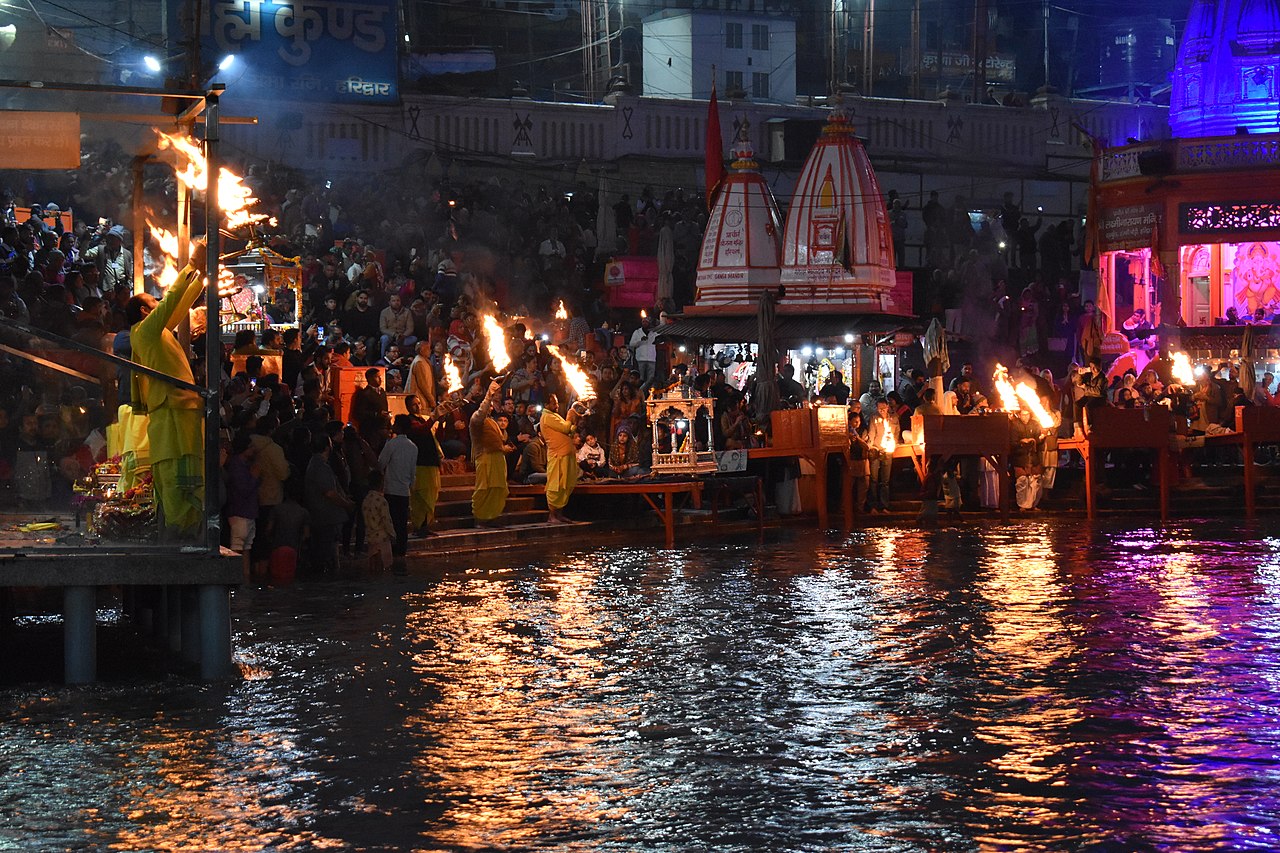
The evening Ganga aarti at Har Ki Pauri is the rite for which the ghat is known, and it is performed at dusk by a body of priests on a floating platform in the middle of the river, with lamps, bells, conches, and drums. The aarti is the fixed point of the Haridwar day, and the sankirtan that accompanies it is sung at the ghat. The figures in earlier versions of this entry — "6 PM" and "about 20,000 pilgrims nightly" — have no cited source and should not be repeated as fact; the timing follows dusk rather than a fixed hour, and the crowd varies enormously with the season, the day of the week, and whether a major festival is running.
Haridwar's larger setting is a live matter. The town is one of the most-visited pilgrimage sites in India and has been the subject of repeated environmental and engineering regulation of the Ganga flow at Haridwar and at the neighbouring Rishikesh, the headworks of the canal system and the Ganga barrage having been built partly to hold the river level and the flow for the town. Haridwar is also one of the four sites of the Kumbh Mela, the great bathing assembly held in rotation in the Ganga basin — at Haridwar, Prayag, Nashik, and Ujjain — on a twelve-year cycle. The 2021 Kumbh at Haridwar was during the COVID-19 pandemic and was attended under extraordinary restrictions; the assembly figures given for it in popular accounts should be treated with care. A mela is a temporary city, and describing it as an annual festival understates what it is.
This entry is grounded in the Mahabharata and the Harivamsha background, the Haridwar temple's own published record, and the Haridwar district gazetteer. A human guardian from a Haridwar or Har-Ki-Pauri tradition should supply and check: the ghat's own account of the footprint and its authentication; the local Banasura and amrita narrative; the current aarti arrangements and discipline; and the Kumbh Mela organisation and any figures the authorities themselves publish. The uncited figures in earlier drafts have been removed. The Sapta Moksha Puri list should be given from a specific source rather than as a fixed seven, and the Haridwar temple's own list of the shrines it administers — the Mansa Devi and Chandi Devi temples are separately administered — should be respected.




