




Sacred Facts · At a Glance
- Gender
- female
- Sacred Colours
- redgold
- Sacred Offerings
- flowers · kumkum · sweets · coconut
Primary Scriptures
0 sourcesNo primary scriptures are catalogued for this entry yet. If you know of scriptural references we have missed, please contribute them.
Haridwar — third of the Sapta Mokshapuri, and a Kumbh site
Two lists that should not be merged
Haridwar is named in this corpus as the third of the Sapta Mokshapuri, the seven cities associated with release (mokṣa). The list itself varies in its members and in its order between textual and regional sources, and the Sapta Mokshapuri as a formal set is a later development of pilgrimage tradition rather than a fixed ancient canon; the corpus's numbering should be treated as one arrangement, not as authoritative.
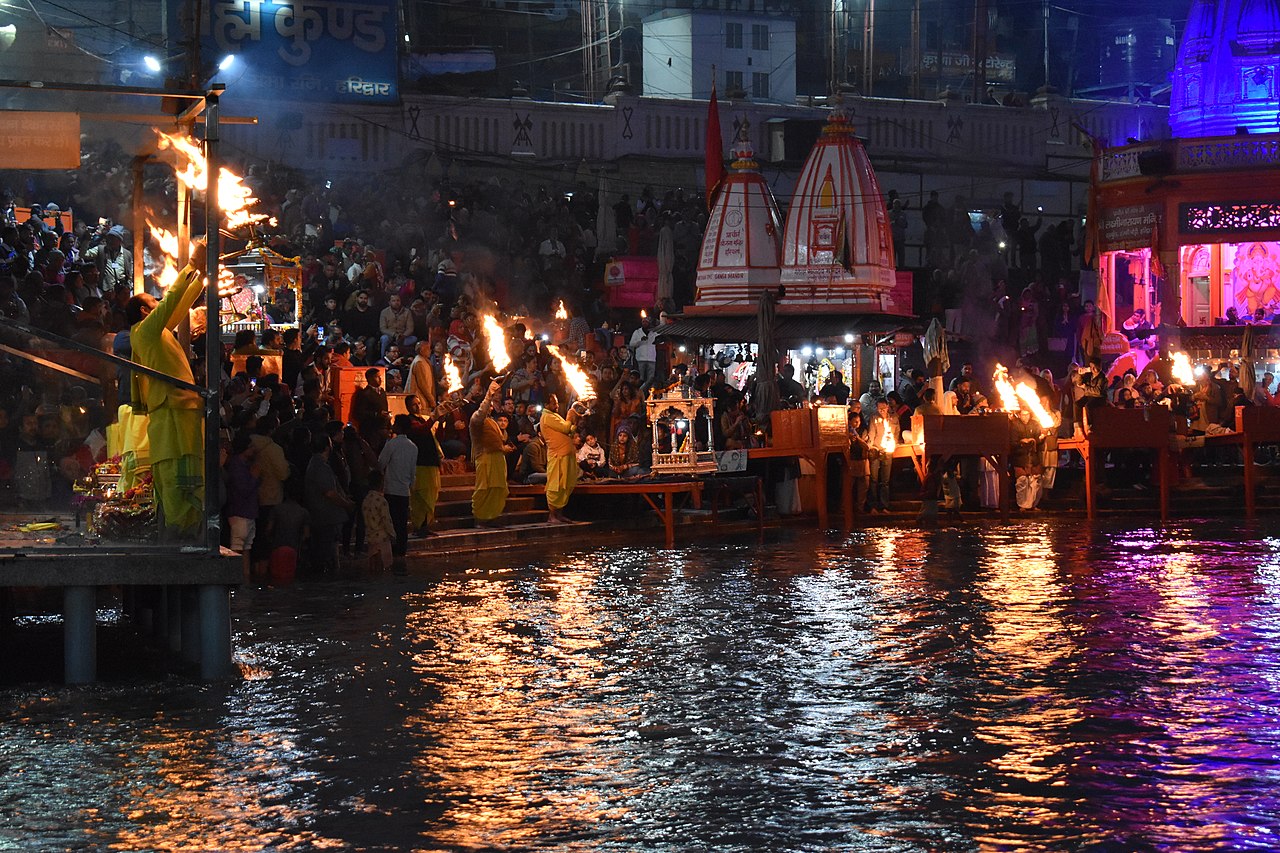
What is not in dispute is that Haridwar is where the Ganga, descending from the higher Himalayas, is said to leave the mountains and enter the plains — haridwāra, the "gate of Hari". That transition point is the whole of its sacred geography. The modern town, with its ghat steps along the river, is a twentieth-century development, but the riverbank at the point of entry has been a place of ritual bathing (snāna) for a very long time, and bathing at dawn during the solar month of Jyestha (Māgha Har Amavasya and the Kumbh period) is among the most densely attended ritual acts in the subcontinent.
The Kumbh
Haridwar is one of four sites of the Kumbh Mela — the others being Prayagraj at the Yamuna–Ganga confluence, Nashik on the Godavari, and Ujjain on the Kshipra — where the periodic great assemblies are held. The Kumbh's fundamental point is that the yātrā here is astrological: the melas are tied to the movement of Jupiter through the zodiac, and the great Mahākumbha at Prayagraj is determined by that reckoning. The relationship between the four sites, the different cycles at each, and the customary intervals between assemblies should be stated from the tradition's own reckoning rather than from summary descriptions.
The presence of the Ganga at this point is what makes the site a mokṣapuri: the water that carries the merit is the water that arrives from the mountains. That logic — a place defined by what happens at it, not by what stands on it — is characteristic of the whole Ganga shrine network, of which Haridwar is the northern gate.
Sources and what is still unverified
The Purāṇic material on the Ganga and on Haridwar, Coomaraswamy's general work, the district gazetteer, and the Encyclopaedia of Hinduism for the Kumbh Mela.
Outstanding for a named guardian: the textual source and order of the Sapta Mokshapuri list this corpus follows; the astrological rules and the intervals observed at each of the four Kumbh sites, which are technical and vary by reckoning; and the modern regulation of the ghat area, which is a live administrative question and not a religious one.
Wisdom Graph: Divine Associations
- Offerings
- flowerskumkumsweetscoconut
- Sacred colours
- redgold
🛕 Principal Temples
- Haridwar Moksha PuriAncient📍 Haridwar, Haridwar, Uttarakhand, IndiaMāyāpurī / Haridwar — Sapta Mokṣapurī #3
🎊 Festivals
- Navratri / Annual Mahotsavavaries
Sources & provenance
- 🎓Scholarly sourceBookThe Purāṇas (pilgrimage and river sections)
- 🎓Scholarly sourceBookKatherine A. Fioravanti, Jeffrey N. Colgan and Dana Good, editors.