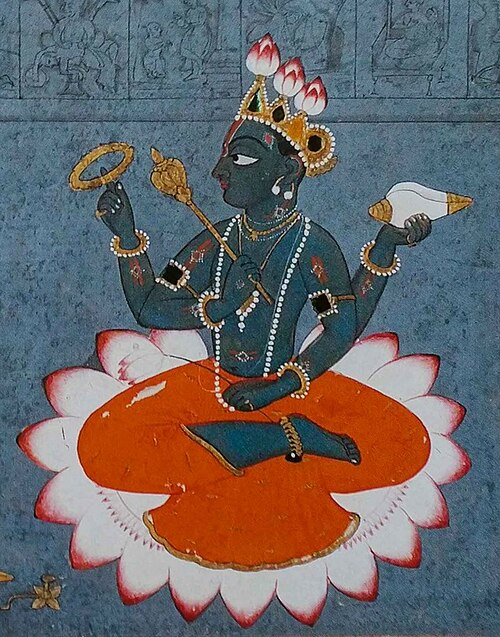
📷 Navaneethpp · [CC BY-SA 4.0](https://creativecommons.org/licenses/by-sa/4.0)
Deities
In brief~2 min read
Kulaśekhara Āḻvār (Tamil: குலசேகர ஆழ்வார்) is the seventh of the 12 Āḻvār saints, traditionally dated to the 9th century CE.
Kulaśekhara Āḻvār (Tamil: குலசேகர ஆழ்வார்) is the seventh of the 12 Āḻvār saints, traditionally dated to the 9th century CE. Unlike other Āḻvārs who were commoners or mystics, Kulaśekhara was a Chera king — a monarch of the dynasty that ruled Kerala and parts of western Tamil Nadu.
As a king, he was renowned for his justice, generosity, and military prowess. But one night, after a successful battle, he had a vision: Ranganatha of Srirangam appeared before him in a dream, reclining on Ādiśeṣa, inviting the king to join him. Kulaśekhara woke, abandoned his throne, and walked barefoot to Srirangam — a journey of several hundred kilometers.
His sole Tamil work, the Perumal Tirumoli ("Sacred Words of the Lord"), consists of 105 verses that revolutionized Vaishnava sacred geography. Before Kulaśekhara, all Divya Desams were considered roughly equal. He declared unequivocally:
"Srirangam is the crown of all shrines. All other temples are its servants."
This hierarchical vision — with Srirangam at the apex — became the organizational principle of the entire Sri Vaishnava tradition. To this day, Srirangam's Brahmotsavam is the model for all other temple festivals, and its priests claim precedence over all other Vaishnava clergy.
Kulaśekhara also composed the Mukunda Mala ("Garland for Mukunda/Vishnu"), a set of 40 Sanskrit verses. This is remarkable: a Tamil king-saint writing in Sanskrit, the language of Brahmins. The work shows his royal education and his desire to communicate with the pan-Indian elite. One verse became especially famous:
"O Lord, let me be born as a worm in the house of a devotee — but never as a king without devotion."
This verse, rejecting his own royal birth, scandalized the courtiers who followed him to Srirangam.
Kulaśekhara's Tirunakṣatram (birth star: Punarvasu) is celebrated with a 10-day festival at Srirangam. His image is carried in procession alongside Ranganatha's — the only Āḻvār honored this way. Chera-era inscriptions (9th c.) at Srirangam record royal endowments attributed to Kulaśekhara, suggesting his historical reality beneath the hagiography.
In the Sri Vaishnava guru lineage, Kulaśekhara represents royal renunciation — proof that even the highest worldly power is worthless without devotion.