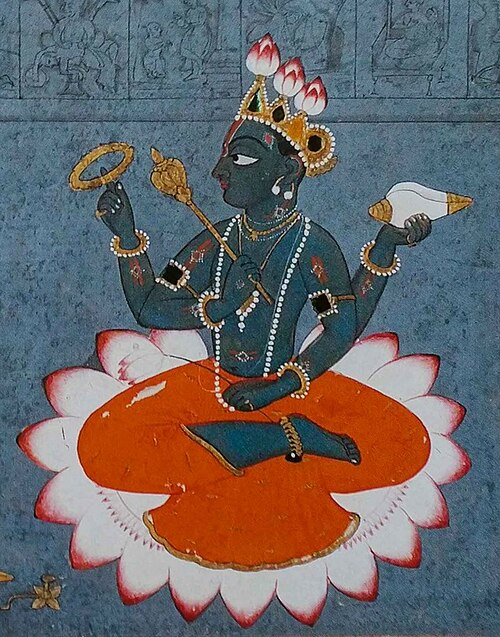
Sacred Facts · At a Glance
- Gender
- male
Primary Scriptures
3 sources- Tiruvāymoḻistotra1,100 verses in 10 decads (pattu) of 100 verses eachComposed 9th c. CEThe 'Tamil Veda' — Sri Vaishnava theology in poetic form
- Tiruviruttamstotra100 versesComposed 9th c. CESeparation poetry — the soul's longing for God
- Tiruvāciriyamstotra7 versesComposed 9th c. CE
Nammāḻvār (Śaṭhakōpaṉ) — The Greatest Āḻvār
Birth and Early Life
Nammāḻvār was born in Alvar Tirunagari (near modern Tirunelveli) in the late 9th century CE. His birth name was Śaṭhakōpaṉ — "he who conquered the six enemies" (lust, anger, greed, delusion, pride, jealousy). Unlike other Āḻvārs who had dramatic conversion experiences, Śaṭhakōpaṉ was born already immersed in God.
For sixteen years, he sat beneath a tamarind tree near the Adinatha temple, neither eating nor speaking. Passersby thought him a mute sage or madman. But inside, he was composing — verses flowed through him like water from a spring.
Meeting Madurakavi Āḻvār
The disciple Madurakavi Āḻvār, a brilliant scholar from Madurai, heard of this silent youth and traveled to test him. Madurakavi asked a single question:
"If what is born from something is finite, what is born from the Infinite?"
Śaṭhakōpaṉ, still silent, responded with a verse:
"That which is born from the Infinite is knowledge (jñāna), and that knowledge is myself."
Madurakavi immediately understood. He fell at the youth's feet and became his disciple — the only Āḻvār who worshipped another Āḻvār as guru. From that day, Śaṭhakōpaṉ was called Nammāḻvār — "Our Āḻvār" — the Āḻvār who belongs to all devotees.
Tiruvāymoḻi — The Tamil Veda
Nammāḻvār's magnum opus, the Tiruvāymoḻi ("Sacred Words"), consists of 1,100 verses organized into 10 sections (pattu) of 100 verses each. Sri Vaishnavas call it the "Tamil Veda" — equal in authority to the Sanskrit Vedas:
- Tiruviruttam (100 verses): The soul's longing in separation
- Tiruvāciriyam (7 verses): Philosophical essence of Visishtadvaita
- Tiruvāymoḻi proper (1,100 verses): Ecstatic union; the theology of surrender (prapatti)
The central teaching: Śaraṇāgati (surrender to the Lord's feet). Nammāḻvār declares that no amount of karma, jñāna, or yoga can save the soul — only the Lord's grace (kṛpā) and the devotee's surrender.
Connection to Rāmānuja
In the 11th century, Rāmānuja (1017–1137), the founder of Visishtadvaita Vedanta, declared that his entire philosophy was nothing but a commentary on Nammāḻvār's verses. Rāmānuja's Śrībhāṣya (commentary on the Brahma Sūtras) cites the Tiruvāymoḻi as scriptural authority (śruti).
The guru-disciple lineage (sampradāya) from Nammāḻvār → Nāthamuni → Rāmānuja → Vedānta Deśika is considered the unbroken chain of Sri Vaishnava orthodoxy.
Legacy and Worship
Every Sri Vaishnava temple begins its day with Nammāḻvār's image being carried in procession. His Tirunakṣatram (birth star: Viśākhā) is celebrated with 10-day festivals. In Srirangam, a separate sanctum houses his image, and devotees believe he continues to compose — his hymns are "still being written by the Lord through him."
Nammāḻvār's tamarind tree still stands in Alvar Tirunagari. Pilgrims touch its bark and recite: "Nammāḻvār, who composed beneath this tree, bless us with your vision of the Lord."
Wisdom Graph: Divine Associations
🛕 Principal Temples
📜 Primary Scriptural Sources
- Tiruvāymoḻistotra9th c. CE1,100 verses in 10 decads (pattu) of 100 verses eachThe 'Tamil Veda' — Sri Vaishnava theology in poetic form
- Tiruviruttamstotra9th c. CE100 versesSeparation poetry — the soul's longing for God
- Tiruvāciriyamstotra9th c. CE7 versesPhilosophical summary
Sources & provenance
- 📜Primary sourceBookNammāḻvār (Śaṭhakōpaṉ). Tiruvāymoḻi (880)1,100 verses; the 'Tamil Veda'
- 📜Primary sourceBook12 Āḻvārs, compiled by Nāthamuni.