

Sacred Facts · At a Glance
- Gender
- male
- Vahana
- Nandi (bull)
- Weapon
- ḍamaru (creation-drum) · agni (flame of dissolution) · abhaya mudrā · gaja-hasta
- Sacred Number(s)
- 5 · 108
- Sacred Colours
- saffrongold
- Sacred Flowers
- konrai (Cassia fistula, Tamil golden shower) · vanni (Prosopis cineraria)
- Sacred Trees
- Chidambaram Tillai (mangrove)
- Sacred Offerings
- sandal paste · bilva leaves · vibhūti
Primary Scriptures
3 sources- TiruvācakambhaktiMāṇikkavācakarComposed 9th c. CE
- Periya Purāṇam (Tiruttoṇṭar Purāṇam)puranaSekkiḻārComposed 12th c. CE
- Coomaraswamy — The Dance of ShivasecondaryComposed 1918
⚠️ CONTENT VERIFICATION STATUS: This draft is . All citations require validation. Content should be reviewed by qualified scholars and practitioners before publication. Do not rely on this content for ritual, liturgical, or spiritual practice without independent verification.
Shiva (शिव — The Auspicious One)
Overview
Shiva is one of the most widely worshipped deities in Hinduism — a god of many faces: destroyer and transformer, ascetic and householder, cosmic dancer and meditative yogi. Within Shaivism, he is considered the Supreme Being — the ground of all existence, beyond form, beyond concept, beyond even the gods.
The name Shiva means "the auspicious one" or "the one who brings good fortune." He is also called:
- Mahadeva (Great God)
- Nataraja (Lord of the Dance)
- Adiyogi (First Yogi)
- Lingadhar (Bearer of the Lingam)
- Bhole Nath ( Innocent Lord)
Shaivas — worshippers of Shiva — number in the hundreds of millions. Major traditions include Shaiva Siddhanta (South India), Kashmir Shaivism (Kashmir), Vira Shaivism/Lingayat (Karnataka), and Pashupata Shaivism (North India). Each tradition understands Shiva differently, but all accord him supreme status.
Iconography: Nataraja Form
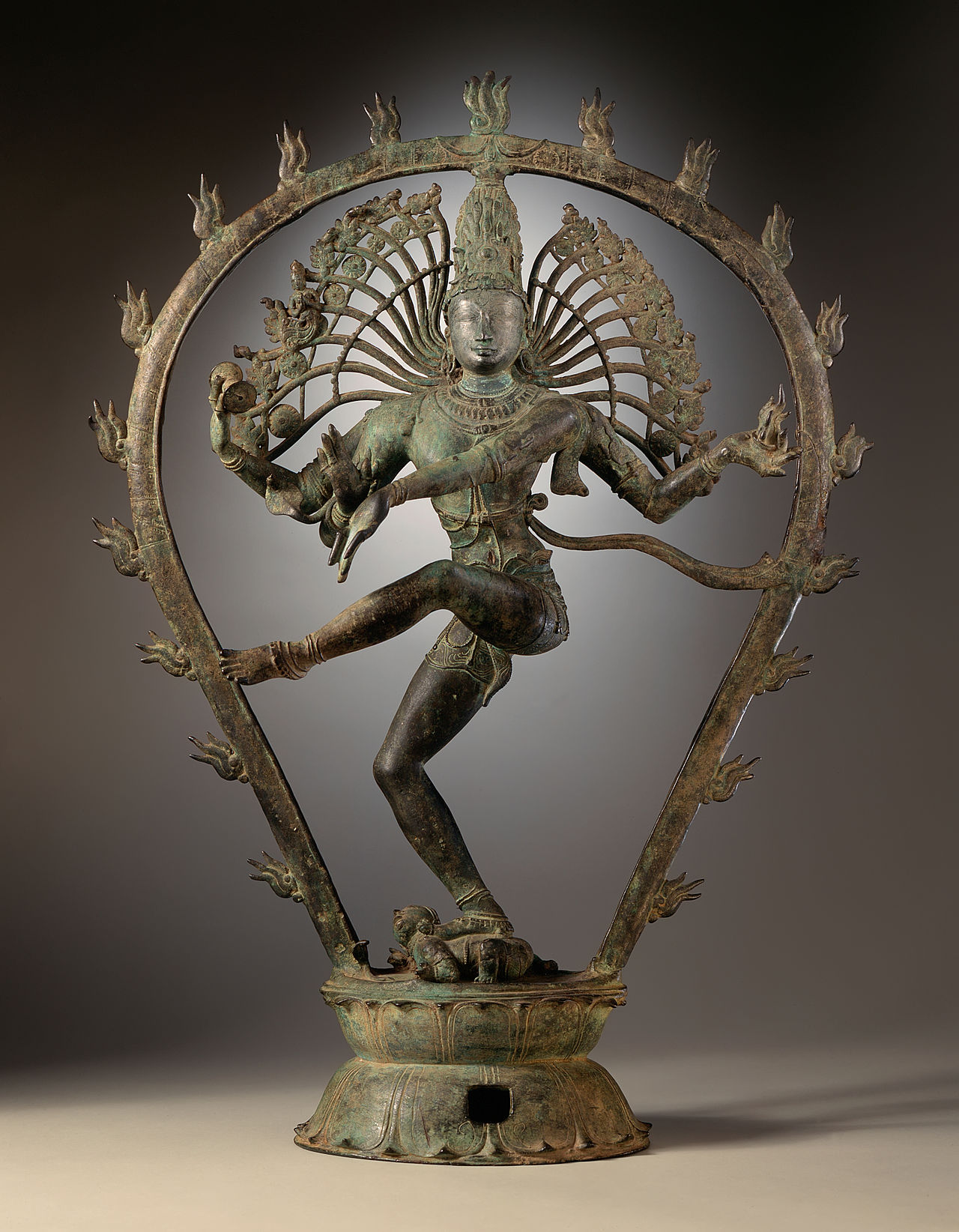
The most iconic representation of Shiva is Nataraja — Shiva as the cosmic dancer whose dance sustains the universe.
The Form
Shiva Nataraja stands in the dancing pose (Tribhanga) within a ring of fire (prabha mandala):
- Upper right hand: Holds a drum (ḍamaru) — the primordial sound that rhythm of creation
- Upper left hand: Holds fire (agni) — the force of destruction
- Lower right hand: Points upward in abhaya mudra — "fear not"
- Lower left hand: Points downward toward the raised foot — liberation for the devotee
- Dwarf beneath: Apasmara (or Muyalaka) — the demon of ignorance, crushed under Shiva's foot
The Significance
The Nataraja form is rich with meaning:
- The drum represents the primordial sound of creation (OM)
- The fire represents destruction of the universe at the end of each cycle
- The dancing pose represents the dynamic, ever-moving nature of reality
- The ring of fire represents the cycle of time (Kalachakra)
- The crushed demon represents ignorance overcome by divine consciousness
- Shiva's raised foot represents Moksha (liberation); his planted foot represents dharma (cosmic order)
This iconography was developed during the Chola dynasty (9th–13th century CE) in South India. The finest bronze examples — like the著名的 Nataraja at the Metropolitan Museum of Art — are Chola bronzes.
Iconography: Lingam Form
The Lingam (लिङ्ग)
The lingam (also linga) is the most common representation of Shiva in temples worldwide. It is an oval-shaped stone (typically uncarved or minimally carved) set on a base (yoni).
Interpretations across traditions:
- Shaiva Siddhanta: The lingam is an an iconic representation of Shiva's formless nature; worship of the lingam is a valid and ancient practice
- Kashmir Shaivism: The lingam represents the union of Shiva (consciousness/purusha) and Shakti (energy/prakriti); the yoni represents Shakti
- Smartas and others: The lingam is one of five forms of the divine worshipped in panchayatana puja
The Story of the Lingam
The Shiva Purana tells how Shiva appeared as an infinite pillar of light (jyotirlinga) to settle a dispute between Vishnu and Brahma. Both gods searched for the beginning and end of the pillar; unable to find either, they bowed to Shiva's supremacy. [Shiva Purana, Rudra Samhita, Chapters 25–40]
The Twelve Jyotirlingas
Twelve sacred Shiva lingams are considered especially powerful:
- Somnath (Gujarat)
- Mallikarjuna (Andhra Pradesh)
- Mahakaleshwar (Madhya Pradesh)
- Omkareshwar (Madhya Pradesh)
- Kedarnath (Uttarakhand)
- Bhimashankar (Maharashtra)
- Kashi Vishwanath (Uttar Pradesh)
- Ghrishneshwar (Maharashtra)
- Rameshwaram (Tamil Nadu)
- Nageshwar (Gujarat)
- Vaidyanath (Jharkhand)
- Triambakeshwar (Maharashtra)
Associated Deities & Family
Consort: Parvati (also called Uma, Shakti, Durga) — the goddess of power and love; daughter of Himavat (king of the Himalayas)
Children:
- Ganesha — god of beginnings, remover of obstacles; his elephant head was given by Shiva after accidentally beheading him
- Kartikeya (also called Murugan, Skanda, Subrahmanya) — god of war, wisdom; commander of the divine army
Associates:
- Nandi — the sacred bull who serves Shiva; gateway guardian at Shiva temples
- Brahma and Vishnu — in many stories, Shiva is the third member of the Trimurti (trinity); in Shaivism, he is supreme
Associated Principles
- Planet: Saturn (Shani) — associated with karma, discipline, spiritual evolution
- Nakshatra: Pushya — a star associated with nourishment and spiritual practice
- Element: Ether/Space (akasha) — Shiva represents the subtlest element
- Tattva: Shiva tattva (consciousness itself)
- Yuga: Kali Yuga — Shiva is said to preside over the dark age of spiritual decline
Sacred Texts
Primary Texts for Shiva Worship
- Shiva Purana: 12 samhitas, 24,000 verses; contains mythology, rituals, and philosophy of Shaivism
- Linga Purana: 11,000 verses; focus on the lingam and its worship
- Kashmir Shaivism: Shiva Sutras (attributed to Vasugupta), Spanda Karikas, Pratyabhijna Hrdayam
- Tirumurai (Shaiva canon, Tamil): 12 books of Shaiva poetry by Nayanmar saints
The Sri Rudram (Fifth Mandala of Yajur Veda)
The most important Vedic hymn to Shiva:
नमः शिवाय च उशीभ्यः च॥ Namah Shivaya ca ushibhyah ca "Homage to Shiva and to the ashes"
This hymn is chanted daily in Shaiva temples and by Shaiva initiates.
Dhyana Shloka (Meditation Verse)
For Nataraja Shiva:
जटिलं मुण्डलितं चन्द्रार्धकलाश्चन्द्रार्धवक्त्रं सुभगं सर्वागं सुभगया सहितं अर्धनागं च कमण्डलुं वडवामुखं सर्वभूतस्थं भावयेत्॥
Jatila mundalita candrardha kalasa candrardha vaktra subhagam sarvangam subhagaya sahitam ardhanagaram kamanḍalu vada vamukham sarvabhuta stham bhavayet
"One should meditate on the Lord of the Universe, who has matted hair (jatila), a crown of the crescent moon (candra ardhakalasa), whose face is half-moon (candra ardhavaktra), who is all auspicious (sarvanga subhaga), who is accompanied by Uma (subhagaya sahita), who is half-female (ardhanarivara), who holds a skull-cup (kamanḍalu), whose mouth is like a mare (vada-vamukha), and who dwells in all beings (sarva-bhuta-stha)." [Shiva Purana]
Major Festivals
Mahashivaratri (महाशिवरात्रि)
"The Great Night of Shiva"
- Date: 14th day of the dark fortnight in February/March (Magha month)
- Observance: All-night vigil (jaagran); fasting; Shiva lingam abhisheka (bathing); chanting of Om Namah Shivaya
- Story: The night Shiva married Parvati; or the night he danced the cosmic dance
- Practices: Special pujas, Rudra abhishekam, reading of Shiva Purana
Shivaratri (शिवरात्रि)
Monthly observance on the 14th day of dark fortnight.
Kumbhabhishekam
Temple consecration ceremony when a new lingam is installed; occurs every 12 years.
Where Shiva is Most Actively Worshipped
Major Temple Complexes
- Varanasi (Kashi): The "City of Shiva" — Vishwanath Temple (Golden Temple), Kashi Vishwanath
- Rameshwaram: One of the 12 Jyotirlingas; linked to Rama's worship of Shiva
- Tiruvannamalai: Arunachaleshvara Temple; associated with Annamalaiyar (Shiva as fire)
- Chidambaram: Thillai Nataraja Temple; Shiva as Nataraja in the cosmic dance
- Mount Kailash: Mythological abode; pilgrimage site in Tibet
- Baba Budan's Gavi Gangadhareshwara Temple (Karnataka)
Shaiva Siddhanta Strongholds
- Tamil Nadu: All Shiva temples, especially Chidambaram, Thilluvannamalai, Tiruvarur
- Global diaspora: Many Shaiva Siddhanta temples in USA, UK, Canada, Malaysia, Singapore
Traditions Considering Shiva Supreme
- Shaiva Siddhanta (South India): Shiva as the ultimate reality, distinct from the world but accessible through grace
- Kashmir Shaivism: Shiva as consciousness (chaitanya) that pervades all; the world is Shiva's sport (lila)
- Vira Shaivism/Lingayat (Karnataka): Shiva is the only reality; the linga is the manifestation of Shiva within the devotee
- Pashupata Shaivism: Shiva as the supreme Pashupati (Lord of Creatures); path of intense yoga
- Siddha Yoga (Muktananda): Shiva as the inner guru, shakti-pat transmission
DivineLens presents perspectives from within this tradition, curated for authenticity. For personal spiritual direction, initiation, advanced study, or questions about lineage-specific practice, we recommend finding a qualified teacher in Shaivism. Our Advisory Council reviews all content for theological accuracy.
Known Limitations
- Citations require verification: All citations need Sanskritist validation.
- Omissions:
- Other Shiva forms (Dakshinamurti, Kal Bhairav, Bhairavi, Nandi, etc.)
- Detailed treatment of Shaiva Siddhanta vs. Kashmir Shaivism differences
- Vira Shaivism (Lingayat) deserves its own dedicated profile
- Regional variations in Shiva worship across India
- Questions for Advisory Council:
- Should the lingam worship be described differently given sectarian sensitivities?
- How to handle the "Shaiva vs. Shakta" interpretation of Shiva-Shakti union?
- The Nataraja form's Chola origins and the controversy over its interpretation
Recommended reviewers: A Shaiva Siddhanta scholar, a Kashmir Shaivism practitioner, a Sanskritist, and a practicing Shaiva.
Revision History
- 2026-04-22: Initial draft generated. . Requires Advisory Council review.
Wisdom Graph: Divine Associations
- Vāhana
- Nandi
- Sacred animals
- apasmāra (dwarf of ignorance) — trampledcobra (Vāsuki)deertiger
- Sacred flowers
- konrai (Cassia fistula, Tamil golden shower)vanni (Prosopis cineraria)
- Sacred trees
- Chidambaram Tillai (mangrove)
- Offerings
- sandal pastebilva leavesvibhūti
- Weapons / emblems
- ḍamaru (creation-drum)agni (flame of dissolution)abhaya mudrāgaja-hasta
- Sacred colours
- saffrongold
- Sacred numbers
- 5108
Sources & provenance
- 🎓Scholarly sourceBookJames G. Lochtefeld. The Illustrated Encyclopedia of Hinduism (2002)
- 🎓Scholarly sourceGazetteer