


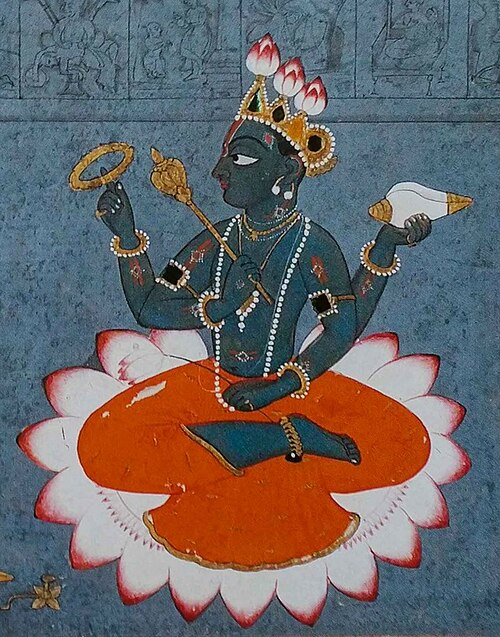


Sacred Facts · At a Glance
- Gender
- male
Primary Scriptures
9 sources- Periya Tirumolistotra473 versesComposed 9th c. CELongest single Āḻvār work; maps 100+ shrines
- Tirukurunthandakamstotra20 versesComposed 9th c. CE
- Tirunetunthandakamstotra30 versesComposed 9th c. CE
Tirumaṅgai Āḻvār — The Warrior-Poet
The Chieftain Who Robbed for God
Tirumaṅgai Āḻvār (Tamil: திருமங்கை ஆழ்வார்) is the tenth of the 12 Āḻvār saints, traditionally dated to the late 8th–early 9th century CE. His name means "he who is beautiful in holiness," but his early life was anything but holy. He was a Kalabhra chieftain — a local warlord who taxed merchants, raided villages, and lived by the sword.
Legend says he fell in love with a beautiful woman named Kumudavalli. She agreed to marry him on one condition: he must feed 1,008 Brahmins daily for a year. Unable to afford this, Tirumaṅgai resorted to highway robbery. One night, he waylaid a wedding party and stole everything — including the bridal jewels. But when he tried to remove a particular necklace, it wouldn't budge. The "bride" was Vishnu himself. The vision transformed the bandit-chieftain into the most prolific poet-saint in the Divya Prabandham.
1,253 Verses — The Most Prolific Āḻvār
Tirumaṅgai composed 1,253 verses across multiple works — more than Nammāḻvār (1,100) and more than any other Āḻvār. His corpus includes:
| Work | Verses | Theme |
|---|---|---|
| Periya Tirumoli | 473 | Longest single work; maps 100+ shrines |
| Tirumālai | 45 | Hymns to Tirumala/Venkateśvara |
| Tirukurunthandakam | 20 | On Kurungudi temple |
| Tirunetunthandakam | 30 | On Netunkāl temple |
| Tiruvelukkutrirukkai | 7 | On Velukkai temple |
| Tirupalliḻḻucci | 10 | Morning wake-up songs for Vishnu |
| Tiruvāciriyam | 7 | Philosophical summary |
| Tiruveḻukūṟṟirukkai | 1 | On Velukkai temple |
The Mapmaker of Vaishnava Geography
Tirumaṅgai's greatest contribution: he personally visited and sang about more Divya Desams than any other Āḻvār. While Nammāḻvār composed from mystical vision, Tirumaṅgai traveled on horseback across Tamil Nadu, Kerala, and Sri Lanka, composing at each shrine. His verses are the primary literary evidence for the 108 Divya Desam circuit.
At Thiru Kannapuram (one of the 108 Divya Desams), he composed 100 pasurams — the most dedicated to any single shrine. The deity there, Sowriraja Perumal, wears a long braid of hair as a debt-payment to Tirumaṅgai: Vishnu had promised "your hair shall be mine" (en kesam tan kesam).
Theology: The Lord Who Pays Debts
Tirumaṅgai established the theology of divine debt: Vishnu is not merely gracious but actually indebted to devotees. Because devotees offer their lives, wealth, and love, the Lord becomes their debtor — and He pays with grace, protection, and liberation. This theological innovation made devotion an active economic exchange, appealing to the merchant and warrior castes of the Chola period.
Legacy
Tirumaṅgai's Tirunakṣatram (birth star: Kṛttikā) is celebrated with massive festivals at Nagapattinam and all the temples he sang about. His image — sometimes depicted on horseback with a sword — is unique among Āḻvārs. In Srirangam, he is honored as the "poet who mapped the Lord's kingdom."
In the guru lineage, Tirumaṅgai represents transformative grace — proof that even the most violent sinner can become the greatest saint through Vishnu's mercy.
Wisdom Graph: Divine Associations
🛕 Principal Temples
📜 Primary Scriptural Sources
- Periya Tirumolistotra9th c. CE473 versesLongest single Āḻvār work; maps 100+ shrines
- Tirukurunthandakamstotra9th c. CE20 verses
- Tirunetunthandakamstotra9th c. CE30 verses
- Tiruvelukkutrirukkaistotra9th c. CE7 versesOn Vishnu at Thiruvelukkai
- Tirupalliḻḻuccistotra9th c. CE10 versesMorning wake-up songs for Vishnu
- Tirumālaistotra9th c. CE45 versesOn Tirumala/Venkateswara
- Tiruvāciriyamstotra9th c. CE7 versesPhilosophical summary
- Tiruveḻukūṟṟirukkaistotra9th c. CE1 verse
- Tiruppāṇāyiram
Sources & provenance
- 📜Primary sourceBookTirumaṅgai Āḻvār. Periya Tirumoli (850)473 verses; longest single Āḻvār work
- 📜Primary sourceBook