


.png/500px-Late_Vedic_Culture_(1100-500_BCE).png)

Sacred Facts · At a Glance
- Gender
- male
- Vahana
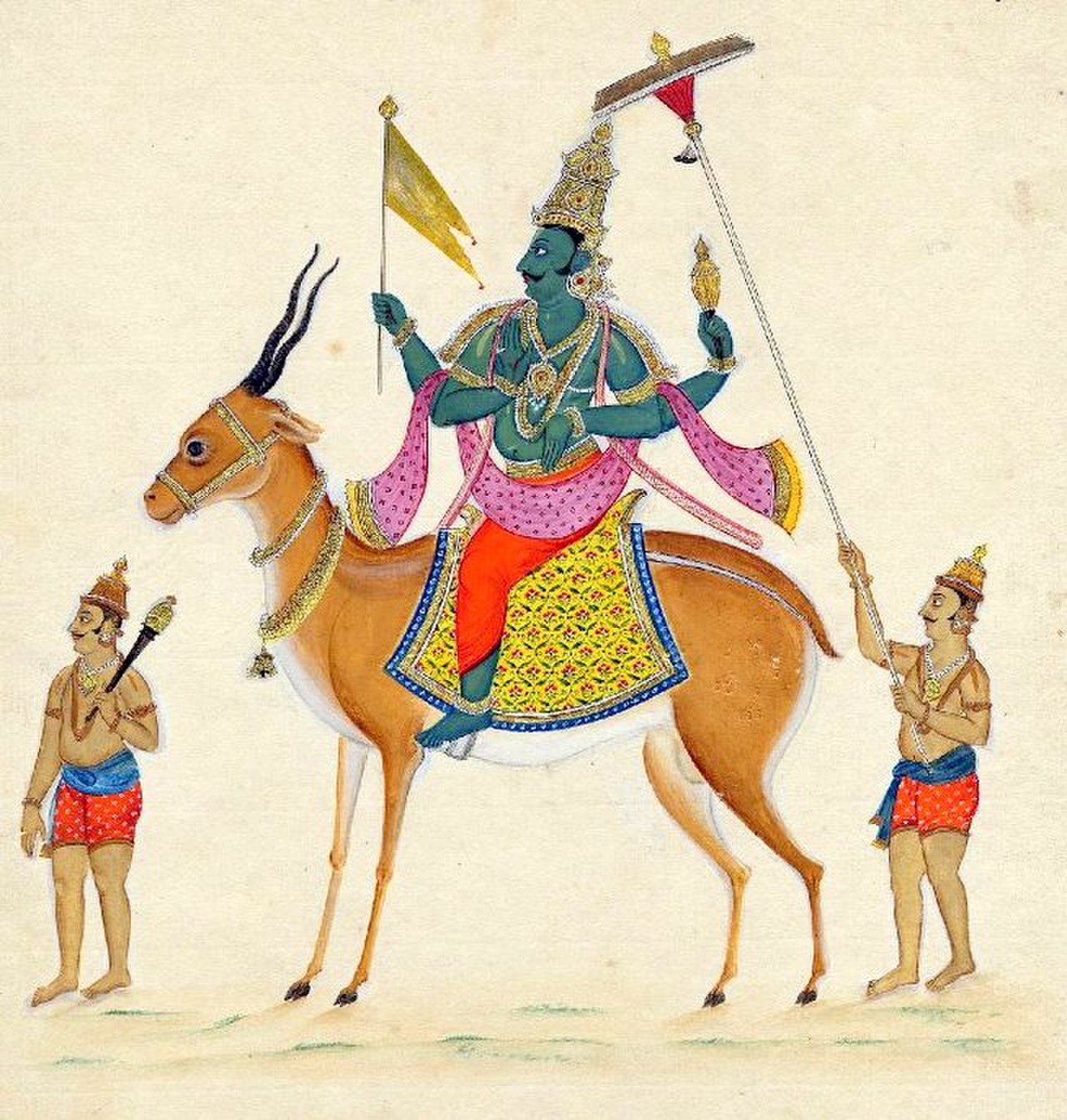
- Hariṇa / Mṛga (swift celestial antelope or gazelle representing effortless speed, lightness, and grace)
- Weapon
- Vāyu-dhvaja (billowing celestial wind banner) · Aṅkuśa (goad of control) · Cakra of currents
- Element
- air
- Sacred Colours
- transparent smoky greyradiant whitepale blue
- Sacred Flowers
- white lotus · white jasmine (mallikā)
- Sacred Trees
Primary Scriptures
4 sources- Ṛgveda Saṃhitā (10.168 — Vāta Sūkta)vedaComposed c. 1500–1200 BCEThe majestic Vedic ode to the storm wind: 'ātmā devānāṃ bhuvanasya garbho yathāvaśaṃ carati deva eṣaḥ... ghoṣā id asya śṛṇvire na rūpam' — 'Soul of the gods, germ of the universe, this god moves at his pleasure. His roars are heard, but his form is never seen!'
- Taittirīya Upaniṣad (1.1)upanishadComposed c. 600 BCE'namo brahmaṇe | namaste vāyo | tvameva pratyakṣaṃ brahmāsi' — 'Salutations to Brahman! Salutations to thee, O Vayu! For thou art the directly perceptible Brahman!'
- Praśna Upaniṣad (Praśna 2)upanishad
Vayu: Lord of the Wind & Cosmic Prana
Breath of the Universe, Guardian of the Northwest & Manifest Brahman
Overview: The Metaphysical Foundation
Vāyu (वायु — from the root *vā-, "to blow, move, breathe, or invigorate"), also known as Vāta, Pavana (the purifier), and Mātariśvan, is the Vedic deity of the wind, atmosphere, and cosmic vitality (Prāṇa). In Vedic philosophy, Vayu is the most intimate of all deities because he is not distant in heaven, but resides inside every living being as the breath that sustains consciousness from birth to departure.
As the guardian of the northwestern direction (Vāyavya Dikpāla), Vayu commands atmospheric storms, monsoon currents, and the five physiological winds (Pañca Prāṇas: Prāṇa, Apāna, Samāna, Udāna, Vyāna). In the Upanishads, Vayu is saluted as Pratyakṣam Brahma—the directly perceptible, palpable reality of the Supreme Spirit.
Canonical Scriptural Evolution across Millennia
1. The Rigvedic Samhita: The First Drinker of Soma
In the Rigveda, Vayu holds the supreme privilege of receiving the first libation of Soma:
- Rigveda 1.2.1: vāyav ā yāhi darśateme somā araṅkṛtāḥ | teṣāṃ pāhi śrudhī havaṃ ("Come, O Vayu, worthy of sight! These somas are prepared; drink of them and hear our call!").
- Rigveda 10.168 (Vāta Sūkta): A thrilling poem capturing the sublime majesty of the wind charging across the earth on a chariot drawn by thousands of red horses, stirring up dust, shattering mountain branches, invisible to mortal eyes yet felt by all living flesh.
2. The Upanishads: The Perceptible Brahman
In the Taittirīya Upaniṣad (1.1), the seeker declares:
namo brahmaṇe | namaste vāyo | tvameva pratyakṣaṃ brahmāsi | tvāmeva pratyakṣaṃ brahma vadiṣyāmi | satyaṃ vadiṣyāmi |
"Salutations to Brahman! Salutations to thee, O Vayu! Thou alone art the directly perceptible Brahman! Thee alone will I declare as the manifest Brahman! I will speak the truth!"
In the Praśna Upaniṣad, the faculties of speech, sight, hearing, and mind boast of their self-sufficiency. Prana-Vayu begins to rise out of the body, and immediately all senses lose consciousness and plead with Prana to stay, proving that all bodily life is an expression of Vayu.
3. The Dvaita Vedanta Synthesis: Mukhyaprana
In the 13th century CE, Jagadguru Madhvacharya established the philosophical doctrine that Vayu is Mukhyaprāṇa—the highest of all created beings, through whose mediation the soul attains the grace of Lord Narayana. Vayu incarnates in every age to serve the Divine: as Hanumān in Treta Yuga, as Bhīma in Dvapara Yuga, and as Madhva himself in Kali Yuga.
Century-by-Century Iconographic & Archaeological Record
ARCHAEOLOGICAL MILESTONES OF VAYU
c. 1500 BCE ──► Rigveda Mandala 1 & 10: Foundational Vayu & Vata hymns
c. 150 CE ──► Kushan Mathura Red Sandstone: Vayu holding wind banner with antelope
c. 750 CE ──► Srikalahasti Temple: Enshrinement of Vayu Linga in granite sanctum
c. 1250 CE ──► Udupi Sri Krishna Matha: Installation of Mukhyaprana by Madhvacharya
c. 1300 CE–Pres ──► Japan: Fūten (風天) enshrined among the Twelve Jūnitenn
- Kushan Mathura Sculptures (1st–2nd c. CE): Red sandstone carvings depict Vayu holding both ends of a billowing scarf or banner overhead, riding a fleet-footed leaping antelope.
- Srikalahasti Temple (Chittoor, AP): One of the most sacred pilgrimage sites in India. In the sanctum sanctorum, the Shiva Linga represents the Vāyu Tattva. While all doors are closed and the air is still, the two ghee lamps beside the Linga continuously waver and flicker, attesting to the presence of the cosmic wind.
- Pattadakal & Khajuraho (8th–10th c. CE): Northwest devakoshtas feature Vayu holding a fluttering flag (dhvaja) and a goad (aṅkuśa), with his gaze directed into the horizon.
Sacred Temples & Shrines
| Temple Name | Location | Century | Significance |
|---|---|---|---|
| Srikalahasteeswara Temple | Srikalahasti, Andhra Pradesh (13.7498° N, 79.6984° E) | 5th c. BCE / 11th c. CE | Supreme Vayu Linga of the Pancha Bhoota Sthalams; miraculous flickering lamps. |
| Sri Mukhyaprana Temple | Udupi Sri Krishna Matha, Karnataka (13.3409° N, 74.7515° E) | 13th c. CE | Epicenter of Dvaita worship established by Sri Madhvacharya. |
| Pattadakal Papanatha Temple | Pattadakal, Karnataka (15.9489° N, 75.8165° E) | 8th c. CE | UNESCO World Heritage Northwest Dikpala stone relief of Vayu. |
Daily Practice & Chanting
- Vāyu Gāyatrī Recitation:
Om Pavana-Puruṣāya Vidmahe Sahasra-Mūrtaye Dhīmahi | Tanno Vāyuḥ Pracodayāt || - Prāṇāyāma as Divine Worship: Practice rhythmic Nadi Shodhana breathing, recognizing every conscious breath as a sacred oblation to Lord Vayu who animates the physical temple of the body.\n
Wisdom Graph: Divine Associations
- Vāhana
- Hariṇa / Mṛga (swift celestial antelope or gazelle representing effortless speed, lightness, and grace)
- Sacred animals
- antelope (hariṇa)gazelledeer
- Sacred flowers
- white lotuswhite jasmine (mallikā)
- Sacred plants
- darbha grasskuśa grass
- Sacred trees
- arjuna treebanyan (whose leaves whisper in the wind)
- Offerings
- prāṇāyāma breath offeringspure camphorwhite sandalwoodwhite clothscented flowers
- Weapons / emblems
- Vāyu-dhvaja (billowing celestial wind banner)Aṅkuśa (goad of control)Cakra of currents
- Sacred colours
Sources & provenance
- 📖Supporting referenceOtherRigveda
- 📖Supporting referenceOtherTaittiriya Upanishad
- 📖