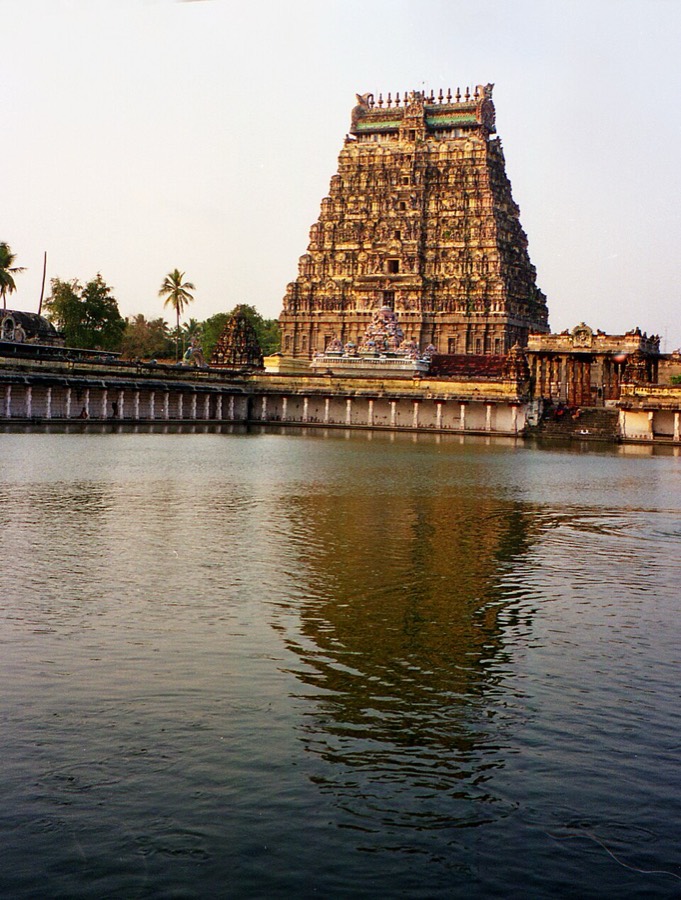
The Secret of Chidambaram — Where the Deity Is Empty Space
In the hall of consciousness, Shiva dances the Ananda Tandava behind golden roofs; and in the innermost shrine, where every temple keeps its god, Chidambaram draws back a curtain to reveal — nothing, which is everything.
The temple Tamil Saivites call simply "The Temple"
On the coastal plain of Tamil Nadu, two hundred and fifteen kilometres south of Chennai and a short distance from the Bay of Bengal, stands the town of Chidambaram, in Cuddalore district 4. For Tamil Saivites the shrine at its centre is not one temple among many. It is Koyil — The Temple — the word used without qualification, the way a Catholic might say "Rome" 5.
The town itself is older than the name. Before Chidambaram it was Thillai, and the shrine was a Shiva shrine in the Tillai forest, standing when the town was still called by the tree 4. "Chidambaram" is two Tamil words run together: chit, consciousness, and ambalam, a hall or stage — the hall of consciousness 5. The name is not a description of the building. It is a description of what the building is for.
There is a limit that has to be stated at the start, because everything later rests on it. The Government of Madras, in a filing on the temple, put it plainly: the temple is a very ancient one, and apart from epical history no historical evidence is traceable as to the details of its founding and age 6. The earliest evidence that can actually be dated is inscription, and the inscriptions of the Chidambaram temple begin, in any number, with the Cholas 4.
So this is a story that begins where the evidence begins, and is candid about the long stretch before it.
What the stone records
The earliest historically verifiable Shiva temple at Chidambaram is traceable in inscriptions dating to Aditya Chola I, in the early tenth century, with considerably more surviving from the reign of Parantaka Chola I in the tenth 4. After that the epigraphic record thickens into a near-continuous royal register: Rajendra Chola I, Kulothunga Chola I, Vikrama Chola I, Rajadhiraja Chola II, Kulothunga Chola III, Rajaraja Chola III 4. The Pandyas follow — Jatavarman Sundara Pandiyan, then Maravarman Kulasekara Pandiyan — and after them Vijayanagara kings including Achyutha Deva Maharaya 4.
Among these, one act of patronage was remembered in a name. Parantaka Chola I laid the golden tiled roof over the Chitrambalam, the sanctum's gilded hall, and for it took the title Thillaiyambalathhukku porkoorai veiyntha thevan — the one who roofed Chidambaram in gold 4. The Thiruvalangadu copper plates also credit him with constructing the golden roof in the ninth century 4. A king who renames himself after a building project is telling you what the building was worth.
Two other Chola facts belong here. The first is that the Cholas revered Nataraja as their family deity, and were crowned in this temple, according to the Periyapuranam 4. The second concerns a loss that made the temple the preserver of a literature. The works of the first three saints, the Thirumurai, were kept as palm-leaf manuscripts at Chidambaram, and it was from Chidambaram, under Rajaraja Chola and with the guidance of Nambiandarnambi, that they were recovered 4. The temple is not only a shrine in this account; it is the archive that kept the canon.
Then the record turns. In the fourteenth century the armies of the Delhi Sultanate reached the temple towns of the south. The court historians of the Sultanate record that Malik Kafur raided Chidambaram, Madurai, Srirangam, Vriddhachalam and Rameswaram, and destroyed the temples that were sources of gold and jewels 4. The art historian George Michell, writing on Indian architecture, described the effect of the fourteenth-century invasions as an abrupt end to the patronage of Chidambaram and the other temple towns 4.
The temple survived. It was damaged, repaired, renovated and expanded through the second millennium 4. Over two hundred record items, including substantial hoards of copper plate inscriptions, have been recovered from it 4 — which is part of why the history above is knowable at all.
The one thing every temple has, and this one does not
Here is the anomaly, and it is the reason this temple is famous. Every great Shiva shrine keeps a god in its sanctum. Chidambaram's innermost hall, the Chit Sabha, keeps a bronze Nataraja — the Lord caught mid-step in the Ananda Tandava, the dance held to be the dance of creation and destruction 4. Beside the image, in the same hall, is a crystal linga; crystal is taken to stand for space 4. A small ruby Nataraja, called Ratnasabhapati, is honoured once a day at half past ten, and the crystal linga is bathed in the six daily pujas 4.
And then there is the space.
In the Chit Sabha, to one side, is a curtained enclosure — three and a half metres long, a metre and a half wide 4. It is closed by two curtains, one red and one black 4. Behind them is no image. There are golden bilva leaves, fifty-two of them, the leaf that is Shiva's own 4. At the time of arati the curtains are drawn, the leaves are waved before, and then the curtains close again.
The arati is done first to the Nataraja, and then to the leaves after the curtains move 4. The order matters: the form is served, and then the formless is served, and the second service follows the first rather than replacing it.
The enclosure has a name. It is the Chidambara Rahasya — the secret of Chidambaram 5.
This is the oldest description of the place and the plainest. Writing at the turn of the twentieth century, Natesa Sastri set down what a Saiva was told when he asked to be shown the god 2:
if he ever asks the priests to show him the God in the temple he is pointed to an empty space in the most holy of the holies, which has been termed the Akāśa, or ether-liṅga. In this is the so-called Chidambara-rahasya — the secret of worship in the sacred city of Chidambaram. 2
Sastri then gives the stakes the tradition attaches to it: a devotee who has reached the stage of worshipping God in this manner is held, in Saiva doctrine, to be exempt from future births and to secure absorption in the supreme essence of God 2. A curtain, in other words, that is not a hiding place but a syllabus.
Read as iconography, the reading attributed to George Michell is that the arrangement symbolises enlightenment inside and illusion outside 4. That is a second-hand attribution and is offered here as such. But the shape of it is visible without commentary: the temple shows you a dancer, a crystal, a ruby, and a gold-leafed emptiness, in that order of proximity.
The space is not unique to the sanctum
Chidambaram is one of the five Pañca Bhūta Sthalams, the elemental shrines of Shiva, and it holds the element ākāśa — space, the subtlest of the five 4. It is also, and unusually, the only Shiva temple that belongs to both the Pañca Bhūta list and the Pañca Sabhā list, the five dancing halls 4. The two classifications overlap here and nowhere else, which is one reason the town accumulated meanings rather than shedding them.
What the space is not, on the evidence, is an absence of ritual. The enclosure is the most tightly scheduled thing in the temple. Its contents are renewed on the tenth day of the principal festivals 4; the evening service closes the doors and windows of the Chit Sabha while the rahasya is honoured 5. A emptiness that gets its own liturgical calendar is doing a great deal of work.
The Natya Shastra, in stone
Turn away from the sanctum and look at the gateways. Chidambaram's gopuras carry one of the most complete sculptural programmes of Indian classical dance anywhere 3.
Bharata Muni's Nāṭyaśāstra — the ancient treatise on performance — defines 108 karaṇas, units of dance, each a coordinated action of the hands and the feet, in its fourth chapter 1. They are not postures in the loose sense. They are a defined and ordered vocabulary, with the combination of gesture, foot position and movement specified.
At Chidambaram, the passages through all four gopurams have been decorated with a complete representation of the 108 karaṇas 3. The east and west gopurams carry them with the relevant verse from the Nāṭyaśāstra carved alongside the panel — the text inscribed next to its own illustration 3. Where the count can be checked, the arithmetic is legible: twenty pilasters of nine panels each, a hundred and eighty panels in all, of which one hundred and eight constitute the karaṇa series as the Nāṭyaśāstra defines it 3.
The eastern gopura, which faces the sanctum, carries the 108 reliefs at twenty-two centimetres each, in separate niches 4. It is credited on epigraphic grounds to Koperunsingan II, of the mid-thirteenth century, and was repaired in the late eighteenth century with the support of a woman named Subbammal 4. The other gopurams carry dance images as well 4.
This is a translation of a text into a medium that will not fade, and the direction of the translation matters. The Nāṭyaśāstra is not illustrated by the temple. The temple is an argument that the Nāṭyaśāstra is a manual of practice, and that this is what it looks like when performed. The karaṇa programme is the foundation on which Bharatanatyam, the classical dance of Tamil Nadu, stands 4.
Five temples are known for the full defined series — the Rajarajeshvara at Tanjore, the Nataraja here, the Sarangapani at Kumbakonam, the Arunachaleshvara at Tiruvannamalai and the Vriddhagirishvara at Vriddhachalam 3. Chidambaram is not the only one. It is the one the others were copied from.
Who keeps it
The temple is administered hereditarily by the Chidambaram Dikshitars, a class of Saiva Brahmins who hold the priesthood as a birthright and a profession 4. The continuity of that office is part of what the temple means to the people who keep it; the community has shrunk over the centuries of invasion and dispossession recorded above, from a body once numbered in the thousands to a few hundred 7. The claim of unbroken Dikshitar administration from the temple's inception is the temple's own, and is the kind of continuity claim that should be verified rather than assumed 4.
The tradition also names two witnesses at the origin. The temple is held to go back to the age of the sages Patanjali and Vyaghrapada 7, the two figures to whom the first audience of the Ananda Tandava is attributed. There is a story told of Manikkavachakar, the ninth-century Saiva poet, entering the temple and seeing the Nataraja image come alive before him, anklets audible 5. These are not dated facts and are not offered as any. They are the layer of the temple that is carried in the body rather than in the record, and they belong in an honest account of the place.
A twelfth-century Sanskrit text, the Chidambaram Mahatmya, and Upati Sivam's Tamil Kovil Puranam, record the temple's own account of itself 7. Neither has been read for this story, and no claim above rests on them 7.
The festivals
The temple's year turns on two great occasions, both tied to the dance. Arudra Darshan, in the Tamil month of Margazhi, falls in December and January and is the most important of the temple's festivals 4; the Aani Thirumanjanam follows in June and July 4. The Natyanjali festival, in which classical dancers perform as an offering to Nataraja, is the town's standing invitation to the art the gopuras carved 5.
Between festivals, the daily round continues: six pujas, the crystal linga bathed, the ruby Nataraja honoured once at half past ten, and the arati performed first to the form and then to the leaves behind the curtain 4.
The claim, kept small
So what is the secret? On the evidence, this: a temple that decided to keep the unrepresentable inside the building rather than outside it. Everything else at Chidambaram — the golden roof Parantaka Chola I paid for with a title, the 108 karaṇas carved as a textbook, the palm-leaf Thirumurai recovered from its care, the Malabar raids and the Vijayanagara repairs — is an argument that a tradition can be preserved by being written into stone and into the calendar.
And in the innermost hall, past the bronze dancer and the crystal and the ruby, the building stops arguing. Two curtains, one red and one black, and behind them fifty-two gold leaves over an empty space three and a half metres by one and a half 4.
The form points beyond itself. The deepest darshan is of the space that form leaves open.
Come and count the karaṇas on the east gopura — then watch a Bharatanatyam class attempt one.
Sit with this
Form points beyond itself; the deepest darshan is of the space form leaves open.
Count the karanas on the east gopura — then watch a bharatanatyam class try one.
Characters in this kathā
- Shiva as Nataraja
- Patanjali
- Vyaghrapada
- Manikkavachakar
- Rajaraja Chola
Where this kathā lives
Source of this telling
Tevaram hymns; Chidambara Mahatmya tradition; Natya Shastra karanas in stone
Further reading
- Bharata Muni, Nāṭyaśāstra, chapter 4 — the 108 karaṇas
- Natesa Sastri, S. M., Hindu Feasts, Fasts and Ceremonials, chapter 1
- Sadanand Shivam, Shiva's Karanas in the temples of Tamil Nadu: the Natya Shastra in stone
- Nataraja Temple, Chidambaram
- Chidambara Rahasyam
- Statement of Case by the Government of Madras, on the founding and antiquity of the Chidambaram temple
- Chidambaram Mahātmya / Upati Śivam, Kovil Purāṇam
- Michell, George — on the iconographic symbolism of the rahasya curtains