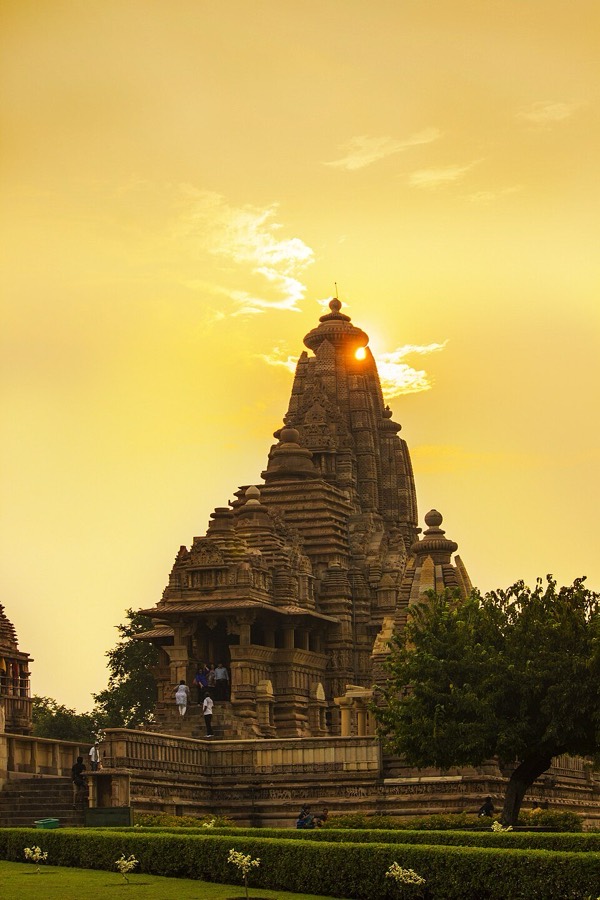
Khajuraho — The Sermon in Sandstone That Was Almost Lost
Eighty-five Chandela temples rose from a Khajur palm grove; jungle swallowed them for seven centuries until a British surveyor cut through the undergrowth — and found gods, dancers, and desire carved on every wall.
A Grove Full of Temples
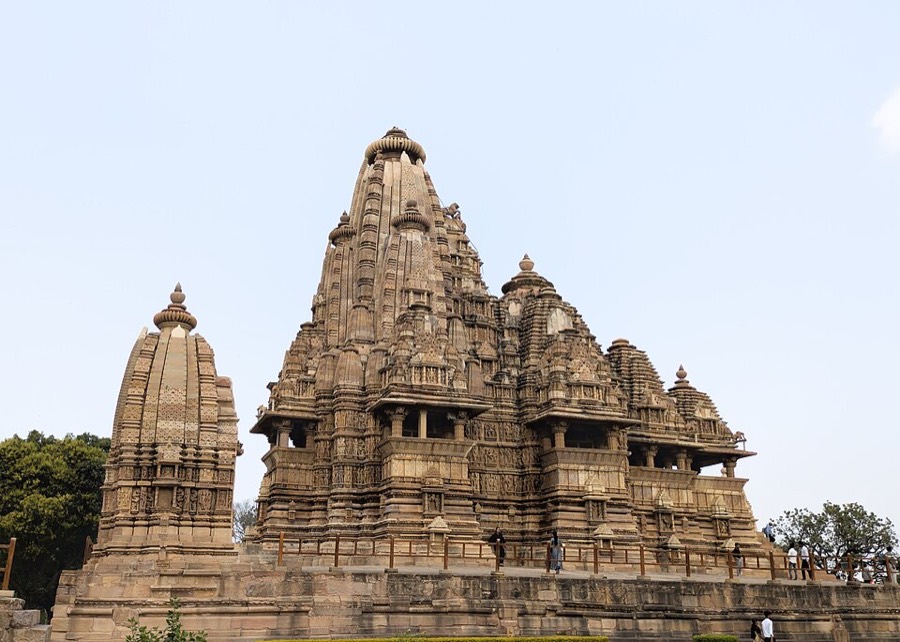
Between roughly 950 and 1050 CE, the Chandela dynasty raised some eighty-five temples at their ceremonial city of Khajuraho — named for the date-palm grove that stood there. Today twenty-five remain, clustered on high terraces, with the Kandariya Mahadeva as the masterpiece: its shikhara climbs about thirty-one metres in a rising chain of peaks that turns sandstone into a mountain range.
Reading the Walls Correctly
Khajuraho's global reputation rests on its erotic panels — and misses the point by ninety percent. Of thousands of carved figures across the complexes, only around a tenth depict lovemaking. The overwhelming majority show gods and goddesses, armies marching, musicians, teachers, potters, elephant keepers — and notably, ascetics. In Chandela theology the four aims of life (dharma, artha, kama, moksha) formed a ladder: the carvings place kama where it belongs on that ladder, neither denied nor dwelt upon — a visual argument that desire acknowledged is desire transcended.
Seven Centuries of Silence, One Morning of Undergrowth
After the Chandelas declined in the 13th century, monsoon forest closed over the plateau. For nearly seven hundred years the temples stood unseen. On a hunting trip in 1838, British surveyor T.S. Burt cut through dense undergrowth and reported finding "a group of temples" his superiors initially doubted existed. Restoration followed within decades; UNESCO inscribed Khajuraho among India's first World Heritage Sites in 1986.
Sit with this
A civilization confident enough to carve everything — including pleasure — trusted the viewer to read upward.
Walk the temple clockwise and count how few panels are erotic — then find the one of a monk-like ascetic beside them.
Characters in this kathā
- the Chandela patrons
- Shiva as Kandariya Mahadeva
Where this kathā lives
Source of this telling
Chandela inscriptions; Al-Biruni's mentions