
The Lamp Goes Out in Kushinagar
Between sala trees at a roadside town, the eighty-year-old Buddha lay down on his right side, gave his last exhortation, and died. Then a Brahmin divided his ashes into ten portions, and the argument over who owned him began.
The last road
The Buddha was in his eightieth year when he set out from Rājagṛha with some of his disciples, on a journey of months: through Pāṭaliputta, then Vesāli, then Bhoganagara, then Pāvā, and finally to Kushinagar 1. He was going home to die, though the tradition frames it as going to the place where the dying would be done.
At Pāvā a resident named Cunda Kammāraputta — Cunda, the smith — invited the company to a meal, and among the dishes was one the Pali text calls sūkaramaddava. The Buddha ate it, and shortly afterwards was seized by a painful illness that the text's description resembles dysentery 18.
What sūkaramaddava actually was has been argued over for a very long time. The word has been read as pork; as a mushroom or truffle of some kind; as bamboo shoots. The reading matters to vegetarians and to anyone reconstructing the last day, and it is not settled 8. This entry does not choose, because the sources do not.
He crossed the Kakkuttha river — the Khanua today — and came into Kushinagar, and lay himself down on his right side among sala trees, his head to the north, his feet to the south, his face turned west 17. He gave a final exhortation to those around him, and entered parinirvana 1.
The text's closing instruction is the most quoted sentence in Buddhism, and its renderings in English differ in ways that change its weight. This entry refers to it by name rather than quoting it, because an unattributed English version would quietly pick a side in that argument.
What the fire left, and who got it
The body was cremated seven days later 8. And then the story takes a turn that no other site in the tradition has quite matched.
The remains were originally destined only for the Sakya clan — the Buddha's own people. Six other clans and a king each laid claim to them. Rather than let the dispute end in violence, a Brahmin named Drona divided the ashes into eight portions 3.
They went to: Ajātasattu, king of Magadha; the Licchavis of Vesāli; the Sakyas of Kapilavastu; the Bulis of Allakappa; the Koliyas of Rāmagāma; the Brahmin of Veṭhadīpa; the Mallas of Pāvā; and the Malla king of Kushinagar, in whose town the fire had been lit 3.
And there were two more relics on top of the eight. Drona himself received the vessel in which the body had been cremated, and the Moriyas of Pipphalivana received the ashes that remained in the funeral pyre 2. Ten portions in all, and ten tumuli that would grow over the centuries into stupas.
Of those ten, the one reported to survive intact is the Ramagrama stupa in Nepal 8 — though the finding aid that reports this itself flags the claim as needing a citation, and it is treated here as unconfirmed rather than as fact.
The Ramabhar stupa on this site, then, does not hold the ashes. It marks the place where everything was burned and then broken up among strangers.
The long forgetting, and the men who found it again
The first modern mention of the ruins came in 1837 from a D. Liston, who recorded them as an object of local worship and pilgrimage, and understood them as the fortress of a powerful divinity named Mata Koonr 8. He was wrong about what it was. He was right that people were still coming.
The ruins came back into knowledge in 1861–62, when Alexander Cunningham excavated the Matha Kuar shrine and the Ramabhar stupa and became the first archaeologist to identify the site as the place of the parinirvana 4. Cunningham also derived the name: Kushinagara for the abundance of kusha grass in the region 4.
In 1876, Archibald Carlleyle exposed the Mahaparinirvana stupa and uncovered the reclining Buddha statue 78. That statue is 6.10 metres long, carved from a single block of red sandstone, and it lies on its right side with its head to the north and its face to the west — in the position the tradition describes for the death itself 5.
The claim is usually repeated that the statue is Gupta work, on the grounds that the Gupta rulers enlarged the stupa and built a temple to contain a reclining image 8. But a copper plate found in the Parinirvana Stupa during excavation carries the text of the Nidānasutta and states that the plate was deposited, and the reclining image installed, by one Haribala 75. So the installation has a named man attached to it by an inscription found at the site, and the statue is not securely Gupta. That is a smaller and stranger fact than the guidebook version, and it is the true one.
In 1896, Laurence Waddell proposed that the true site of the parinirvana was somewhere else entirely, at Rampurva 8. The proposal did not carry, but it is worth knowing that the identification was contested by serious people after it was made.
By 1901 a Burmese monk, Sayadaw U Chandramani, had to petition the English Governor of India for permission to let pilgrims worship the reclining image 8. Excavations continued into the twentieth century under J. Ph. Vogel, in campaigns across 1904–07 8.
The site was abandoned by Buddhist monks around 1200 CE, and decayed through the long stretch of rule that followed 8. The population of the modern town was 22,214 at the 2011 census, across 3,462 households, with 68.2 per cent literacy 8.
What stands there
The Parinirvana Temple holds the reclining image on a large brick platform with stone posts at the corners 5. Behind it, the Parinirvana Stupa — the Nirvana Chaitya — was excavated by Carlleyle in 1876 and is the structure that gave up the copper plate 57.
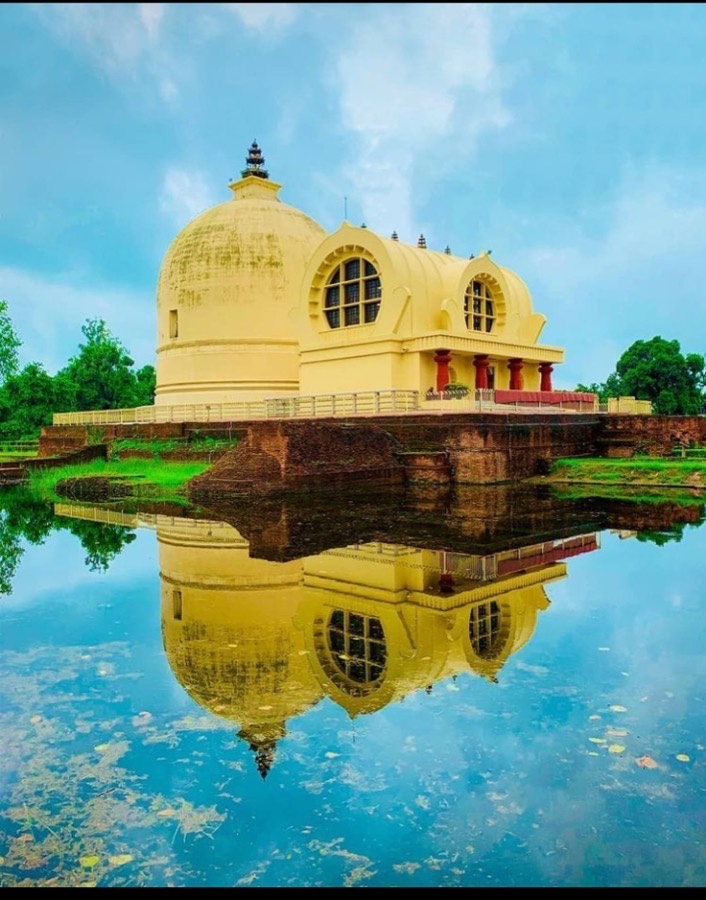
The Ramabhar Stupa, also called the Mukutbandhan Chaitya, is the cremation place: a giant stupa unearthed in 1910, with votive stupas and the remains of viharas around it, standing 1.5 km east of the temple on the Kushinagar–Deoria road 5.
The Matha Kuar shrine holds a three-metre seated Buddha, monolithic, carved from blue stone brought from Gaya, in the bhumisparsha mudra — the earth-touching gesture of the moment of awakening, which is a strange and moving thing to find at the site of the death. The inscription at its base dates to the tenth or eleventh century; the statue was found in 1876 and enshrined in its present temple-like structure in 1927 5.
Ashoka had built a stupa here and set a pillar to mark the parinirvana, which is why the evidence from the third century BCE already treats Kushinagar as an ancient place of pilgrimage — long before any sutta would have been written down 6.
The fourth place
The Mahaparinibbāṇa Sutta has the Buddha name four places a devout follower should commemorate as long as they live. Birth at Lumbini, enlightenment at Bodh Gaya, the turning of the wheel at Sarnath, and here 1.
Kushinagar and Lumbini became sister cities in 2022 8. The road between a birth and a death, formally twinned.
Three of those four once existed here as entries of about two hundred words each. This is the third to be rebuilt.
Sit with this
A teacher's greatest lesson can be the manner of his leaving.
Walk around the reclining image once in silence, then stand at the Ramabhar Stupa and try to hold in mind that everything burned here was divided among strangers.
Characters in this kathā
- the Buddha
- Ananda
- Cunda the smith
- Drona the Brahmin
- the Mallas of Kusinārā
- Archibald Carlleyle
Where this kathā lives
Source of this telling
Mahāparinibbāṇasutta (DN 16); Nidānasutta copper-plate deposit; Rhys Davids and Fleet on the relics
Further reading
- translated by Bhikkhu Thanissaro, Mahāparinibbāṇa Sutta (DN 16), translated from the Pali
- J. F. Fleet, The tradition about the Corporeal Relics of Buddha, 1906
- T. W. Rhys Davids, Asoka and the Buddha-Relics, 1901
- Alexander Cunningham, Four reports made during the years 1862-63-64-65, vol. 1 — Kusinagara, 1871
- Archaeological Survey of India, Sarnath Circle, Places in Kushinagar
- Lars Fogelin, An Archaeological History of Indian Buddhism, 2015
- D. R. Patil, Kusīnagara, 1981
- Kushinagar