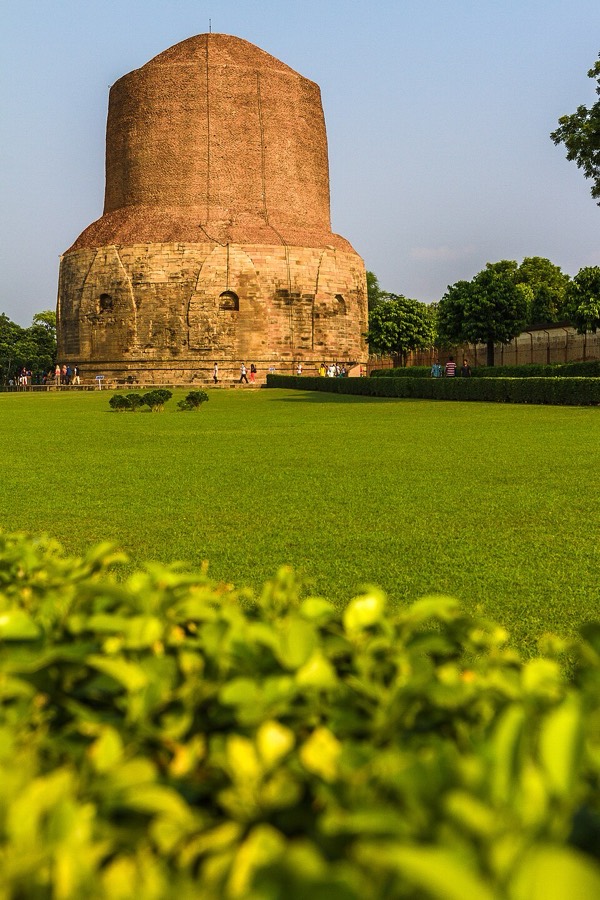
Sarnath — Where the Wheel First Turned
In a deer park outside Varanasi the awakened Buddha taught five companions, and the Sangha began. Ashoka raised a pillar whose four lions now crown India's emblem. What actually destroyed the city in 1194 is a question scholars still argue about.
The park with a name that means "the place holy men descended"
Sarnath sits about eight kilometres northeast of Varanasi, close to where the Ganges is joined by the Varuna 7. Its oldest name is not Sarnath at all. In Pali it is Isipatana; in Sanskrit, Rishipattana — from rishi, an accomplished or enlightened person — and both translate to roughly "the place where holy men descended" 16. The later name, Sāranganātha, means "Lord of the Deer," and it carries a story the tradition tells about itself: in a former birth the Bodhisattva was a deer, and when a king's arrow found a doe instead, the buck offered his own life in her place. The king then let the park become a sanctuary 7.
The Lalitavistara names the ground precisely — "Deer Park by the Hill of the Fallen Sages, outside of Varanasi" 7. It was here, after the awakening at Bodh Gaya, that the Buddha came to five men he had once practised austerities alongside: Kaundinya, Assaji, Bhaddiya, Vappa and Mahanama 2.
What was said, and to whom
The teaching is called the Dhammacakkappavattana — the setting in motion of the wheel of Dharma 2. In the account the tradition preserves, it was given to those five, and one of them saw its meaning as it was being spoken; the community that became the Sangha began there and then 2. This entry names the teaching and its recipients but does not reproduce its doctrine. That is a deliberate limit: a careless rendering of a central sacred text does more harm than no rendering, and the sutta's own verses were not followed line by line here.
The tradition dates the sermon to about 528 BCE, when the Buddha was roughly thirty-five 7. That date belongs to the tradition, and it deserves saying plainly. No independent source fixes the year, and the episode survives only in the texts of the Sangha itself. Worse, the chronologies in circulation do not agree on the shape of his life at all: the Sri Lankan long chronology puts his dates at roughly 624–544 BCE, an alternative long chronology at 567–487, an Indian short chronology at 448–368, and the so-called contemporary chronology at 563–483 8. A swing of a century and three-quarters sits between the earliest and latest of those. So 528 BCE is one tradition's reckoning, not a measured fact.
The pillar that became a republic's face
Ashoka marked the ground with a monolithic pillar, and what stood on it is the single most reproduced sculpture in India: four lions seated back to back on an abacus carved with dharma-wheels, and above them a wheel of thirty-two spokes 7.
The inscription he had cut into this pillar is not a devotional flourish. It is one of the Schism Edicts — the warning against dissent inside the Sangha, in the rolling administrative prose of the Mauryan edicts 51. That Ashoka placed an edict about the unity of the monastic community on the exact ground where that community began is either a coincidence or the most economical symbolism in Indian history 1. J. Ph. Vogel translated the Sarnath inscription and tentatively dated it to 249 BCE, while other work puts the Ashokan inscriptions of the site in a range of c. 241–233 BCE; the date is given here as a range because the sources do not agree 71.
The capital had fallen from the top of the pillar — the Sarnath article records the drop as forty-five feet, some fourteen metres — and it lay broken on the ground through the centuries until 1904–05, when Friedrich Oertel's team was working the ground between the Dhamek Stupa and the "Jagat Singh" stupa to its west 71. In March 1905 they exhumed the base and lower shaft of the pillar, still carrying the Schism Edict, together with the lion capital and the remnants of the dharmachakra that had sat above the lions 5.
The capital and the wheel went to the Sarnath Museum, where they remain. On 26 January 1950 the Lion Capital became the State Emblem of India; the wheel it carries went onto the flag, and a slightly different thirty-two-spoke version sits on the seal of the Supreme Court 7.
So the emblem is not a decorative borrowing. It is the actual object, lifted from this ground, and the wheel on it is the wheel of a teaching given to five people.
What the stone of this park actually says
Two inscriptions from the last Buddhist century of the site are worth more than any description of it. The first is Ashoka's, above. The second is a stone of the mid-twelfth century: the inscription of Queen Kumaradevi, consort of King Govindachandra, which takes credit for building or restoring living quarters for monks 16. It is the record of a Hindu royal house funding Buddhist monastic life — and, in the same text, it records Govindachandra protecting Varanasi against invaders it calls "Turushkas," a word for Turkish mercenaries 16.
The Kumaradevi inscription is very likely among the last things built at Sarnath before the destruction of 1194 1.
1194, and the argument about what caused it
The conventional account runs like this. In the winter of 1194–95, Muhammad of Ghor marched into the Ganges plain and his commander Qutb ud-Din Aibak led the vanguard to Varanasi and Sarnath; the cities were plundered 16. Hasan Nizami, the thirteenth-century Persian historian, records that nearly a thousand temples were destroyed and mosques raised on their foundations, and later chronicles add that Aibak carried off something in the order of fourteen hundred camel-loads of treasure 1. The Mahaviharas of the Ganges valley did not survive the century.
That account is widely repeated and it is not unchallenged. Giovanni Verardi's reassessment argues the opposite cause for the monasteries of this region: "the great monasteries of Gangetic India, from Sarnath to Vikramaśīlā, from Odantapurī to Nālandā, were not destroyed by the Muslims, but appropriated and transformed by the Brahmans with only the occasional intervention of the Muslim forces" 4. Federica Barba's review of Sarnath's own excavation evidence goes further and narrower: the Gahadavalas were building large Hindu temples on traditionally Buddhist ground and converting Buddhist shrines into Brahmanical ones; the evidence indicates Buddhists were expelled from Sarnath, and the site was in the process of becoming a Shiva temple compound before any Muslim army arrived 4.
This entry gives both positions and does not adjudicate between them, because the literature does not reconcile them. Readers should know that the sentence "Sarnath was destroyed in 1194" — which is what its guidebooks and, until now, its own previous entry said — is a simplification of an argument that is still live.
Six centuries, and what actually survived them
It was not six centuries of scrubland and a single stupa. Sarnath stayed on the map.
Sarnath continued to be a Jain pilgrimage site throughout. The seventeenth-century Jain text the Tirthakalpa, written in 1612, describes a Jain temple in Varanasi standing close to what it calls "a famous Bodhisattva sanctuary" at a place named dharmeksā — "pondering of the law," plainly the Dhamek Stupa 1. The Jain temple still standing, built in 1824, is about seventy metres southwest of the stupa 1.
Buddhist pilgrims from Tibet, Burma and Southeast Asia kept coming to this region from the thirteenth to the seventeenth centuries, though their principal destination was Bodh Gaya rather than Sarnath 1.
The modern rediscovery is also more complicated than a single dig. William Hodges, possibly the first British landscape painter to visit, saw the Dhamek in 1778 and mistook it for a ruined Hindu temple 1. In January 1794, workers dismantling a brick stupa for a local landholder found a green marble reliquary inside a sandstone box; Jonathan Duncan described it, the bones and pearls inside were thrown into the Ganges, and the reliquary itself has disappeared 1. Then in 1835–36 a twenty-one-year-old British Army engineer named Alexander Cunningham, who had studied the Chinese pilgrims Faxian and Xuanzang carefully, ran the first systematic excavations — and by 1836 he had established the identification 1.
That is the sequence worth holding on to, because it means the identification of Sarnath came from reading Chinese monks and digging, not from the site having been continuously known.
What stands there now
The Dhamek Stupa still marks the ground of the first teaching; it is the one structure that was never lost. Eight hundred metres outside the Deer Park, the Chaukhandi Stupa marks where the Buddha is said to have reunited with the five companions, and it is capped by an octagonal brick tower raised by Akbar in 1588 in memory of his father Humayun 5.
The Mulagandha Kuti Vihara marks where the Buddha spent his first rainy season. The present temple was built by the Maha Bodhi Society and opened in 1931, much of the money coming from the Hawaiian philanthropist Mary Robinson Foster, with Anagarika Dharmapala supervising the work; its interior carries frescoes by the Japanese artist Kosetsu Nosu, and a gilded replica of the fifth-century sandstone sculpture of the Buddha preaching his first sermon — the original of which was excavated at the site and is in the Sarnath Museum together with the Kumaradevi inscription 57.
Standing on the grounds of the Thai monastery is a Buddha image 24.3 metres tall, its scale inspired by the destroyed figures at Bamiyan; construction began in 1997 and it was unveiled in 2011 7. Monasteries in the national styles of the Buddhist world ring the archaeological area, and Sri Lankan, Thai, Tibetan, Japanese and Korean communities worship in the park daily 7.
Two caveats on what a visitor will read about the place. The Dhamek Stupa's height and diameter are given on Wikipedia as 39 m by 28 m, and Wikipedia itself flags that figure as needing a citation; no reliable measurement was located for this entry, so none is given 7. And the site's tourist totals, published by the Uttar Pradesh Tourism Department, put 2019 at 1,468,751 visitors, of which 336,136 were international 7.
The four places
The Mahaparinibbana Sutta — the long account of the Buddha's final journey — has him name four places a devout follower should commemorate as long as they live: where he was born, where he attained enlightenment, where he set the wheel turning, and where he entered total unbinding 3. Birth is Lumbini, now in Nepal. Enlightenment is Bodh Gaya. The wheel is Sarnath. The end of the journey is Kushinagar, three hundred kilometres to the north.
Three of those four once existed here as entries of about two hundred words each. The fourth was already longer.
UNESCO inscribed the ancient Buddhist site of Sarnath as a World Heritage Site in 2026, on criteria (iii) and (vi), with an area of 8.05 hectares and a buffer zone of 72.2 hectares 67.
Sit with this
One teaching given to five people under trees outlived every empire that tried to own it.
Circle the Dhamek Stupa once at dusk, then walk to the Chaukhandi tower and look back the way the Buddha walked in.
Characters in this kathā
- the Buddha
- Kaundinya
- Ashoka
- Qutb ud-Din Aibak
- Alexander Cunningham
- Friedrich Oertel
Where this kathā lives
Source of this telling
Dhammacakkappavattana Sutta; Mahaparinibbana Sutta (DN 16); Ashokan pillar and Schism Edict; Kumaradevi inscription
Further reading
- Frederick M. Asher, Sarnath: A Critical History of the Place Where Buddhism Began, 2020
- translated from the Pali by Bhikkhu Thanissaro, Dhammacakkappavattana Sutta (SN 56.11)
- translated from the Pali by Bhikkhu Thanissaro, Maha-parinibbana Sutta (DN 16), the Great Discourse on the Total Unbinding
- Giovanni Verardi, Hardships and Downfall of Buddhism in India, 2011
- Friedrich Oertel, Annual Report of the Archaeological Survey of India, 1904-05 — Sarnath excavations, 1908
- UNESCO World Heritage Centre, Ancient Buddhist Site, Sarnath, Varanasi, Uttar Pradesh — Tentative List 1096
- Sarnath
- Lumbini