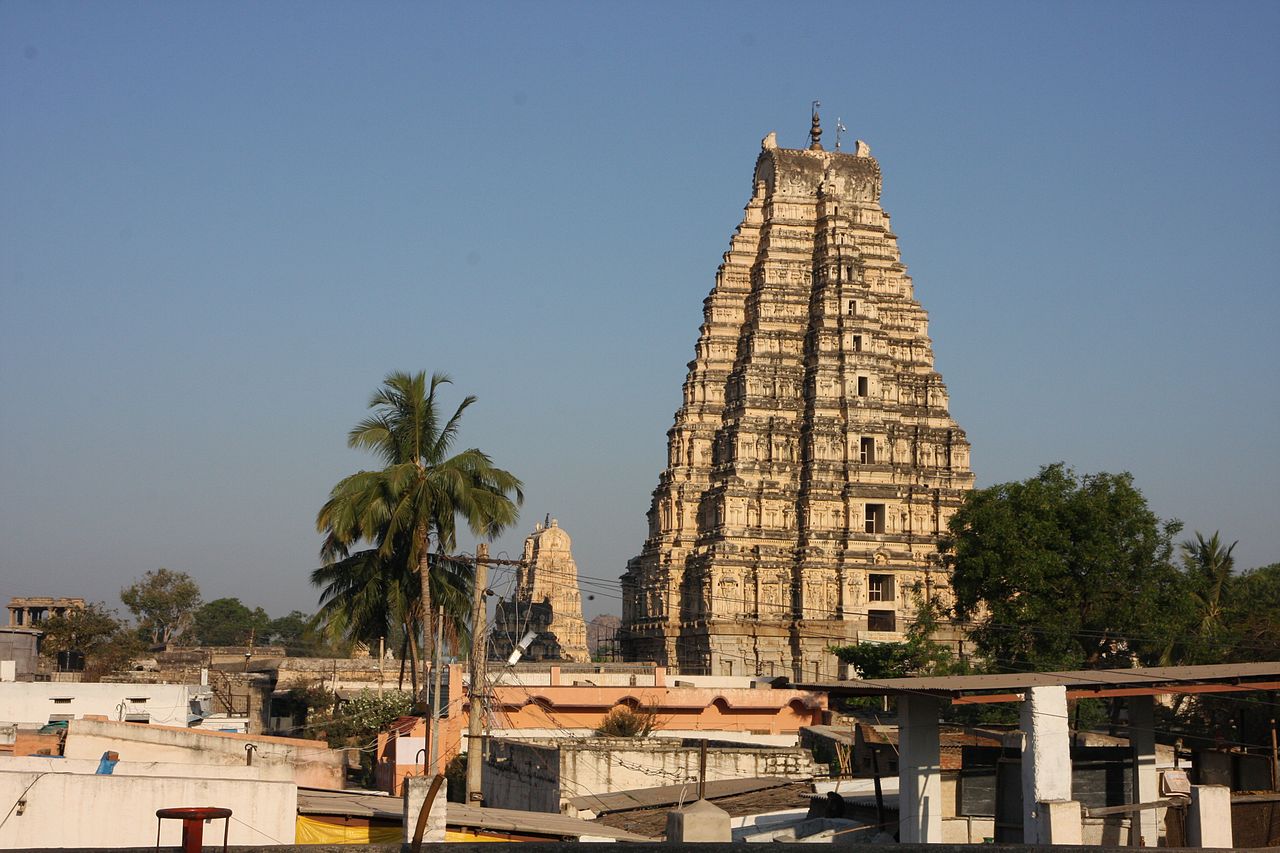
Virupaksha Temple — Hampi
HampiKarnataka
Earliest shrine c. 7th c. CE (Chalukya); major expansion under Vijayanagara (14th–16th c.); gopuram by Krishnadevaraya (1510 CE)
earth
A Temple Record

Virupaksha Temple — Hampi

Virūpākṣa — The Unblinking Eye of Śiva at Vijayanagara

HinduShaiva
Enter the Record
I.Overview

A Sacred Site

In Hampi, Karnataka, there stands Virupaksha Temple — Hampi — the Virupaksha Temple at Hampi is the oldest functioning temple in the Vijayanagara capital, continuously worshipped since at least the 7th century CE. Its 50-m gopuram dominates the ruins of Hampi — a UNESCO World Heritage Site and the last great Hindu empire of South India.

II.Architecture

The Built Form

Dravidian (Chalukya origin, Vijayanagara expansion)

1
Gopurams
50m
Height
0
5
Hectares

Vimana / Gopuram

Early Chalukya sanctum tower — modest compared to the towering gopuram

Sanctum Sanctorum

Chalukya-era garbhagriha at the western end — the oldest part of the complex (7th c. CE)

Mandapas · Halls

  1. Krishnadevaraya Mandapa

    Built by Krishnadevaraya in 1510 to commemorate his coronation — elaborately pillared hall for festive worship

  2. Ranga Mandapa

    Main worship hall in the inner courtyard

  3. Mukya Mandapa

    Primary pillared hall with Vijayanagara-style carved pillars

Sacred Tank

No major temple tank; the Tungabhadra river serves as the sacred water body

Enclosing Wall

Two concentric prakaras with colonnaded walkways; the outer prakara opens onto Hampi Bazaar

Construction Material

Granite (local Hampi boulder-stone), mortar, brick gopuram superstructure

Pinhole camera effect — light through an aperture in the gopuram projects an inverted image of the tower onto the inner wall; 700-m Hampi Bazaar was one of the greatest market streets of the medieval world

§Plan View

An architectural reading of Virupaksha Temple — Hampi — a top-down plan derived from the temple's recorded data.

Sacred TankKrishnadevaraya …Ranga MandapaMukya MandapaSanctumVimana 50mEast GopuramN
Legend
Gopurams (1)
Vimana & Sanctum
Mandapas (3)
Sacred Tank
Enclosing Wall
III.Timeline

Sacred Timeline

  1. Vijayanagara founding (1336 CE)

    Harihara I and Bukka Raya established the Sangama dynasty capital, with Virupaksha as the state deity

  2. Krishnadevaraya's coronation and gopuram expansion (1509–1510)

    The 50-m eastern gopuram and the Krishnadevaraya mandapa were built to commemorate his coronation and the Orissa campaign victory

  3. Battle of Talikota (1565 CE)

    Vijayanagara was sacked by the Deccan Sultanates; Hampi was plundered but Virupaksha was spared — it remains continuously worshipped to this day

  4. UNESCO World Heritage designation (1986)

    The Group of Monuments at Hampi was inscribed for its outstanding Vijayanagara architecture and landscape

  5. Purandara Dasa's composition of kīrtanas at Virupaksha (1540s)

    The Karnāṭa Vāggeyakāra (composer-saint) lived in Hampi and composed over 475,000 kīrtanas — the foundational corpus of Carnatic music — in the temple's shadow

IV.Elements

Sacred Elements

The colours, creatures, and offerings that mark this site.

Sacred Colours

saffron
white

Sacred Flowers

bilvachampakalotus

Sacred Creatures

Nandi (sacred bull)tiger (puli — South Indian Shaiva tradition)elephant (temple elephant processions)

Sacred Trees

tamarind (Hampi's iconic tamarind groves)bael (bilva)

Sacred Offerings

milk abhishekasandal pastebilva leavescoconut

Divine Mount

Nandi (sacred bull)
V.Patrons

Royal Patrons

  1. Krishnadevaraya (r. 1509–1529, Vijayanagara)

  2. Harihara I (r. 1336–1356)

  3. Deva Raya II (r. 1424–1446)

VI.Texts

Sacred Texts

  1. Virūpākṣa Pañcharātra (temple liturgy)

    Type: āgama

  2. Vijayanagara inscriptions (600+ at Hampi)

    Type: inscription

    Records of endowments, festivals, and market taxes

VII.Trade

Trade Routes

  1. Vijayanagara horse trade via Goa — Persian and Arabian horses imported through ports, traded inland through Hampi bazaar

  2. Tungabhadra river trade corridor — gold, iron, and cotton from the Ballari mines to the coast

  3. Hampi Bazaar: the temple street was one of the largest market streets in the medieval world — diamonds, rubies, silk, and spices

  4. Portuguese trade link via Goa (1510 CE onward) — Portuguese horses traded for Vijayanagara pepper and cotton

VIII.Festivals

Festivals & Celebrations

  1. Maha Shivaratri (Feb–Mar)

  2. Hampi Utsav (Nov) — Karnataka government cultural festival

  3. Purandara Dasa Aradhana (Jan–Feb) — birth anniversary of the Kannada composer-saint

  4. Chariot festival (annual ratha) — Virupaksha Ratha in Dec

X.Sacred Story

A Temple Record

An editorial reading of the site, woven from its architectural, historical, and scriptural data.

In Hampi, Karnataka, Virupaksha Temple — Hampi — a earliest shrine c. 7th c. ce (chalukya); major expansion under vijayanagara (14th–16th c.); gopuram by krishnadevaraya (1510 ce) site — the Virupaksha Temple at Hampi is the oldest functioning temple in the Vijayanagara capital, continuously worshipped since at least the 7th century CE. Its 50-m gopuram dominates the ruins of Hampi — a UNESCO World Heritage Site and the last great Hindu empire of South India.

§Historical Arc

The site is associated with the patronage of Krishnadevaraya (r. 1509–1529, Vijayanagara), Harihara I (r. 1336–1356) and Deva Raya II (r. 1424–1446). The earliest event recorded here is vijayanagara founding (1336 ce). Through the centuries, the temple witnessed purandara dasa's composition of kīrtanas at virupaksha (1540s). Harihara I and Bukka Raya established the Sangama dynasty capital, with Virupaksha as the state deity.

§Reading the Built Form

Built in the Built in the Dravidian (Chalukya origin, Vijayanagara expansion) tradition, the temple's 1 gopurams rise 50 metres into the sky the garbhagriha holds chalukya-era garbhagriha at the western end — the oldest part of the complex (7th c. ce) with halls named Krishnadevaraya Mandapa, Ranga Mandapa and 1 more . Pinhole camera effect — light through an aperture in the gopuram projects an inverted image of the tower onto the inner wall; 700-m Hampi Bazaar was one of the greatest market streets of the medieval world

Vijayanagara founding (1336 CE)
§A Visitor's Approach

01Walk the pradakshina path. Note the earliest event recorded here — vijayanagara founding (1336 ce).

02Look up. The vimana above the sanctum is the temple's vertical sermon — each tier a step toward the divine.

03Return during Maha Shivaratri (Feb–Mar), when the temple wears its festival form.

04The tradition here is hindu. Sit. Listen. The darshan is its own teaching.

§Practical Notes

Virupaksha Temple — Hampi

The Unblinking Eye of Śiva at Vijayanagara

The Virupaksha Temple at Hampi is the oldest continuously functioning temple in the Vijayanagara capital — a place of worship since at least the 7th century CE, when the earliest Chalukya shrine was built on this site. Its 50-metre eastern gopuram, erected by Krishnadevaraya after his 1509 coronation, dominates the ruins of a city that was once the second-largest in the world (after Beijing).

The name Virūpākṣa means "the one with oblique eyes" — a reference to Śiva's third eye, which sees beyond maya. The temple is built along the Tungabhadra river, at the foot of Hemakuta Hill, directly across from the elephant stables and the Queen's Bath — in the heart of what was the Vijayanagara sacred centre.

What Makes It Unique

  • Continuous worship for 1,300+ years — unlike every other Hampi monument, Virupaksha was never abandoned after the 1565 sack
  • The gopuram's pinhole camera effect — light passing through a small aperture in the gopuram projects an inverted image of the tower onto the inner wall of the temple — a pre-photographic demonstration of the camera obscura principle
  • Hampi Bazaar Street — the 700-metre temple street leading east from the gopuram was one of the greatest market streets of the medieval world, dealing in diamonds, rubies, silk, and Arabian horses
  • The temple elephant — Virupaksha still maintains a live temple elephant, Laxmi, who gives blessings daily

The Tiger, the Bull, and the Elephant

Śiva's vāhana at Virupaksha is Nandi (the sacred bull) — an indigenous Indian animal. But the Vijayanagara sculptors also depicted Śiva in his tiger-skin-clad Bhikshatana form, and the temple elephant participates in every ratha (chariot) festival. The Sanskrit siṃha (lion) was never native to the Tungabhadra basin; the apex predator here was the tiger (puli), and the Vijayanagara emblem itself was the boar-swordsman.

Trade and Empire

Hampi's position astride the Tungabhadra river trade corridor made it one of the wealthiest cities of the medieval world. Persian and Arabian horses — essential for the Vijayanagara cavalry — were imported through Goa and Bhatkal, then driven inland through the temple bazaar. The inscriptions record taxes on pepper, cotton, and iron from the Ballari mines. Portuguese traders (post-1510) established a factory in Hampi, exchanging horses for southern spices. Domingo Paes, the Portuguese chronicler who visited in 1520, wrote: "The city is as large as Rome and very beautiful to see."

Festivals

  • Maha Shivaratri — the principal festival of Virupaksha; the entire Hampi sacred zone becomes a pilgrimage site
  • Hampi Utsav (November) — the Karnataka government's cultural festival
  • Purandara Dasa Aradhana — the birth anniversary of the founding composer of Carnatic music, who lived and composed at Virupaksha
  • Annual chariot festival — the ratha processions through the 700-m bazaar street

The 1565 Sack — and Survival

After the Battle of Talikota (1565), the Deccan Sultanates looted Vijayanagara. Every monument in Hampi was vandalised — except Virupaksha. The temple's priests negotiated its survival by continuing pūjā through the sack. The temple has never ceased to be a living place of worship.

Standard Disclaimer

⚠️ This entry is REVIEWED — Advisory Council review pending.

Wisdom Graph: Divine Associations

Vāhana
Nandi (sacred bull)
Sacred animals
Nandi (sacred bull)tiger (puli — South Indian Shaiva tradition)elephant (temple elephant processions)
Sacred flowers
bilvachampakalotus
Sacred trees
tamarind (Hampi's iconic tamarind groves)bael (bilva)
Offerings
milk abhishekasandal pastebilva leavescoconut
Sacred colours
saffronwhite

📜 Primary Scriptural Sources

  • Virūpākṣa Pañcharātra (temple liturgy)āgama
  • Vijayanagara inscriptions (600+ at Hampi)inscription
    Records of endowments, festivals, and market taxes
