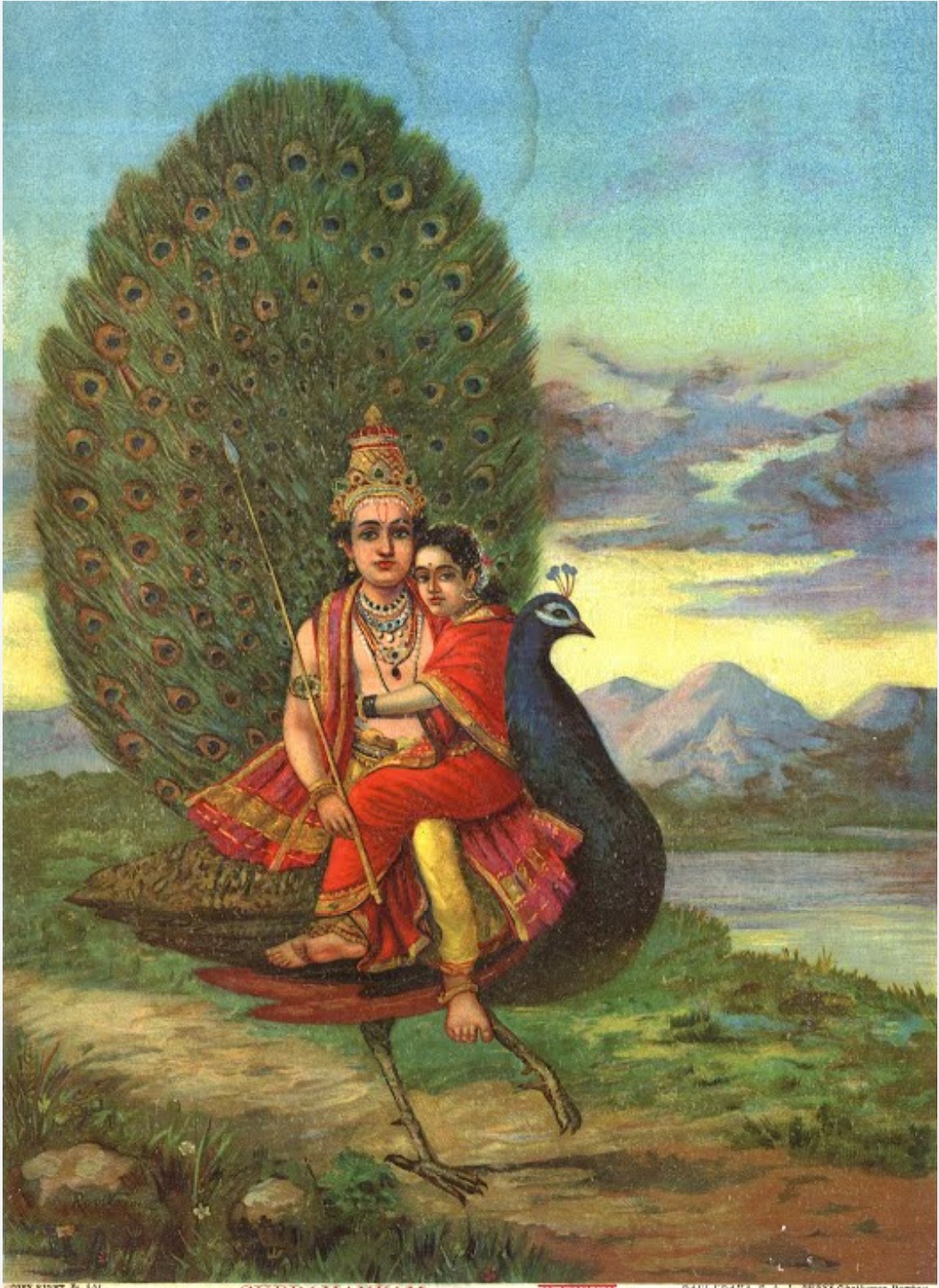
Sacred Facts · At a Glance
- Gender
- male
- Sacred Colours
- whiteredgold
- Sacred Offerings
- white lotus · vel (spear) · fragrant flowers · camphor
Primary Scriptures
3 sources- Skanda Purana (Tamil version)purana
- Kantapuranampurana
- Thevaram (Thevaaram) bhakti hymns
Devasenā — Indra's daughter
Tradition
Hindu / Shaiva / Murugan
Location
- Tirupparankundram, Madurai, Tamil Nadu (9.8803°N, 78.0789°E)
- Palani, Dindigul, Tamil Nadu (10.4500°N, 77.5200°E)
Sacred Narrative
Devasenā — the daughter of Indra — was the first consort of Murugan, given to him after his victory over Sūrapadman. She represents the celestial-orthodox path; Valli the earthly-popular path. Both consort-marriages are re-enacted annually at the 6 Padai Veedu. The divine wedding (Kalyanam) at Panguni Uthiram is the most celebrated festival at Tirupparankundram.
5-Period Timeline
Period 1 — Ancient / Vedic (c. 500 BCE–500 CE): Devasenā appears in the Vedas as a minor goddess, daughter of Vedic Indra. She is later elevated in the Puranic tradition as the consort of Skanda/Kartikeya/Murugan. The Skanda Purana develops her character as the celestial bride. The six Padai Veedu (six battle camps) temples are established in the early medieval period, with Tirupparankundram as the first.
Period 2 — Medieval / Pāla–Chola (c. 500–1500 CE): Under the Pāla dynasty of Bengal (8th–12th c.) and the Chola empire of Tamil Nadu (9th–13th c.), Murugan worship expands dramatically. The Kantapuranam by Kacciyappa Shivacharya (c. 12th c.) standardizes the Tamil Murugan mythology, establishing Devasenā and Valli as the two consorts. Inscriptions at Tirupparankundram record temple donations by Chola kings.
Period 3 — Colonial / Vijayanagara–Maratha (c. 1500–1850): The Vijayanagara empire (14th–17th c.) patronizes Murugan temples. The Madurai Nayak dynasty (16th–18th c.) builds the current gopuram at Tirupparankundram. Portuguese and British observers note the 'Vel' festival of Madurai. The temple's annual festival becomes a major regional event.
Period 4 — Modern / Colonial–Independence (c. 1850–1950): British gazetteers document the Tirupparankundram temple and its festival. The Indian National Congress and Swadeshi movement increase interest in Murugan as a Tamil nationalist symbol. The Kantapuranam is printed and widely distributed. Saiva saints' songs (Thevaram) are revived.
Period 5 — Contemporary (c. 1950–Present): Tirupparankundram becomes a major tourist and pilgrimage site. The annual festival draws thousands from across Tamil Nadu and Sri Lanka. Devasenā continues to be worshipped alongside Valli as Murugan's two consorts. The temple is declared a monument of national importance by the Archaeological Survey of India.
Temples
Thirupparankundram Murugan Temple — One of the six Padai Veedu (battle camps) of Murugan; Devasenā's main shrine. Rock-cut cave temple originally. Inscriptions record Chola and Pandya royal grants. Festival dates: Thai Poosami (January–February), Vaikasi Visakam (May–June).
Palani Murugan Temple — One of the six Padai Veedu. The hill temple is reached by foot or ropeway. Devasenā and Valli both have shrines here. Festival dates: Thai Poosami (January–February), Panguni Uthiram (March–April).
Festivals
Thai Poosami (January–February): Celebrates Murugan's victory over Surapadman. Devasenā is bathed, adorned, and placed beside Murugan for the final procession.
Panguni Uthiram (March–April): Celebrates the divine wedding of Murugan and Devasenā (Kalyanam). Car festival with the deity's processional images through the temple streets.
Vaikasi Visakam (May–June): Marks Murugan's birthday. Devasenā is prominently featured as his consort. The celestial wedding (Devasena Kalyanam) is re-enacted.
Sources
- Archaeological Survey of India inscriptions, Tirupparankundram (8th–10th c. CE) — Tier 1
- Skanda Purana (Tamil version), c. 5th–10th c. CE — Tier 1
- The Tamil Veda: A Study of the Kantapuranam, Thomas E. Pons, 1951 — Tier 2
- Murugan: The God of the Tamils, Kannan M., 2015 — Tier 2
- Madurai District Gazetteer, 1906 — Tier 3
Wisdom Graph: Divine Associations
- Offerings
- white lotusvel (spear)fragrant flowerscamphor
- Sacred colours
- whiteredgold
Worship Procedures
- Daily rites
- • Morning abhishekam (6 AM)• Morning darshan (7 AM–12 PM)• Evening archana (5–8 PM)• Night pallu (8 PM)
- Puja sequence
- Flowers (lotus, jasmine)
- Vel (spear) offering
- Camphor darshan
- Abhishekam with sandal paste
- Food offering (pongal, payasam)
- Vratas (vows / fasts)
- • Skanda Shashti fasting• Karthigai Deepam vow
Principal Temples
- Thirupparankundram Murugan Temple8th–10th c. CE (inscribed); 16th–17th c. Nayak additions📍 Tirupparankundram, Madurai, Tamil Nadu, IndiaFestivals: Thai Poosami (January–February) · Vaikasi Visakam (May–June)One of the six Padai Veedu (battle camps) of Murugan; Devasenā's main shrine here. Rock-cut cave temple originally. Inscriptions record Chola and Pandya royal grants.
- Palani Murugan Temple10th–12th c. CE📍 Palani, Dindigul, Tamil Nadu, IndiaFestivals: Thai Poosami (January–February) · Panguni Uthiram (March–April)One of the six Padai Veedu. The hill temple is reached by foot or ropeway. Devasenā and Valli both have shrines here.
Festivals
- Thai PoosamiJanuary–February (Thai month, Tamil calendar) · 10 daysCelebrates Murugan's victory over Surapadman. Devasenā is bathed, adorned, and placed beside Murugan for the final procession. Thousand-year tradition.
- Vaikasi VisakamMay–June (Vaikasi month) · 1 dayMarks Murugan's birthday. Devasenā is prominently featured as his consort. Celestial wedding (Devasena Kalyanam) is re-enacted.
- Panguni UthiramMarch–April · 10 daysCelebrates the divine wedding of Murugan and Devasenā (Kalyanam). Car festival with the deity's processional images through the temple streets.
Primary Scriptural Sources
- Skanda Purana (Tamil version)purana
- Kantapuranampurana
- Thevaram (Thevaaram) bhakti hymns
Sources & provenance
- 📜Primary sourceArchaeological Survey of India. Tirupparankundram inscriptions (8th–10th c. CE)
- 📜Primary sourceSkanda Purana (Tamil version) (c. 5th–10th c. CE)
- 🎓Scholarly sourceBookThomas E. Pons. The Tamil Veda: A Study of the Kantapuranam (1951)
- 🎓Scholarly sourceBookKannan M.. Murugan: The God of the Tamils (2015)
- 📖Supporting referenceGazetteerMadurai District Gazetteer (1906)






