Yakshini
Overview
Yakshinis are the female class of nature spirits, not an individual goddess with a
biography, a birth story or a home temple. Dowson's 1879 dictionary is unusually blunt
about how unsettled the term is, giving three separate senses under one heading: a
female yakṣa; the wife of Kubera; and a female demon or imp attendant on Durgā [S1].
That dispersion is itself the finding — the category is not one thing, and an entry
that smoothed it into a single goddess would be inventing coherence the sources do not
supply.
Identity & Iconography
The most consequential claim about yakshinis is iconographic: the female figure at the
foot of a tree, hand on the branch, is very often identified as a yakshini. Zimmer's
Myths and Symbols in Indian Art and Civilization is the study usually cited for the
stronger reading, that the young girl at the foot of the tree preserves an older tree
deity, the figure being derived from a tree-spirit rather than invented as a yakshini
[S2][S5]. Misra's independently documented point from the textual side runs the same
way: the elements of tree-worship run through the yaksha cult closely enough that a
deity in a tree can be identified as a yakṣa from its attributes, and tree-spirits and
yakṣas share the granting of wishes and a broadly similar mode of worship [S3].
Sacred Narrative
There is no single yakshini myth. What the class contributes to narrative is a
function rather than a story: the yakshini is the being who interrupts an ascetic, the
agent of the curse that ends a penance. Misra's survey of the epic and Tamil material
documents the same figure appearing as both the vengeful and the devoted — he cites
Tatakā as a violent yakṣi, and elsewhere benevolent yakṣas who wait upon Sūrya and
follow his chariot [S3]. Both poles are traditional; neither is the exception to the
other.
Scriptural Basis
The class is not confined to one stratum of scripture. Dowson places a yakshī beside
the yakṣa in the lexicon of the Purāṇic and epic corpus [S1], and Misra tracks the
class from the Kauśika Sūtra, where yakṣas appear among ill-omened portents, through the
Śūtras' half-god material to the epics [S3]. Where a human should go next is the
Kauśika Sūtra's own catalogue, which Misra cites as a source rather than quoting.
Worship Practice
The honest position is that this entry has no sourced worship practice to report. The
previous frontmatter claimed the "Puranas" as its only source, which was both
uncited and too narrow: Misra documents the class in the Sūtras, the Brāhmaṇas, the
epics and the Purāṇas alike [S3]. The widely circulated tantric material — the
thirty-six yakshinis of the Uddamareshvara Tantra with their mantras, and the
parallel list in the Tantraraja Tantra — has been deliberately excluded and
recorded in pending_facts instead. It reached this rewrite only through a Wikipedia
paragraph carrying an explicit citation-needed tag, and neither tantra was consulted.
Temple(s) / Seats
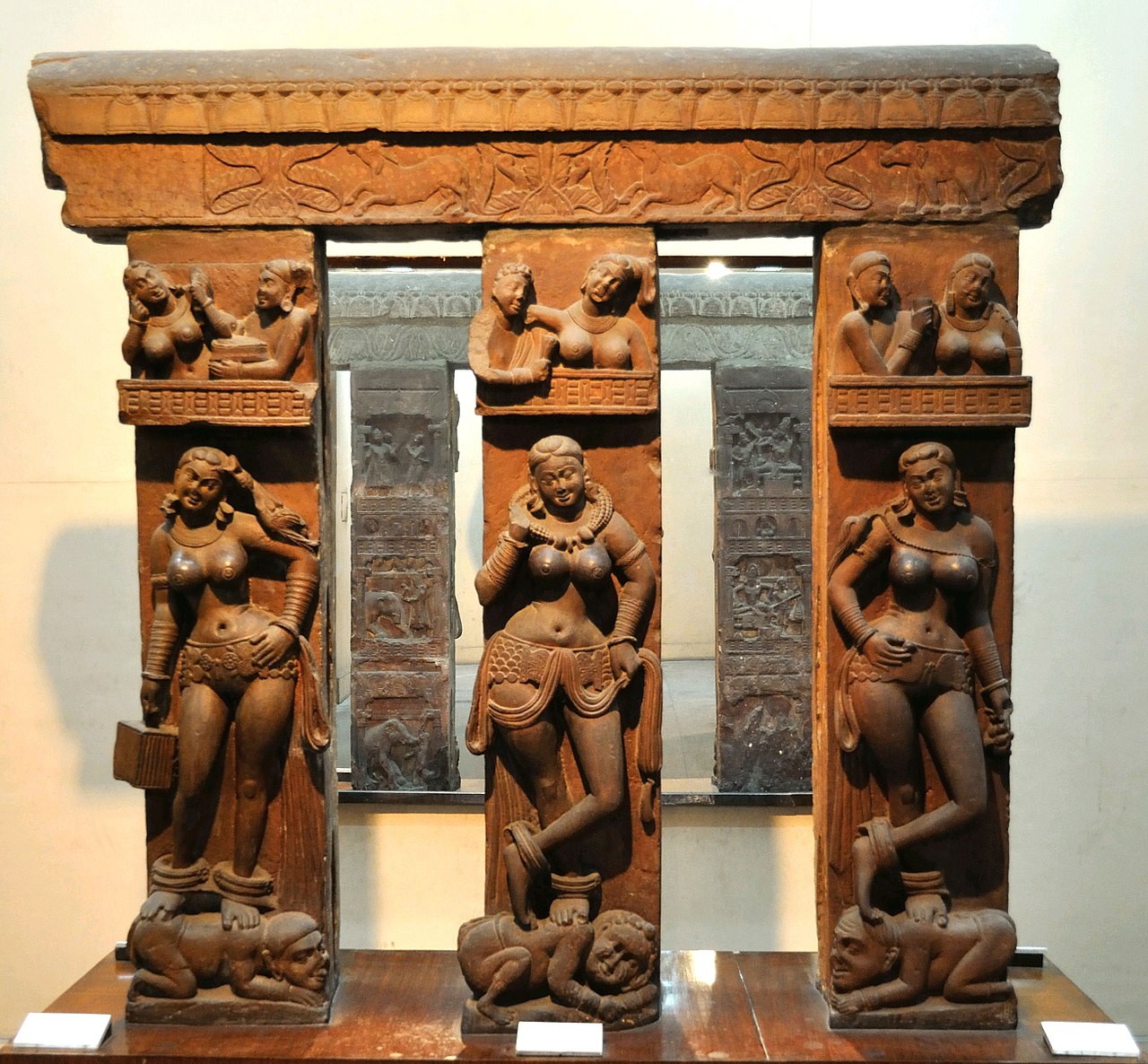
No seat of her own, and no founding legend, because none was sourced. The class appears
as a sculptural category, most characteristically as the free-standing female figure
of Mauryan date discussed by Misra, and later as a subordinate attendant rather than a
principal deity [S3].
Regional Forms
Misra documents the female figures in north and central Indian sculpture [S3]. The
Kerala and Tamil folk traditions, in which yakshinis appear frequently as malevolent,
are reported by the finding aid but were not checked against any source retrieved
here, and are therefore not described in this entry [S5]. The blanket
geographical_spread: All India has been withdrawn pending a real survey.
Known Limitations
Unverified frontmatter fields after this rewrite: geographical_spread. Zimmer 1946 is
the source of the tree-deity reading in the iconography section and was not
retrieved — it is paywalled, and is known here only as summarised by the finding aid,
so the claim is flagged rather than asserted [S2][S5]. One caution worth carrying: the
Huntington Archive catalogues the famous Didarganj object as a cauri-bearer, a
fly-whisk bearer, of about the third century BCE [S4]. Misra discusses that same
object as a yakshi and proposes an identification with Hārītī only as a hedged
possibility, noting that Hārītī's own iconic attributes are absent from the image [S3].
"Yakshi" is therefore a modern scholarly convention, not the museum's catalogue word,
and this entry does not treat the identification as settled. The Kerala legends and the
tantric lists are named in pending_facts precisely so that a later editor does not
mistake their absence here for evidence that they do not exist.
Sources
- [S1] Dowson, John. A Classical Dictionary of Hindu Mythology and Religion, Geography, History, and Literature. London: Trübner, 1879. https://archive.org/details/classicaldiction00dows_0 (retrieved 2026-09-29)
- [S2] Zimmer, Heinrich Robert. Myths and Symbols in Indian Art and Civilization. Princeton: Princeton University Press, 1946. DOI 10.1515/9781400866847. Record verified via Crossref; paywalled, not retrieved.
- [S3] Misra, Ram Nath. Yaksha Cult and Iconography. New Delhi: Munshiram Manoharlal, 1981. https://archive.org/details/69855 (retrieved and read in full, 2026-09-29)
- [S4] Huntington Library and Art Gallery, Huntington Archive ObjectID 3809: sculpture of a cauri-bearer, Didarganj, Maurya, ca. third century BCE, beige sandstone, H 162.50 cm, Patna Museum. https://web.archive.org/web/20060904160524/http://huntington.wmc.ohio-state.edu/public/index.cfm?fuseaction=showThisDetail&ObjectID=3809 (retrieved 2026-09-29)
- [S5] "Yakshini" (Wikipedia), revision 1376616530 — finding aid only. https://en.wikipedia.org/w/index.php?title=Yakshini&oldid=1376616530 (retrieved 2026-09-29)