Sacred Facts · At a Glance
- Vahana
- Garuda (eagle mount)
- Sacred Colours
- goldsaffron
Primary Scriptures
1 source- Nālāyira Divya Prabandhamstotra
Thiru Parameswara Vinnagaram
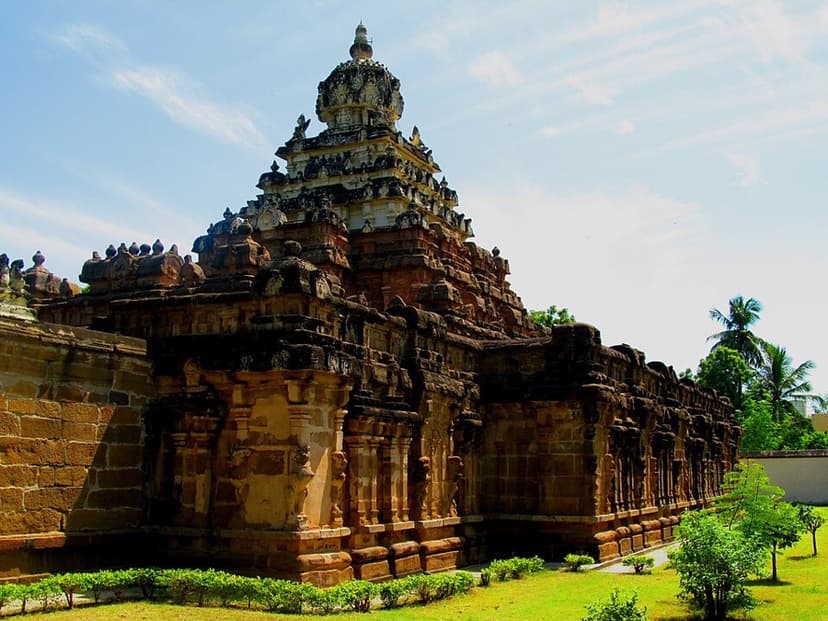
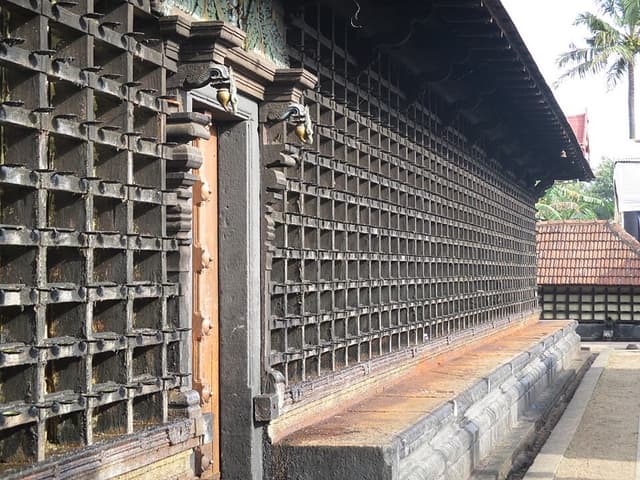
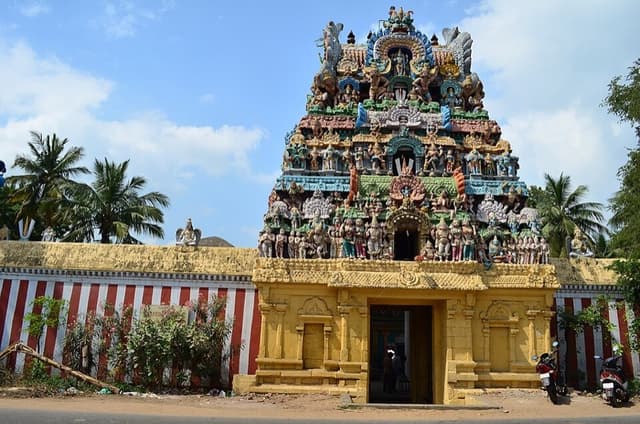
The Tiru Parameswara Vinnagaram — today generally called the Vaikunta Perumal temple — stands in Kanchipuram, the former Pallava capital, and is one of the 108 Divya Desams hymned in the Nālāyira Divya Prabandham. It is unusual in that collection for being a Viṣṇu temple inside a Śaiva capital city, and it is one of the few Divya Desams where the scholarly literature has read the building itself as a text.
Name
The shrine was originally Paramechuravinnagaram in Tamil and Vishnugriha in Sanskrit — "house of Viṣṇu". The name is a statement of claim: Kanchipuram was a Śaiva city, and a Viṣṇu temple of this standing inside it was not an accident of geography. Vinnagaram (விண்ணகம்) is a lexical rarity, essentially "the heavenly place", and it survives in the modern name.
Date — and what kind of date it is
The temple is attributed to Nandivarman II Pallavamalla (r. c. 731–800) and dated to the 8th century CE. That is a construction date for the Pallava phase, not for the building as it now stands.
This distinction is the one to hold onto. The complex was enlarged under the Cholas and again under the Vijayanagara Nayakas, and its most famous architectural feature is later than the Pallava core. A visitor standing in the prakara in 2026 is looking at a multi-century composite whose oldest fabric is eight hundred years old and whose most photographed elements are not.
The Pallava attribution rests on the temple's Tamil inscriptions — primary epigraphy that has not yet been transcribed into this entry and remains the single most important outstanding task for a guardian on this page.
Why scholars care about this temple
D. Dennis Hudson's monograph on the temple reads its iconography and layout as an architectural summa of the Bhāgavata Purāṇa — that is, as the physical building enacting a specific text rather than merely illustrating it. If that reading holds, the temple is not only a shrine but a doctrinal argument in stone, and it becomes a candidate for the kind of site the wider world treats as a monument in its own right rather than as one shrine among many in a crowded city.
This claim is the reason the entry is `` rather than REVIEWED. The
attribution and date are well supported; the interpretive claim depends on a monograph whose
full bibliographic details have not been confirmed here, and a reader should not be told the
temple "encodes the Bhāgavata Purāṇa" on the strength of a Wikipedia sentence. Confirm the
monograph, transcribe the inscriptions, and this page can be promoted.
Deity
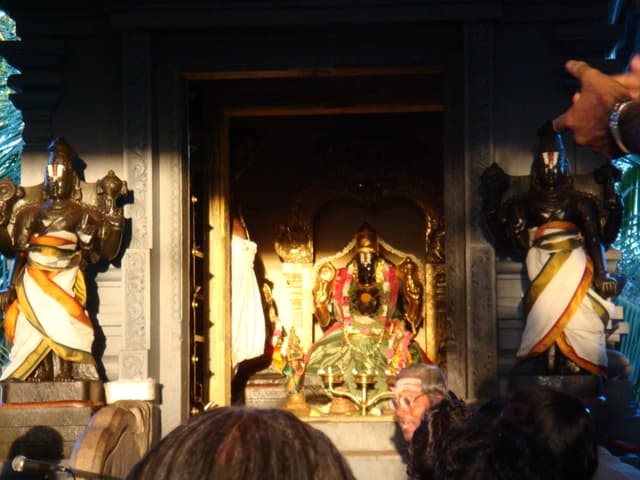
The presiding image is Vaikundanātha Perumal — Viṣṇu as Vaikunṭha, of the Vaikunṭa Perumāl Tīrttha legend associated with the foot-washing (padukā) at Tirupparkadal. The consort shrine holds Vaikunṭavallī Tāyār.
The Vaikunṭa form is worth a word for visitors who arrive expecting Rāma or Kṛṣṇa: this is Viṣṇu in his post-creation aspect, the one who has measured out the cosmos, and the temple's connection to a tīrtha tradition rather than a mūrti tradition is part of why its architecture resists easy description.
Region
The temple belongs to the Tondai Nadu division of the Divya Desam geography — the northwestern Tamil country around Kanchipuram that the early Āḻvārs worked. In a collection otherwise dominated by the Kumbakonam–Tiruchirappalli belt, it marks the southern edge of the Vaiṣṇava hymnic zone.
What this entry still owes
- The Pallava inscriptions transcribed and cited (highest priority — they are the primary evidence for the date).
- Hudson's monograph given a full citation.
- The Chola and Vijayanagara building phases separated from the Pallava core, with dates.
- The sthalapurāṇa of the Paramechuravinnagaram legend, which is told differently in different sources and should be recorded with both variants rather than merged.
- The Āḻvār pasuram for this shrine quoted in the original with translation.
Wisdom Graph: Divine Associations
- Vāhana
- Garuda (eagle mount)
- Sacred colours
- goldsaffron
Primary Scriptural Sources
- Nālāyira Divya Prabandhamstotra
Sources & provenance
- 📜Primary sourceWikipediaTiru Parameswara Vinnagaram — Wikipedia (permalink)Permalink to revision 1373637501 (2026-09-07). Used as a finding aid per SOURCES_POLICY rule 5; the dating below was taken from the sources Wikipedia itself cites, not from Wikipedia.Retrieved 2026-09-28View source →
- 📜Primary sourceBookD. Dennis Hudson. Monograph on the Vaikunta Perumal (Vishnugriha) temple, Kanchipuram — iconography and layout read as an architectural summa of the Bhagavata PuranaCited by the Wikipedia article as the detailed study of this temple. FULL BIBLIOGRAPHIC DETAILS STILL TO BE CONFIRMED against a library catalogue — author and subject are established, publisher/year are not yet verified. Do not treat as a finished citation.
- 📜Primary sourceOtherTamil inscriptions at Tiru Parameswara Vinnagaram (Pallava period epigraphy)The temple carries Tamil inscriptions; these are the primary evidence for the Pallava attribution and should be transcribed and cited in place of this note.
- 🎓Scholarly sourceOtherNālāyira Divya Prabandham (Āḻvār pasuram for Tiru Parameswara Vinnagaram)The hymns are the primary attestation that the shrine was venerated as a Divya Desam; they carry a devotional, not a constructional, date.