


.png/500px-Late_Vedic_Culture_(1100-500_BCE).png)

Sacred Facts · At a Glance
- Gender
- male
- Vahana
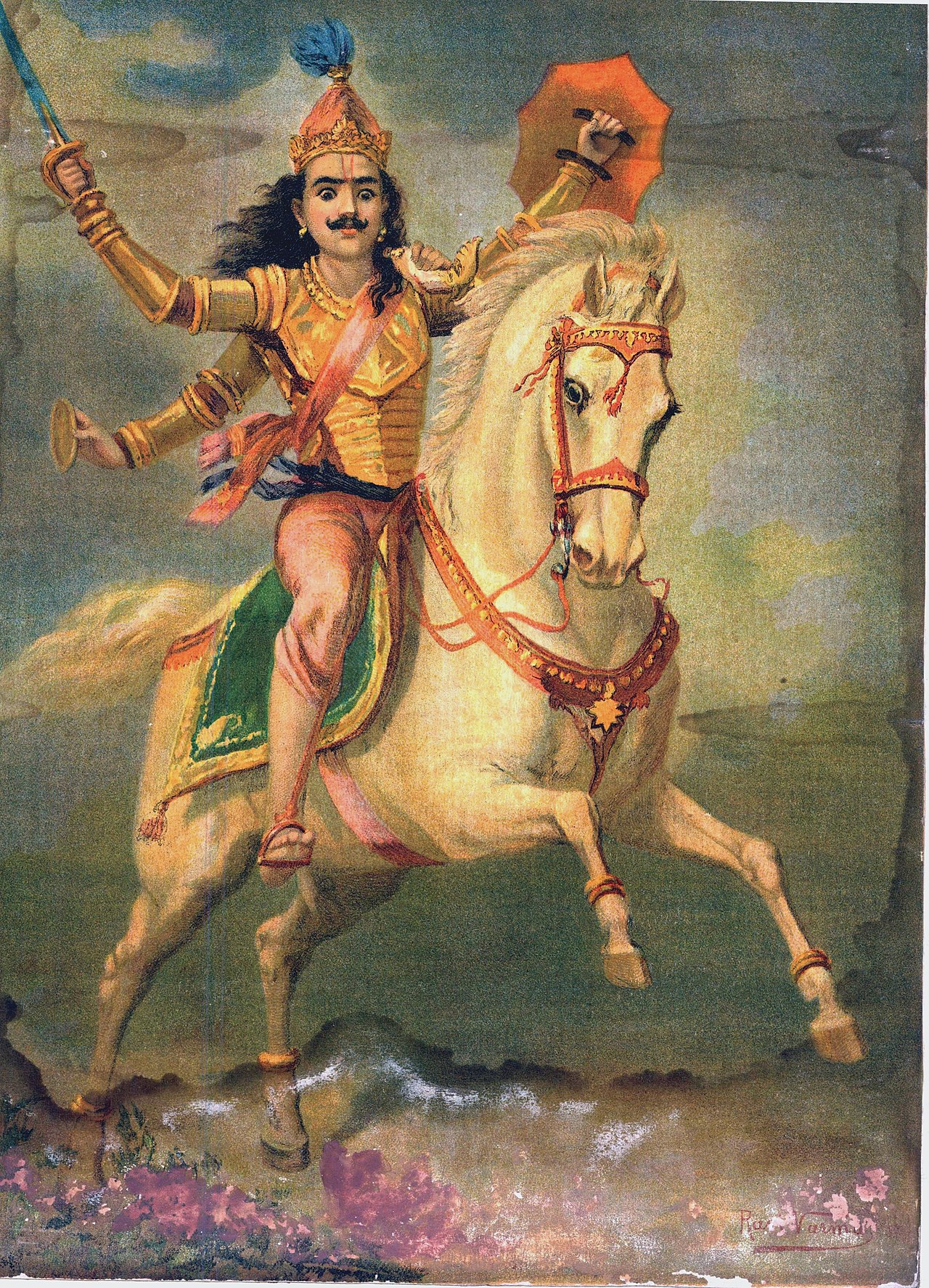
- Devadatta (celestial white winged stallion)
- Weapon
- Ratnamāru (blazing sword of cosmic discrimination) · Cakra (Sudarśana) · Dhanu (celestial bow)
- Element
- ether
- Sacred Colours
- radiant whiteblazing crimsonpure gold
- Sacred Flowers
- white lotus · parijata · red marigold
- Sacred Offerings
Primary Scriptures
3 sources- Mahābhārata (Vana Parva 190 — Markandeya's Prophecy)epicComposed c. 4th c. BCE – 4th c. CEThe foundational canonical prophecy: Sage Markandeya describes the moral decay of Kali Yuga, followed by the birth of Kalki in the village of Shambhala, riding a celestial horse and vanquishing falsehood to inaugurate Satya Yuga.
- Kalki Purāṇa (Chapters 1–35)puranaComposed c. 800–1200 CEComprehensive chronicle detailing Kalki's birth in Shambhala, his instruction under Chiranjivi Parashurama, his winged steed Devadatta, his sword Ratnamaru, and the global re-establishment of Vedic Dharma.
- Śrīmad Bhāgavata Purāṇa (Canto 12, Chapter 2)purana
Kalki: The Future Redeemer
Tenth Avatar of Vishnu, Restorer of Satya Yuga & Lord of Shambhala
Overview: The Metaphysical Foundation
Kalki (कल्कि — "destroyer of darkness and ignorance"), also rendered Kalkin, is the prophesied tenth and culminating descent (Daśama Avatāra) of Lord Vishnu. While the earlier nine avatars manifested in past epochs to address specific crises, Kalki represents the ultimate promise of eschatological renewal and cyclical hope in Sanatan Dharma.
According to the cosmological timeline of the Catur-Yuga system, the fourth age (Kali Yuga) is marked by the gradual erosion of righteousness, the rise of corruption in governance, the commercialization of truth, and spiritual amnesia. When moral degradation reaches its nadir, Vishnu descends not to end the world forever, but to clear away spiritual rot and usher in the pristine golden age of truth and harmony (Satya Yuga).
Canonical Scriptural Evolution across Millennia
1. The Mahabharata: Markandeya's Classical Prophecy
In the Mahābhārata (Vana Parva 190), Sage Markandeya details the precise circumstances of Kalki’s advent:
kalkir viṣṇuyaśā nāma dvijaḥ kālapracoditaḥ | utpatsyate mahāvīryo mahābuddhiparākramaḥ ||
prādurkariṣyati punar yajñān vidhividhānatān | sarvaśo dharmanirato brāhmaṇaiḥ parivāritaḥ ||
"A noble soul named Kalki, son of Vishnuyashas, impelled by time, will be born endowed with supreme heroism, intellect, and courage! He will rekindle the sacred sacrificial fires, uphold universal righteousness in all ways, and lead the community of the wise."
Markandeya foretells that upon his appearance, the clouds will shower auspicious rain, crops will flourish in abundance, human hearts will be cleansed of cruelty and greed, and the Krita (Satya) Yuga will instantly begin anew.
2. The Kalki Purana: The Epic Journey of the White Steed
The Kalki Purāṇa chronicles the detailed saga of his manifestation:
- Born in the peaceful village of Śambhala to the pious Brahmin couple Viṣṇuyaśas and Sumati.
- Journeying to the Himalayas, Kalki is instructed in the Vedas and military sciences by the immortal master Parashurama.
- Lord Shiva presents him with the indestructible celestial flying white horse Devadatta, the sharp, lustrous sword Ratnamāru, and the all-knowing parrot Śuka.
- Surrounded by virtuous allies, Kalki dismantles systemic tyranny across the globe and restores the Vedic way of life based on non-violence, truth, and devotion.
Century-by-Century Iconographic & Archaeological Record
ARCHAEOLOGICAL MILESTONES OF KALKI
c. 4th c. BCE ──► Mahabharata Vana Parva: Earliest recorded Kalki prophecy
c. 500 CE ──► Deogarh Dashavatara Temple: Gupta stone panel of Kalki beside steed
c. 1100 CE ──► Khajuraho & Hoysala Temples: Intricate sandstone & chlorite friezes
1739 CE ──► Jaipur Kalki Temple: Historic royal standalone temple by Sawai Jai Singh II
- Gupta & Medieval Dashavatara Friezes (5th–12th c. CE): Across monumental temples including the Deogarh Dashavatara Temple, Khajuraho Lakshmana Temple, and Belur Chennakeshava Temple, Kalki is sculpted as the tenth figure in the Dashavatara series, holding an unsheathed sword while standing proudly beside a caparisoned horse.
- Kalki Temple at Jaipur (1739 CE): Built by the astronomer-king Maharaja Sawai Jai Singh II, this unique double-storeyed marble and sandstone temple directly opposite the Hawa Mahal and City Palace was designed specifically to venerate the future avatar. In an open courtyard stands a beautifully sculpted white marble horse (Devadatta) with a carved depression on its left hind hoof, symbolizing the impending moment of the avatar's manifestation.
Sacred Temples & Shrines
| Temple Name | Location | Century | Significance |
|---|---|---|---|
| Kalki Temple | Badi Chaupar, Jaipur, Rajasthan (26.9244° N, 75.8286° E) | 1739 CE | World's premier standalone royal temple dedicated to Kalki; marble horse Devadatta. |
| Kalki Vishnu Mandir | Sambhal, Uttar Pradesh (28.5833° N, 78.5500° E) | Ancient / Historic | Ancient pilgrimage site revered as the geographical Shambhala of Puranic prophecy. |
Daily Practice & Chanting
- Kalki Gāyatrī Recitation:
Om Nārāyaṇāya Vidmahe Kalkirūpāya Dhīmahi | Tanno Kalkiḥ Pracodayāt || - Contemplation on Hope and Renewal: Reflect on the cyclical nature of time—remembering that darkness in human history is always transient, and the light of truth inevitably returns.\n
Wisdom Graph: Divine Associations
- Vāhana
- Devadatta (celestial white winged stallion)
- Sacred animals
- white horse (Devadatta)parrot (Shuka)
- Sacred flowers
- white lotusparijatared marigold
- Sacred plants
- tulasīdarbha grass
- Offerings
- white flowerschandanghee lampssaffron ricefragrant incense
- Weapons / emblems
- Ratnamāru (blazing sword of cosmic discrimination)Cakra (Sudarśana)Dhanu (celestial bow)
- Sacred colours
- radiant whiteblazing crimsonpure gold
🛕 Principal Temples
Sources & provenance
- 📖Supporting referenceOtherMahabharata
- 📖Supporting referenceOtherKalki Purana
- 📖