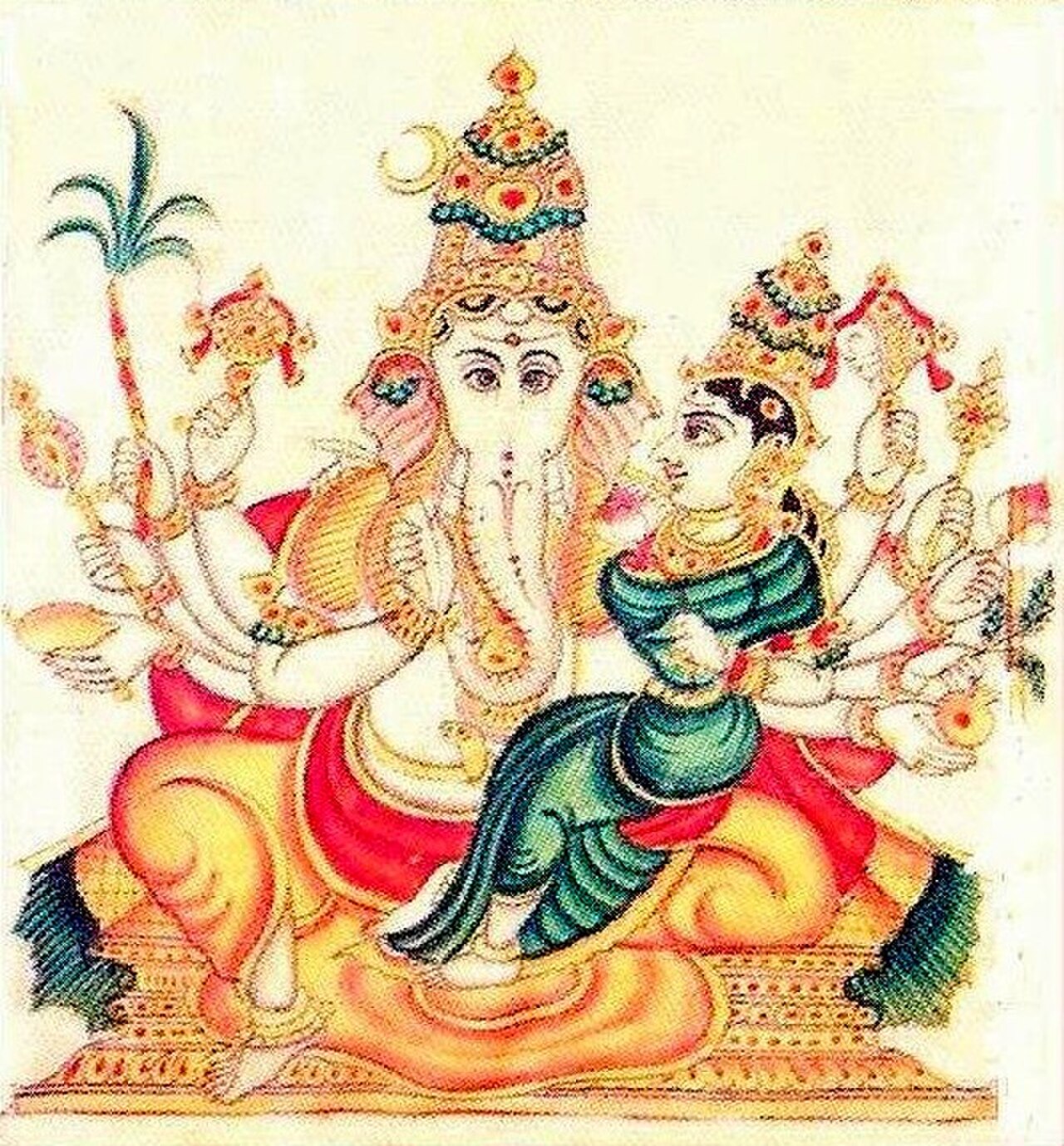





Sacred Facts · At a Glance
- Gender
- male
- Vahana
- Mūṣika (mouse)
- Sacred Offerings
- modaka · dūrvā · red hibiscus
Primary Scriptures
2 sources- Gaṇeśa Purāṇapurana
- Mudgala Purāṇapurana
Mahaganapati of Ranjangaon
The eighth Ashtavinayak
Mahaganapati is the Ganesha shrine at Ranjangaon, in Pune district, Maharashtra, on the bank of the Karha river in the country west of Pune and below the Bhimashankar hills. It is the eighth and final station in the traditional list of the Ashtavinayaks — the eight Ganesha temples of the Maharashtra-Konkan region, most of them in the Pune–Satara–Kolhapur belt — and it is a Maharashtrian institution in a way that distinguishes it from Ganesha shrines elsewhere in India. The list itself is not identical in every source; some versions include or exclude Moirang at Kolhapur and some differ on the position of Sangli, and a Maharashtrian family and its kasar devas have their own ordering. Do not present the popular list as the only one.
The deity's name carries the theology of the shrine. Mahaganapati is read as the great Ganapati of the preceding narrative cycle — the Ganesha who existed, and was worshipped, before the battle with Tripurasura, and who is addressed in that register as the one who was honoured at the beginning of the war. Ranjangaon's identity is therefore partly a claim to precedence, and the shrine's own literature makes that claim explicitly. It is also, in local tradition, one of the seats of the Pandava association: the five Pandava brothers are held to have established five Ganesha images, of which Ranjangaon is one, and the temple's setting places the sthalapuranam story at Bhimashankar as the background to Pandava presence in the valley.
The image
The most discussed feature of the shrine is its iconography. The inner or mahamurti is described as having ten trunks and twenty arms, a form normally kept out of public view, while the image carried in procession is a more ordinary two-armed one. Whether the ten-armed image has been continuously present since a specific historical foundation, or is a later elaboration of a simpler original, is not something the published summaries settle. A claim in an earlier version of this entry that the temple was built as "Chola-era solar-alignment architecture transplanted to Maharashtra" has been withdrawn: it attributes a south Indian architectural and ritual tradition to a Deccan shrine without a source, and should not be restored. What can be said is that the building is a late-medieval Deccan structure in the regional hemāpanti idiom, repeatedly repaired, and that its principal fame is ritual rather than architectural.
Sources and what is still unverified
This entry draws on Maharashtrian Ganesha tradition, the Ashtavinayak literature, and standard studies of the Deccan temple. A named Maharashtrian source should supply: the temple's own shilahara or later inscriptions and their dates; the Ashtavinayak list as held by the Ranjangaon kasar deva trust, including which eight they recognise; the history and provenance of the ten-armed image; and the current arrangements for the deity's sankalpa on the first and eleventh days of the bright fortnight, which is a distinctive feature of this shrine. The claims about Pandava foundation and about solar alignment should be presented as tradition until a dated source is produced. No dynastic attribution is asserted here.
Wisdom Graph: Divine Associations
- Vāhana
- Mūshika
- Offerings
- modakadūrvāred hibiscus
🛕 Principal Temples
- Mahaganapati Temple17th–18th c. CE📍 Ranjangaon, Pune, Maharashtra, IndiaFestivals: Ganesh Chaturthi · Māgha Śukla Caturthī
🎊 Festivals
- Bhadrapada (Aug–Sep) · 10 days
📜 Primary Scriptural Sources
- Gaṇeśa Purāṇapurana
- Mudgala Purāṇapurana
Sources & provenance
- 📜Primary sourceBookGaṇeśa Purāṇa
- 🎓Scholarly sourceBook