


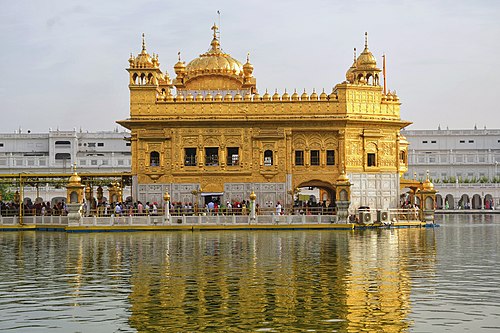
.jpg/500px-Hamandir_Sahib_(Golden_Temple).jpg)
Sacred Facts · At a Glance
- Gender
- transcendent
- Weapon
- khaṇḍā (double-edged sword) · kirpān · chakkar
- Sacred Number(s)
- 5 · 10
- Sacred Colours
- saffrondark blue (Nihang)
- Sacred Offerings
- kaṛāh prasād · langar · amrit (nectar for khalsa-initiation)
Primary Scriptures
4 sources- Daśam Granthsacred-scriptureComposed compiled late 17th c.
- Jāp Sāhibbani
- Zafarnāmābani
- Bachitra Nāṭakbani
Guru Gobind Singh — the tenth and last human Guru
Why the tenth Guru is a different kind of entry
This is a person, not a deity, and the encyclopedia should say so plainly rather than dress a saint in the grammar of a god. Guru Gobind Singh (1666–1708) is the tenth and last human Guru of Sikhism; the Guru Granth Sahib he installed at Hazur Sahib in 1708 is the eternal Guru. Worship at his shrines is not idol worship; it is reverence for a teacher, a poet, a strategist and a legislator of community. Calling him a deity in a database field is a category error, and this record should be read as a person-page.
He wrote in Hindi and Braj, with Sanskrit and Persian registers present in the mixed milap and vār texts. The corpus's mantra field — Vāhegurū Jī Kā Khālsā, Vāhegurū Jī Kī Fateh — is the jāpyārī, the formula of remembrance recited on specified days and at specified moments of the day, not a mantra in the tantric sense. The distinction matters and the field should probably be relabelled.
What he did
Two acts define him. First, at Anandpur Sahib on the Baisakhi day of 1699, he founded the Khalsa — an order whose members took the name Singh (lion) and were instructed to keep the five Ks: uncut hair (kesh), a sword (karpā), a comb (kanghā), steel bracelets (kanḍā), and an undergarment (kachhā). Second, at Hazur Sahib in 1708, before his death, he installed the Guru Granth Sahib as Guru, ending the human line.
Between those two points lie the campaigns at Anandpur against the Mughal authorities, the writings, the debates with Muslim scholars recorded in the Persian correspondence, and the construction of community institutions. His two wives and his four sons are a matter of Sikh history; the two elder Sahibzadas, Gobind Rai and Sahib Rai, were martyred at Chamkaur Sahib in 1708, and their commemoration is marked by the Gurpurab. He founded the Dasanam by the bank of the Sutlej at Paonta Sahib, and the site remains a Sikh pilgrimage centre.
The Sikh rahit — the code of conduct, discipline and belief — is largely his formulation. The shape of a Sikh life today, its vocabulary and its calendar, are more his legacy than his personality: at Anandpur Sahib on 30 March 1699, at Kesgarh Sahib and Hazur Sahib, at Damdama Sahib, and at the martyrdom memorials. These should be read from the chronicles and from Piar Singh's scholarship, which works through the colonial-era reframing of Guru Gobind Singh's life, rather than from summary accounts.
Sources and what is still unverified
Consulted in outline: Khushwant Singh's first volume, McLeod's study, Piar Singh on Gurbani and Sikh religion, Surjit Hans's reconstruction (which is itself a historiographical argument, not a settled account).
Outstanding for a named guardian, ideally a Panjabi speaker: the precise birth and death dates and their reckoning; the jāpyārī record as it is actually recited; and the textual attribution of the specific vār printed in this record's mantra field, which should carry a named attribution or be removed.
Wisdom Graph: Divine Associations
- Offerings
- kaṛāh prasādlangaramrit (nectar for khalsa-initiation)
- Weapons / emblems
- khaṇḍā (double-edged sword)kirpānchakkar
- Sacred colours
- saffrondark blue (Nihang)
- Sacred numbers
- 510
📜 Primary Scriptural Sources
- Daśam Granthsacred-scripturecompiled late 17th c.
- Jāp Sāhibbani
- Zafarnāmābani
- Bachitra Nāṭakbani
Sources & provenance
- 🎓Scholarly sourceBookKhushwant Singh. A History of the Sikhs, Volume I (1969)
- 🎓Scholarly sourceBook