.jpg/1280px-Kallazhagar_(31).jpg)




Sacred Facts · At a Glance
- Gender
- male
Primary Scriptures
0 sourcesNo primary scriptures are catalogued for this entry yet. If you know of scriptural references we have missed, please contribute them.
Kallazhagar
The Handsome Lord of Thirumaliruncholai
Kallazhagar (Tamil: கள்ளழகர்; also Azhagar, Alagar, or Paramaswamy) is Vishnu as the presiding deity of Thirumaliruncholai — the forested hill-temple at Alagar Koyil, 21 km northeast of Madurai. He is counted among the 108 Divya Desams, the canonical Vaishnava pilgrimage sites celebrated in the 7th–9th century hymns of the twelve Alvar saints. Thirumaliruncholai appears in Periyalvar's and Andal's corpus and receives particularly effusive treatment in Tirumangai Alvar's Periya Tirumoli.
Why "Kal"-Azhagar?
The prefix kal (கள்) — which can mean "stone," "toddy," or, more pertinently in Tamil folk etymology, "thief" or "trickster" — is explained two ways. The vernacular reading treats Kallazhagar as "the Beautiful One who steals [hearts]" or "the Stone Beautiful One," referring to the black-stone mula-vigraha in the sanctum. The ritual reading, reinforced in the Chithirai cycle, casts him as the brother who "runs away with" the invitation to his sister's wedding and, through his theft, with the devotion of pilgrims lining the Vaigai.
Relationship to Meenakshi: the Chithirai wedding cycle
In Madurai's composite festival calendar, Kallazhagar is the elder brother of Meenakshi. During the 12-day Chithirai Thiruvizha (see entry), day 10 is the Azhagar Vaigai Ezhuntarulutal — Kallazhagar sets out on his ceremonial horse from Alagar Koyil to bless his sister's wedding in Madurai, arrives at the Vaigai on the morning of the Purnima, and is informed that the wedding has already concluded. In some versions he refuses to enter the city; in others the river itself rises to prevent his crossing. He displays his ten avatars at the Karuparayar Mandapam on the Vaigai banks and returns home. Paul Younger (2002) reads the ritual as the Nayak-era formalisation of a much older act of communal theatre that joins the Shaiva and Vaishnava populations of Madurai into a single ceremonial economy.
The temple
The shrine at Alagar Koyil is hill-set, inside a dense sacred grove; it is one of few Vaishnava Divya Desams that is not an urban tank-temple. The complex includes the Kalyana Mandapam (where Kallazhagar rests on his return from Madurai), the Karuparayar Mandapam, and a Kartikeya shrine at the hill's base known as Pazhamudir Cholai, itself one of the Arupadai Veedu (six abodes) of Murugan — meaning Alagar Koyil functions as a twin Vaishnava-Murugan site. The temple is administered by the Tamil Nadu HR&CE.
Iconography
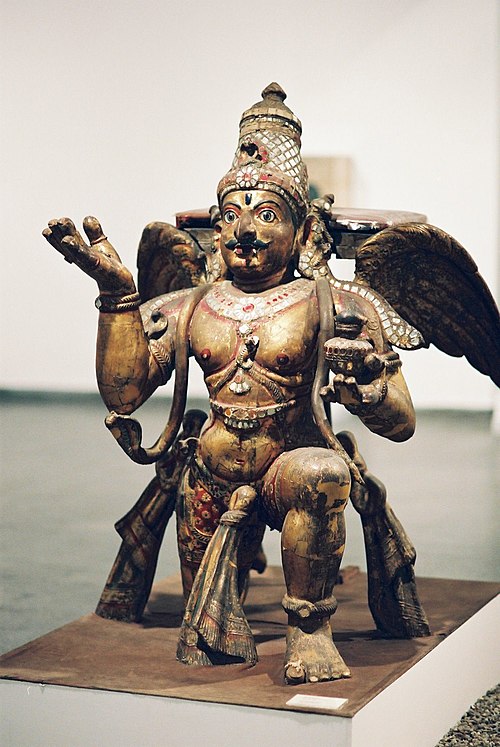
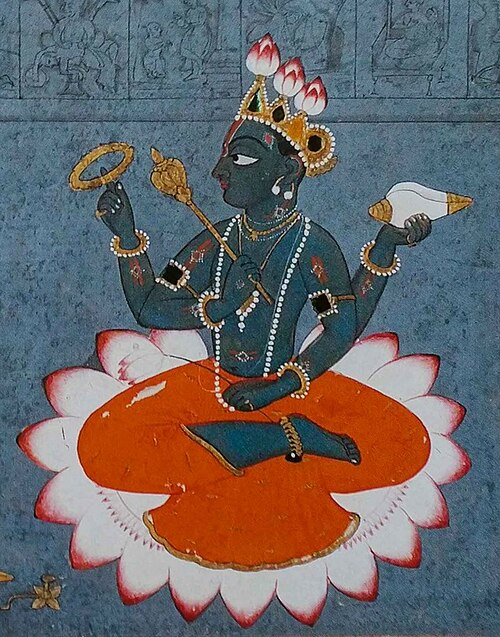
The mula-vigraha is a black-stone standing Vishnu with four arms — shankha and chakra above, gadā and lowered hand below — roughly 6 feet in height. The utsava-murti used in procession is bronze, cast in Vijayanagara-Nayaka idiom, and the processional horse (the kudirai-vahana used for the Chithirai ride) is one of the iconic visual objects of the Madurai cycle: it is ritually decorated with sola-pith armour and climbs into the Vaigai as its central event.
Why this entry matters
Kallazhagar anchors the Vaishnava side of the Madurai pilot cluster, shows how a single district supports both an urban Shakta-Shaiva complex and a wilderness Vaishnava complex, and demonstrates why festival geography — not temple count — is the right census unit: the Chithirai ritual binds Meenakshi, Sundareswarar, and Kallazhagar into a single inter-temple system that no atomised entry can capture.
Sources & provenance
- 📜Primary sourceBookVasudha Narayanan. The Vernacular Veda: Revelation, Recitation, and Ritual (1994) pp. 38–94University of South Carolina Press; on Alvar geography including Thirumaliruncholai
- 📜Primary source