



Sacred Facts · At a Glance
- Element
- fire
Primary Scriptures
0 sourcesNo primary scriptures are catalogued for this entry yet. If you know of scriptural references we have missed, please contribute them.
⚠️ CONTENT VERIFICATION STATUS: This draft is . All citations require validation.
Judaism (Yahadut)
Section 1: Overview
[BEGINNER]
Judaism is one of the world's oldest religions — over 3,000 years old — and the foundational tradition of Western monotheism. It is the religion of the Jewish people, who trace their origins to Abraham, Isaac, and Jacob, and to the covenant God made with them at Mount Sinai.
The core of Judaism is a relationship with Yahweh (often called Adonai, "Lord") — the one God who created the universe, chose the Jewish people as a "kingdom of priests and a holy nation" (Exodus 19:6), and gave the Torah (Teaching/Law) at Mount Sinai.
Judaism teaches:
- One God: The creator of all, who is transcendent, just, and merciful
- Covenant: God chose Abraham and his descendants to be in a special relationship; the Torah is the expression of this covenant
- Torah: The first five books of the Hebrew Bible (the Written Torah), plus the Oral Torah (Mishnah and Talmud)
- Mitzvot (Commandments): 613 commandments guide Jewish life; they cover ethical behavior, ritual practice, and civil law
- Ethics: Judaism emphasizes action — how you live matters; charity (tzedakah), justice, and compassion are central
Judaism is not primarily about belief — it is about practice and relationship. A Jew is defined by mother's Jewish identity (in mainstream Judaism) and by practice, not solely by belief.
The Jewish sacred year centers on:
- Shabbat (Sabbath): Weekly day of rest, from Friday evening to Saturday evening
- Rosh Hashanah (New Year) and Yom Kippur (Day of Atonement)
- Passover (Pesach): Liberation from Egypt
- Shavuot: Receiving the Torah
- Sukkot: Festival of Booths
[INTERMEDIATE]
Major Branches of Judaism Today
Orthodox Judaism (~10% of Jews worldwide): Maintains strict adherence to Jewish law (Halacha) as derived from the Torah and interpreted by rabbinic tradition. Includes:
- Modern Orthodox: Integration of traditional observance with modern life
- Haredi (Ultra-Orthodox): Separate from modern life; includes Hasidic Judaism (mystical)
Conservative Judaism (~15%): Committed to Jewish law but allows flexibility in application; originated in 19th-century Germany as "Historical Judaism."
Reform Judaism (~30% in the US): Emphasizes ethical monotheism over ritual law; originated in 19th-century Germany as "Liberal Judaism."
Reconstructionist Judaism (~5%): Views Judaism as an evolving religious civilization; emphasizes community and ethics over law.
Jewish Denominational Diversity
The differences between denominations concern how much authority is given to Halacha (Jewish law):
- Orthodox: Halacha is binding
- Conservative: Halacha is authoritative but can be adapted
- Reform: Halacha is guidance, not obligation
- Reconstructionist: Judaism is a "evolving religious civilization"
Section 2: Origin & History
[BEGINNER]
The Patriarchal Period (c. 1800–1500 BCE)
Abraham, the father of Judaism, is traditionally dated to c. 1800 BCE. According to the Bible, God called Abraham to leave his homeland and go to Canaan. God made a covenant with Abraham: "In you all the families of the earth shall be blessed" (Genesis 12:3). Abraham's son Isaac, and Isaac's son Jacob (later renamed Israel), continued this tradition.
The Exodus and Sinai (c. 1250–1200 BCE)
According to the Bible, the Israelites (descendants of Jacob) were enslaved in Egypt. God sent Moses to free them. At Mount Sinai, God gave Moses the Torah — including the Ten Commandments — and entered into covenant with Israel. The Mishnah (Avot) says: "Moses received the Torah at Sinai and transmitted it to Joshua, Joshua to the elders..." (m. Avot 1:1).
The Monarchy and Prophecy (c. 1000–586 BCE)
King David (c. 1040–970 BCE) established Jerusalem as the capital. His son Solomon built the First Temple. After Solomon, the kingdom split into Israel (north) and Judah (south). In 722 BCE, the Assyrians destroyed Israel; in 586 BCE, the Babylonians destroyed Jerusalem and the First Temple, and exiled Judah's elite to Babylon (the Babylonian Exile).
The Second Temple, Rabbinic Judaism, and Dispersion (586 BCE – 70 CE)
After the Persian conquest of Babylon (539 BCE), Jews returned to Jerusalem and rebuilt the Temple (515 BCE). This period saw the development of Jewish sects (Pharisees, Sadducees, Essenes, Qumran community). In 70 CE, the Romans destroyed the Second Temple after a Jewish revolt. In 135 CE, after the Bar Kokhba revolt, rabbinic Judaism emerged under the leadership of Yohanan ben Zakkai, who established the Yeshiva at Yavneh.
Rabbinic Judaism — based on the Written Torah (the Hebrew Bible) and the Oral Torah (interpreted in the Mishnah and Talmud) — became normative. Jews dispersed (galut) throughout the Mediterranean and Middle East.
Section 3: Sacred Texts
[BEGINNER]
The Hebrew Bible (Tanakh)
The Hebrew Bible, called the Tanakh (from the initials of its three divisions), comprises:
- Torah (Instruction/Pentateuch): Genesis, Exodus, Leviticus, Numbers, Deuteronomy — attributed to Moses; the most sacred text
- Nevi'im (Prophets): Joshua, Judges, Samuel, Kings, Isaiah, Jeremiah, Ezekiel, and the Twelve Minor Prophets
- Ketuvim (Writings): Psalms, Proverbs, Job, Song of Songs, Ruth, Lamentations, Ecclesiastes, Esther, Daniel, Ezra-Nehemiah, Chronicles
The Talmud
The Talmud (from Hebrew "to learn") is the massive body of rabbinic commentary on the Mishnah. It exists in two versions:
- Babylonian Talmud (Talmud Bavli): Completed c. 600 CE; more authoritative
- Jerusalem Talmud (Talmud Yerushalmi): Completed c. 400 CE
The Talmud contains legal discussions (halacha), ethical teachings (aggadah), stories, and debates. It is studied daily in traditional Jewish communities.
The Siddur
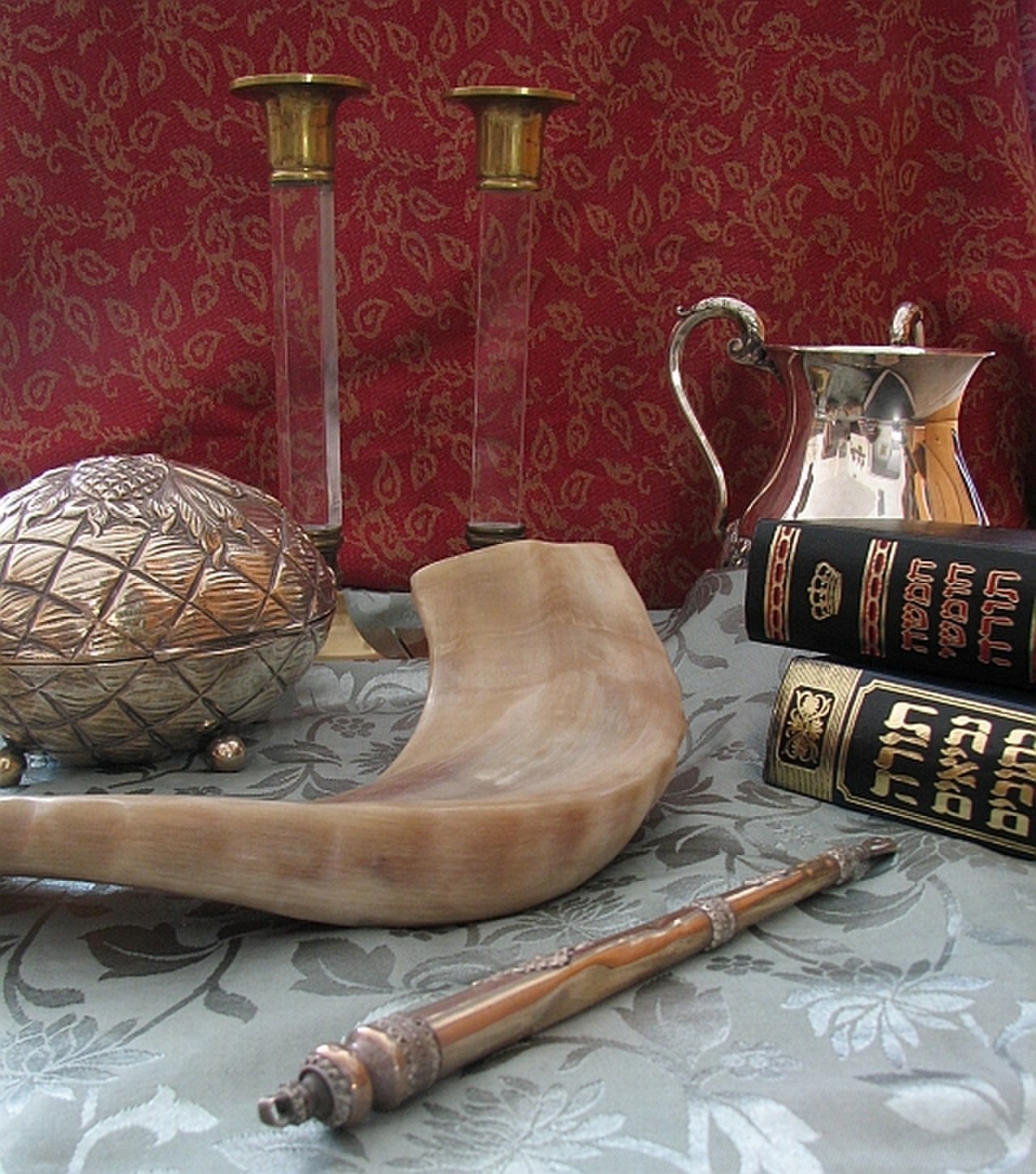
The Siddur (from Hebrew "order") is the Jewish prayer book, containing prayers for daily, Shabbat, and festival use. It includes the Amidah (the core prayer, also called the Shemoneh Esreh — "Eighteen Blessings"), the Shema (Deuteronomy 6:4–9), and much more.
Section 4: Daily Practice & Ritual
[BEGINNER]
Shabbat: The Weekly Day of Rest
Shabbat begins Friday evening ( sunset) with the Kabbalah Shabbat service and ends Saturday evening after three stars appear. Observances include:
- No work (melacha) — 39 categories of creative work prohibited
- Lighting two candles (at least) before sunset Friday
- Reciting Kiddush (blessing over wine) Friday night
- Sharing a festive meal ( Challah bread)
- Attending synagogue services
- Resting from electronic devices, driving, business
Daily Prayers
Traditional Jews pray three times daily:
- Shacharit (morning)
- Mincha (afternoon)
- Ma'ariv (evening)
Prayers are recited from the Siddur, with the Amidah (standing prayer) at the core.
Kashrut: Dietary Laws
Kashrut (from Hebrew "fit, proper") includes:
- No pork (pig is non-kosher)
- No shellfish
- No mixing of meat and dairy
- Animals must be slaughtered humanely (shechita)
- Blood must be drained from meat
Kosher certification is required for packaged foods.
Practices you can explore today:
-
Shabbat Candles: Light two candles on Friday evening (if appropriate) and say the blessing: "Baruch atah Adonai Eloheinu Melech ha-olam, asher kid'shanu b'mitzvotav v'tzivanu l'hadlik ner shel Shabbat." This invites peace into the home.
-
Tzedakah: Judaism teaches that caring for the poor is a religious obligation (mitzvah). Give tzedakah (charity) today — even a small amount.
-
Study of Hebrew: Hebrew is the language of Jewish prayer. Spend 10 minutes learning the aleph-bet (alphabet) if you have access to a Hebrew primer.
Section 5: Living Tradition Today
[BEGINNER]
Jewish Population
- World Jewish population: ~15 million
- Israel: ~7 million
- United States: ~6–7 million
- Europe: ~1 million
- Other: ~1 million
Major Jewish Movements:
- Orthodox (~10%): Strict Halacha adherence
- Conservative (~15%): Moderate; halakhic but flexible
- Reform (~30% in US): Liberal; ethics over law
- Reconstructionist (~5%): Evolutionary; civilizational view
Hasidic Judaism
A mystical movement founded by Israel ben Eliezer (the Baal Shem Tov, 1698–1760) in Ukraine. Hasidism emphasizes:
- Joy in serving God
- The saintliness of the rebbe (spiritual leader)
- Outreach to ordinary Jews
Major Hasidic dynasties: Chabad-Lubavitch, Breslov, Satmar, Ger, Viznitz.
Contemporary Issues:
- Anti-Semitism and security concerns
- Intermarriage and Jewish continuity
- Israel-Diaspora relations
- Jewish responses to modernity
- Bioethical questions (genetics, end-of-life)
- Environmental ethics
Prominent Jews:
- Moses Mendelssohn (1729–1786): Jewish Enlightenment
- Franz Kafka (1883–1924): writer
- Albert Einstein (1879–1955): physicist, humanitarian
- Elie Wiesel (1928–2016): Holocaust survivor, Nobel laureate
DivineLens presents perspectives from within this tradition, curated for authenticity. For personal spiritual direction, advanced study, or questions about tradition-specific practice, we recommend finding a qualified teacher in Judaism. Our Advisory Council reviews all content for theological accuracy.
Known Limitations
- Citations require verification.
- The internal diversity of Judaism (Orthodox, Conservative, Reform, Hasidic, etc.) is simplified.
- The Holocaust's impact on Judaism is barely addressed.
- Jewish mysticism (Kabbalah) is underexplored.
- Contemporary political issues (Israel, antisemitism) are sensitive.
Recommended reviewers: A Rabbi from at least two different denominations (Orthodox, Conservative, Reform).
Sources & provenance
- 🎓Scholarly sourceBookJames G. Lochtefeld. The Illustrated Encyclopedia of Hinduism (2002)
- 🎓Scholarly sourceGazetteer