
_cropped.png/500px-Krishna_Holds_Up_Mount_Govardhan_(MET_70694)_cropped.png)

Sacred Facts · At a Glance
- Element
- fire
Primary Scriptures
0 sourcesNo primary scriptures are catalogued for this entry yet. If you know of scriptural references we have missed, please contribute them.
⚠️ CONTENT VERIFICATION STATUS: This draft is . All citations require validation.
Swaminarayan Sampradaya
Section 1: Overview
[BEGINNER]
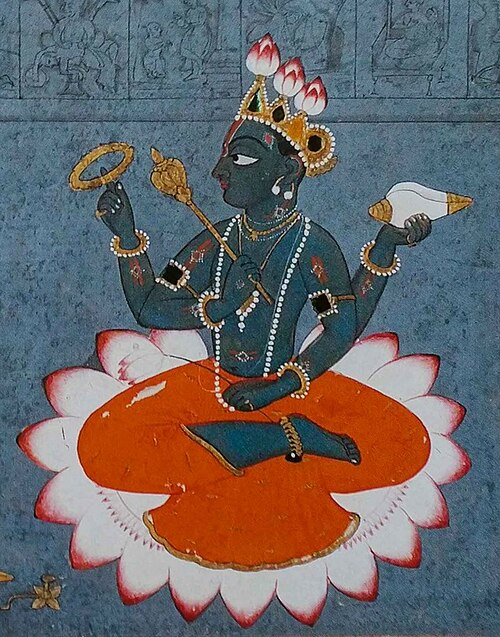
The Swaminarayan Sampradaya is a major Vaishnava reform movement of Hinduism, founded in early 19th-century Gujarat by Sahajanand Swami (1781–1830), known to his followers as Swaminarayan. His followers regard him as an incarnation of the Supreme Being, Krishna, who appeared to revive dharma, devotion, and moral living.
The movement teaches devotion to Krishna as the Supreme God, strict ethical living, and the discipline of the body, senses, and mind. It is famous today for its magnificent mandirs (temples) — built of intricately carved stone and marble, constructed without steel — and for its vast humanitarian work.
Key features:
- Worship of Krishna (and of Swaminarayan as his incarnation)
- The five moral vows — no adultery, no meat, no intoxicants, no theft, no untruth
- Daily personal worship (upasana) — prayers, puja, and devotion at home and in the mandir
- The sacred text Shikshapatri — Swaminarayan's 212-verse guide to ethical and religious life
- Satsang — the community of faithful devotees, with the gunatit guru (spiritual successor) as guide
[INTERMEDIATE]
Sahajanand Swami (1781–1830): Born Ghanshyam in Chhapaiya (near Ayodhya, Uttar Pradesh), he left home as a young ascetic and, after extensive pilgrimage across India, settled in Gujarat, where he established his mission. His personal purity, learning, and preaching drew enormous followings. He initiated thousands of sadhus (monks) and established five great mandirs — at Ahmedabad (1822), Bhuj, Vadtal, Dholera, and Junagadh — the last of which he consecrated in 1829.
The Akshar-Purushottam theology: The tradition teaches that there are two eternal realities besides the individual souls: Purushottam (the Supreme God, Krishna/Swaminarayan) and Akshar (His eternal abode and divine abode-personified). The living guru — the spiritual head — is understood as Akshar in human form, through whom devotees worship God. This is the distinctive doctrinal hallmark of the sampradaya.
The Shikshapatri: In 1826, Swaminarayan dictated the Shikshapatri ("the written lessons"), a 212-verse Sanskrit text setting out the ethics, rituals, and theology of the tradition — devotion to Krishna, daily worship, moral conduct, and the duties of householders and ascetics. It remains a central text, studied by devotees worldwide.
The division (1906): After the deaths of the early leaders, the sampradaya divided into two main lineages:
- The NarNarayan Dev Gadi (headquartered at Ahmedabad and Vadtal)
- The Laxmi Narayan Dev Gadi (headquartered at Vadtal, under a different guru line)
- Later, BAPS (Bochasanwasi Akshar Purushottam Sanstha) — founded in 1907 by Shastriji Maharaj — emerged as a separate, highly organized branch under the guidance of the gunatit gurus (Pramukh Swami Maharaj and now Mahant Swami Maharaj)
Section 2: Worship & Service
[BEGINNER]
The mandirs are the heart of Swaminarayan worship. The tradition is renowned for building great stone temples — from the historic 19th-century mandirs to modern masterpieces:
- Akshardham, Delhi (2005) — a vast complex of carved stone, exhibitions, and gardens
- Akshardham, Gandhinagar — the largest
- The Atlanta and New Jersey mandirs — among the largest outside India, built by thousands of volunteers
- The Swaminarayan Mandir, London (Neasden, 1995) — the first traditional Hindu stone mandir in Europe, built entirely by volunteers
Festivals: The sampradaya celebrates the full Vaishnava calendar — Janmashtami, Diwali, Holi — and its own great festivals marking the births and anniversaries of Swaminarayan and the gurus, with processions, scripture readings, and feasts of vegetarian prasadam.
Seva (service): Humanitarian service is a defining feature:
- BAPS Charities — free health check-ups, medical camps, blood drives, and disaster relief worldwide
- Educational institutions — schools and colleges across Gujarat and in the diaspora
- Environmental care — tree-planting and water-conservation programs
- The "3HO"-style volunteer ethos — thousands of devotees serve in the mandirs and communities
Section 3: The Sampradaya Today
[BEGINNER]
The Swaminarayan Sampradaya is one of the most vibrant and visible Hindu movements in the world today, with millions of followers in India and a strong diaspora in the United Kingdom, United States, East Africa, Australia, and Canada.
Contemporary significance:
- Global temples — the tradition has built major mandirs on every continent, making it a leading face of modern Hinduism abroad
- Interfaith leadership — BAPS and other branches participate actively in interfaith dialogue, including the Parliament of the World's Religions and the UN initiatives
- Youth and education — extensive programs for young people, including camps, bal-mandirs, and cultural education
- Swaminarayan Research — the movement funds scholarship on Indian religion, philosophy, and culture
The sampradaya's historical importance lies in its successful reform of Hindu practice in 19th-century Gujarat — curbing practices it considered corrupt, promoting non-violence and vegetarianism, educating the poor, and organizing a vast, disciplined community — and in its demonstration, in the modern era, of how traditional Hindu devotion can thrive in the global age.
Known Limitations
- The claim that Swaminarayan was an incarnation of God is a matter of faith within the tradition.
- The divisions within the sampradaya (the two gadis and BAPS) are complex; simplified here.
- The gunatit guru doctrine is distinctive and easily misunderstood; treated with care.
- BAPS's scale and prominence in the modern era is emphasized; the other branches deserve fuller treatment.
- Some historical episodes within the movement's early history are contested among scholars.
Recommended reviewers: A Swaminarayan religious authority (from the relevant branch), a scholar of Gujarati religious history, an expert on the Hindu diaspora.
Standard Disclaimer
Sources & provenance
- 🎓Scholarly sourceBookRaymond Brady Williams. Swaminarayan Hinduism: Tradition, Adaptation and Identity (2001)
- 🎓Scholarly sourceBook