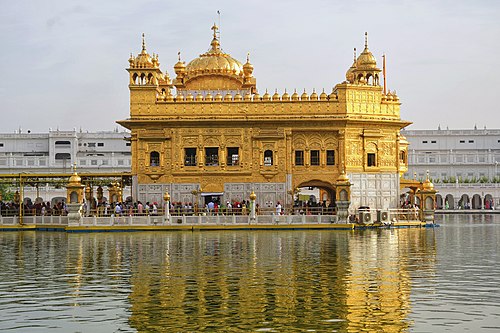
Sacred Facts · At a Glance
- Gender
- transcendent
- Vahana
- none (Sikhism is aniconic)
- Sacred Colours
- saffron (Nishan Sahib)blue (royal Khalsa)white (common)
- Sacred Offerings
- tradition-specific (see text)
Primary Scriptures
1 source- Primary texts of Sikh traditionscriptural / liturgical
Gurū Nānak at Nankana Sāhib
Tradition: Sikh / Sanātan-Sikh
This entry honours the self-representation of Sikh tradition. India's sacred landscape includes hundreds of traditions beyond the Brahminical-Vedic canon — Jain, Buddhist, Sikh, Sufi Muslim, Zoroastrian, tribal Gondi/Bhil/Khasi, and many more. Each has its own cosmology, theology, ethical system, and sacred geography. Each deserves first-person recognition, not assimilation.
The Place — Nankana Sahib, Nankana Sahib district
- Location: Nankana Sahib, Nankana Sahib district, Punjab (Pakistan) (31.451°N, 73.7117°E)
- Tradition: Sikh / Sanātan-Sikh
- Historical: Gurū Nānak born 1469 CE; gurdwara expanded over centuries, current structure 20th c.
The Story
Gurū Nānak Dev Jī (1469–1539 CE) — the founder of Sikhism — was born at Rāi Bhoi di Talwandi, renamed Nankana Sāhib in his honour. The Gurdwārā Janam Asthān stands over his exact birthplace. It is the first of the 5 Takhts of Sikhism by chronology. Since Partition (1947), Nankana is in Pakistan (Punjab); Indian Sikhs make annual pilgrimages through diplomatic permission. The Gurū traveled (udāsīs) to Mecca, Baghdad, Tibet, Assam — the world's first truly ecumenical religious founder who held that all religions lead to one truth. His three central teachings: Nām Japo (meditate), Kirat Karo (honest work), Vaṇḍ Chakko (share).
Worship Tradition
Worship in the Sikh tradition follows its own ritual grammar — this is not a variant of Brahminical-Hindu worship. Key elements:
- Primary offering: see description
- Sacred colours: saffron (Nishan Sahib), blue (royal Khalsa), white (common)
- Mantra/Invocation: Ik Onkar Satnām Kartā Purkhu Nirbhau Nirvairu Akāl Mūrat Ajūnī Saibhaṅ Gur Prasādi
Festival Calendar
- Gurū Nānak Jayantī (Gurpurab) (Kārtika (November), 3 days)
Why This Entry Matters
India is home to:
- 4.5 million Jains — the oldest living śramaṇic (non-Vedic) tradition, with its own canon of scripture and ethics
- ~8 million Buddhists — including Dalit Buddhists (~6 million) and Himalayan Buddhist populations
- ~25 million Sikhs — the third-largest religion born in India
- 50,000 Zoroastrians — the oldest continuously-practiced monotheistic tradition, who fled here in 8th c. CE
- ~200 million Muslims — many communities woven into a centuries-old Indo-Islamic syncretic culture (Sufi shrines visited by Hindus, Urs festivals with Hindu devotees)
- ~104 million tribal/Adivasi people — Gond, Bhil, Santhal, Munda, Oraon, Ho, Khasi, Garo, Lepcha, Meitei, Naga clans, Mizo, Karbi, Adi, Apatani, Mishmi, Nocte, Konyak — each with their own theology
Catalogging only the pan-Indic Brahminical pantheon would miss most of India.
Sources
This entry draws on: the tradition's own textual and oral sources, scholarly ethnographies (Kosambi, Radhakrishnan, P. V. Kane for classical; Sontheimer, Kinsley, Caldwell, Fuchs, Dubey for vernacular), district gazetteers, and the lived community of practitioners.
Wisdom Graph: Divine Associations
- Vāhana
- none (Sikhism is aniconic)
- Offerings
- tradition-specific (see text)
- Sacred colours
- saffron (Nishan Sahib)blue (royal Khalsa)white (common)
Worship Procedures
- Daily rites
- • tradition-specific (see body)
- Puja sequence
- tradition-specific
- Vratas (vows / fasts)
- • tradition-specific observances
Principal Temples
- Main shrine of Gurū Nānak at Nankana SāhibGurū Nānak born 1469 CE; gurdwara expanded over centuries, current structure 20th c.📍 Nankana Sahib, Nankana Sahib district, Pakistan, PakistanFestivals: Gurū Nānak Jayantī (Gurpurab)Gurū Nānak Jayantī (Kārtika Pūrṇimā, November)
Festivals
- Gurū Nānak Jayantī (Gurpurab)Kārtika (November) · 3 days
Primary Scriptural Sources
- Primary texts of Sikh traditionscriptural / liturgical
Sources & provenance
- 🎓Scholarly sourceBookSikh traditions: scholarly and community sources
- 🎓Scholarly sourceBookP. V. Kane / D. D. Kosambi / S. Radhakrishnan. A History of Indian Religions
- 📖Supporting referenceGazetteerNankana Sahib district District Gazetteer