


.jpg/500px-Hamandir_Sahib_(Golden_Temple).jpg)
Sacred Facts · At a Glance
- Gender
- transcendent
Primary Scriptures
0 sourcesNo primary scriptures are catalogued for this entry yet. If you know of scriptural references we have missed, please contribute them.
Harmandir Sahib — the gurdwara as a living institution
What actually happens there
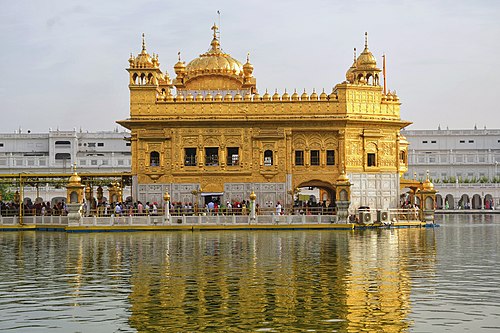
The Golden Temple is best understood not as a monument but as a working religious institution. Three things happen there daily, every day, without exception: the continuous kīrtan (scripture recitation) from the Akal Takht; the kīrtan sōbhā performed by devotees in the darbār hall; and the langar, the free community kitchen that feeds tens of thousands of people a day, including anyone, with no requirement of caste, sex, class or religion. Pilgrims come for the darśana of the Guru Granth Sahib — the open volume, the eternal Guru — which is carried out on request by attendants, read by a granthī, or placed for a night's vigil.
The mahāmantra or daily liturgical order, which is recited by the congregation through the year, includes the arārti of the four arms of the Khalsa (sānganī, phūlaṅgī, khaṇḍā, kirpa) — the swords, the quoits, the knife and the bow — a reminder that the community founded in 1699 was an armed one. Harmandir's centrality lies in the combination of scripture and service: it is simultaneously a sanctuary of the Word, an administrative seat, and a kitchen that operates on a national scale during festivals.
A note on the corpus
This entry and the Golden Temple entry in the corpus overlap: they are two records of one shrine, one focused on the institution and its daily life, one on the building's history and symbolism. That duplication is flagged rather than resolved here — reconciling it is an editorial decision for a named guardian, not an editorial convenience.
Sources and what is still unverified
The Sikh Encyclopedia and Khushwant Singh's history give the institutional and chronological frame; Harjot Oberoi's study of religious boundaries in Punjab is the right kind of source for the gurdwara as a social institution rather than a building.
Outstanding for a named guardian: the contemporary census of pilgrims and the langar's service figures (they change and should be dated); how the four doors and the lowered approach are explained in the Sikh sources themselves rather than in later summary writing; and the documented history of exclusion and of the Gurdwara Reform Movement, which belongs on this page rather than being omitted for tidiness.
Sources & provenance
- 🎓Scholarly sourceBookKhushwant Singh, editor. The Sikh Encyclopedia
- 🎓Scholarly sourceBook