Sacred Facts · At a Glance
- Gender
- transcendent
- Sacred Colours
- redgold
- Sacred Offerings
- flowers · kumkum · sweets · coconut
Primary Scriptures
0 sourcesNo primary scriptures are catalogued for this entry yet. If you know of scriptural references we have missed, please contribute them.
Hazur Sahib, Nanded — where the Guru Granth became Guru
The succession that happened in a room
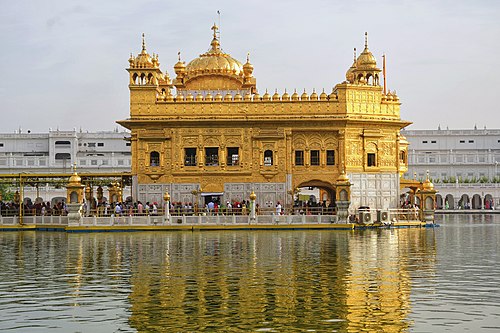
At Nanded, on the banks of the Godavari, Guru Gobind Singh — the tenth and last human Guru of the Khalsa — declared the Guru Granth Sahib the eternal Guru, and ceased to be one himself. The transfer is not a metaphor in Sikh doctrine; it is treated as a historical event of the same order as his founding of the Order of the Khalsa in 1699, and the shrine where it occurred stands on the rank of the Five Takhts.
The chronology the corpus previously carried — the declaration on 7 October 1708, the building of the shrine in 1832–37 under Maharaja Ranjit Singh — should be handled with care. Sikh sources agree on the year and give the days differently; the two-date problem is a live question in the historiography and should be sourced rather than settled here. The shrine's later construction under Ranjit Singh is a matter of Sikh historical record, but the specific year range should be checked against the gurdwara's own account.
Two objects in the shrine carry unusual weight. The Sach Khaṇḍ, the manuscript on which Guru Gobind Singh wrote his letter to the Mughal emperor Aurangzeb, is kept at the Takht; and the room in which the Guru died is preserved, with the memory of the four companions who were cremated with him, whose sacrifice is commemorated at the Chaukhatī Sahib. The inner room where his wife and child are said to have been laid, and the Baoli well nearby, are part of the same complex of memory.
Living practice
Hazur Sahib is administered by the Shiromani Gurdwara Parbandhak Committee, and the daily kīrtan, the continuous reading of the Granth, and the langar run here as they do at every major gurdwara. On the death anniversary of the tenth Guru, the shrine fills with pilgrims from across the Sikh world; the fair held in the surrounding streets is one of the largest religious gatherings in the region.
Sources and what is still unverified
The Sikh Encyclopedia, Khushwant Singh's history, McLeod's study of Guru Gobind Singh, and Piar Singh's work on the relation between Gurbani and Sikh religious authority were consulted in outline.
Still to be checked by a named guardian: the two-date problem for October 1708; the exact sequence of construction at the shrine and the role of the Shiromani Gurdwara Parbandhak Committee; the documentary basis for the Sach Khaṇḍ letter manuscript; and how the site presents the events of the Guru's last days to visitors today.
Wisdom Graph: Divine Associations
- Offerings
- flowerskumkumsweetscoconut
- Sacred colours
- redgold
Principal Temples
- Takht Hazur Sahib1832–37 CE📍 Nanded, Nanded, Maharashtra, IndiaHazūr Sāhib (Nanded) — where Guru Gobind Singh declared the Granth as Guru
Festivals
- Navratri / Annual Mahotsavavaries
Sources & provenance
- 🎓Scholarly sourceBookKhushwant Singh, editor. The Sikh Encyclopedia
- 🎓Scholarly sourceBookKhushwant Singh. A History of the Sikhs, Volume I (1969)
- 🎓Scholarly sourceBookW. H. McLeod. Guru Gobind Singh and the Sikh Religion (1969)
- 🎓Scholarly sourceBookPiar Singh. Gurbani and the Sikh Religion (1981)
- 📖Supporting referenceGazetteerNanded District Gazetteer