
_in_1868.jpg/500px-Bah%C3%A1'u'll%C3%A1h_(M%C3%ADrz%C3%A1_%E1%B8%A4usayn-%60Al%C3%AD_N%C3%BAr%C3%AD)_in_1868.jpg)



Sacred Facts · At a Glance
- Gender
- male
Primary Scriptures
0 sourcesNo primary scriptures are catalogued for this entry yet. If you know of scriptural references we have missed, please contribute them.
The Báb
Note on "deity" classification: As with Baháʼu'lláh, the Báb is revered in Baháʼí theology as a Manifestation of God — not as God himself. Baháʼís worship God alone and revere the Manifestations as divine educators. This entry uses the "deity" category of ELGODS as its umbrella for venerated divine-revelatory figures.
Section 1: Overview
[BEGINNER]
The Báb — meaning "the Gate" — was born Siyyid ʻAlí-Muhammad Shírází in Shiraz, Iran, on 20 October 1819, into a family of merchants claiming descent from the Prophet Muhammad. On the evening of 23 May 1844, at age 24, he declared to a young seeker named Mullá Ḥusayn that he was the promised Qáʼim (the "One Who Will Arise") expected in Shiʻa Islamic eschatology, and a Manifestation of God in his own right — the founder of an entirely new religious dispensation.
The Bábí movement spread rapidly in Iran during the 1840s, attracting several thousand followers including prominent clerics and intellectuals. Its radical claims — that a new prophet had arisen, that Islamic law was to be replaced by the Báb's own code (the Bayán), and that a still greater figure ("Him whom God shall make manifest") would soon appear — provoked a severe reaction from the Qajar government and the orthodox clergy.
The Báb was imprisoned in the remote fortresses of Máh-Kú and Chihríq from 1847 onward. On 9 July 1850, at age 30, he was executed by firing squad in the public square of Tabriz. A famous incident — attested by foreign observers and widely reported — describes the first volley severing only the ropes suspending him, and a second firing squad being hastily assembled to complete the execution.
[INTERMEDIATE]
The Báb's teachings transformed Shiʻa messianic expectation in several ways:
- He declared that the hidden Twelfth Imam had "returned" in his person — but symbolically, not literally
- He abrogated the Sharia and replaced it with his own revelatory law (the Bayán)
- He re-interpreted Islamic eschatology as progressive spiritual renewal rather than literal resurrection
- He repeatedly pointed forward to a still-greater Manifestation, "Him whom God shall make manifest" — understood by Baháʼís as Baháʼu'lláh, who publicly declared his mission in 1863
In Baháʼí theology, the Báb and Baháʼu'lláh are "twin Manifestations" — two prophets of a single dispensation, with the Báb serving as the herald and Baháʼu'lláh as the promised one. Baháʼí holy days include:
- Declaration of the Báb — 23 May (1844)
- Martyrdom of the Báb — 9 July (1850)
- Birth of the Báb — based on the lunar calendar
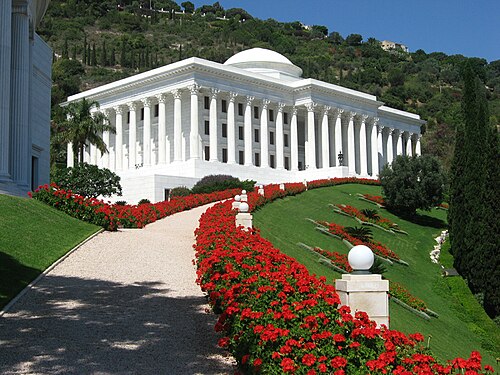
His remains were hidden by the Bábí community after his execution, eventually transferred to Palestine in 1899 at Baháʼu'lláh's instruction, and interred in 1909 on Mount Carmel in Haifa. The Shrine of the Báb, with its distinctive golden dome, is the architectural and spiritual centre of the Baháʼí World Centre.
Section 2: Writings
The Báb's revelation is voluminous — the Persian and Arabic Bayán (the Exposition), the Qayyumu'l-Asma (a commentary on the Qur'an's Surah of Joseph), the Dala'il-i-Sab'ih (Seven Proofs), and many tablets to his followers. Because he expected his writings would be superseded by "Him whom God shall make manifest," the Bayán itself instructs Bábís to accept the coming Manifestation.
Section 3: Relationships
- Baháʼu'lláh — the promised Manifestation foretold by the Báb; took up and expanded the Báb's mission
- Mullá Ḥusayn — the first to recognise him (Letter of the Living #1)
- Táhirih (Fatimih Baraghani, 1814/1817–1852) — celebrated Bábí poet, theologian, and women's-rights pioneer; one of the Letters of the Living
- Eighteen Letters of the Living — the first disciples, who together with the Báb formed the foundational nineteen
Section 4: Key facts
- Tradition: Baháʼí Faith (and precursor Bábí religion)
- Role: Manifestation of God; forerunner of Baháʼu'lláh
- Lifespan: 20 October 1819 – 9 July 1850
- Declaration of mission: 23 May 1844, Shiraz
- Execution: 9 July 1850, Tabriz
- Shrine: Mount Carmel, Haifa (Baháʼí World Centre)
- Principal text: Persian and Arabic Bayán
Sources & provenance
- 📖
- 🎓Scholarly sourceBook