


.jpg/500px-Hamandir_Sahib_(Golden_Temple).jpg)
Sacred Facts · At a Glance
- Gender
- transcendent
Primary Scriptures
0 sourcesNo primary scriptures are catalogued for this entry yet. If you know of scriptural references we have missed, please contribute them.
Guru Granth Sahib
The Guru in book form
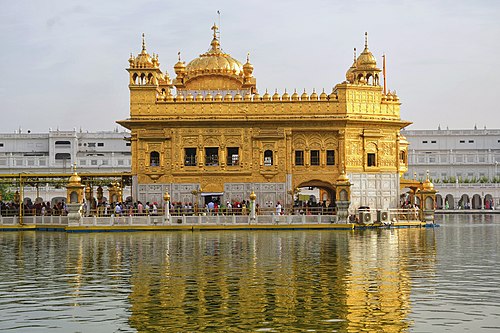
The Guru Granth Sahib is the central sacred writing of Sikhism and, since 1708, the perpetual Guru of the Khalsa. Guru Arjan, the fifth Guru, compiled the volume at Amritsar and installed it on the throne at the Harmandir Sahib in 1604. Guru Gobind Singh, the tenth and last human Guru, added his own compositions and those of Guru Tegh Bahadur, and then declared that after his death there would be no further human Guru: the office would pass to the Guru Granth Sahib itself. That declaration is why the volume is venerated rather than merely read.
The contents are the collected compositions of the Sikh Gurus — the poetry of Guru Nanak through Guru Arjan, and then the added material — arranged by raag, the musical mode in which they were sung. The commonly cited total is some 5,900 compositions in 31 raag ragas, though the count depends on whether one counts verses, refrain-repeats, or separate works, and published tallies differ. Alongside these stand other bodies of writing in the wider Sikh corpus, notably the Dasam Granth, whose authorship is a matter of long-standing scholarly and community debate and which is not part of the Guru Granth Sahib proper.
How it is honoured, not worshipped
Sikh practice is deliberately careful here. The Guru Granth Sahib is not an object of worship (pūjā) in the sense that a mūrti is; it is venerated, and the distinction is maintained in the vocabulary Sikhs use. In a gurdwara the volume rests on a raised seat, dressed in cloth (chola), under a canopy. Feet are uncovered, heads are covered, and care is taken that the volume is not stepped on, sat upon, or handled disrespectfully. The palki and pālā on which the volume rides during processions are themselves treated as sacred and are given their own pālā.
Around the text is a whole disciplined life of recitation and singing. Kīrtan — the sung reading of the scripture — opens and closes the day in the gurdwara; gurbāṇī kīān, the slow metered reading, is done by individuals; cāṇḍī is sung at nightfall; and the mālā is counted on a rosary of 108 beads through the whole text. The kīrtan soḥilā is performed at dawn and again in the evening. Pañj grāñthī readings, kathā and kīrtan kār travel through the diaspora, and langar — the free kitchen that accompanies all of it — makes the practice visibly social rather than private. A Sikh initiated at gurprasadī receives amrit, prepared from khaṇḍā sugar and water, under the open sky with the Guru Granth Sahib present.
Sources and what is still unverified
This entry is grounded in Richard Mann's translation of the Guru Granth Sahib, Piar Singh's study of the scripture, J. S. Grewal's work on the Sikhs of the Punjab, and Giani Gian Singh's Panth Prakash, together with the Sikh Reformatory and Darbar Sahib tradition. A human guardian should check: which raag-by-raag totals are current, and the exact scope of Guru Gobind Singh's 1708 additions including the Chaupai Sahib and the Ashtadhatu; the etymology and usage history of khalisa; and the precise seating and dressing protocol at any particular gurdwara, which varies between gurdwaras. Do not raise this entry's verification status without a named Sikh granthi or scholar signing off on the details of ritual protocol.
Sources & provenance
- 📜Primary sourceBookRichard Mann. Guru Granth Sahib: A Translation of the Sacred Text
- 📜Primary source