



.jpg/500px-Church_of_the_Holy_Sepulchre_by_Gerd_Eichmann_(cropped).jpg)
Primary Scriptures
0 sourcesNo primary scriptures are catalogued for this entry yet. If you know of scriptural references we have missed, please contribute them.
St. Thomas the Apostle
The Apostle of India
Overview
Thomas — called Didymus ("the Twin") in Greek, Mar Thoma in Syriac-Malayalam — was one of the twelve apostles of Jesus. In the Gospel of John he doubts the resurrection until he touches Christ's wounds ("My Lord and my God!"), then carries the Gospel further than any other apostle: to India.
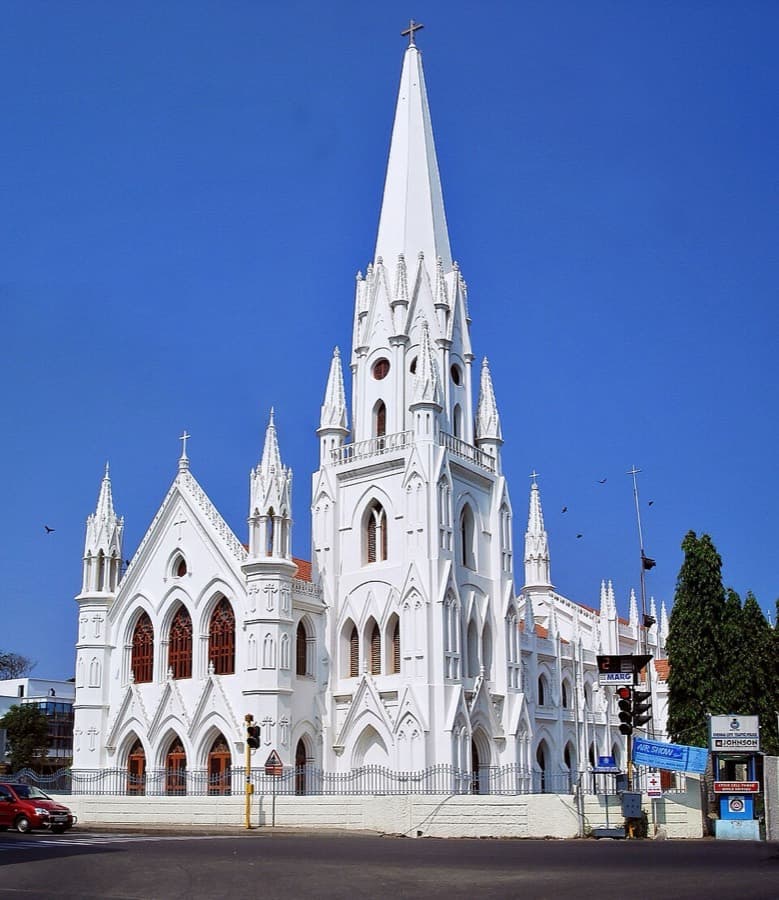
The 3rd-century Acts of Thomas (an apocryphal text, honoured as tradition rather than history) sends him east to the court of an Indian king. Indian Christian tradition holds that he landed at Muziris (Kodungallur), Kerala, in 52 CE, preached along both coasts, founded seven churches — Kodungallur, Kollam, Niranam, Nilackal, Kokkamangalam, Kottakkavu, Palayoor — and was speared to death while praying at St. Thomas Mount, Mylapore (Chennai), in 72 CE, and buried where San Thome Basilica now stands.
Key Facts
- Feast: July 3 (Dukhrana — "remembrance" — among St. Thomas Christians)
- Symbols: spear, carpenter's square, twin
- Patron: of India, of architects, of doubters who seek honestly
- San Thome Basilica: one of only three churches in the world built over an apostle's tomb (with St. Peter's, Rome, and Santiago de Compostela); Portuguese church 1523, neo-Gothic rebuilding consecrated 1896, minor basilica 1956
The Seven Churches
The Ezharappallikal (seven churches) form Kerala's oldest pilgrimage circuit, still walked by thousands:
- Kodungallur (Muziris) — landing place, 52 CE by tradition
- Kollam — the southern port church
- Niranam — inland river-port church
- Nilackal (Chayal) — forest church of the high ranges
- Kokkamangalam — lakeside church
- Kottakkavu (North Paravur) — northern church
- Palayoor — near the ancient port of Muziris
Each claims foundation by Thomas himself; historians treat the circuit as living tradition, its churches rebuilt many times over nineteen centuries.
Witnesses Across Centuries
- Marco Polo (1292) recorded the tomb of St. Thomas on the Coromandel coast, venerated by local Christians.
- Ibn Battuta (1334) visited Mylapore and described the tomb, noting Hindus also honoured it.
- The Portuguese (1523) built the first formal church over the tomb; the British-era rebuilding (1893–96) gave the present neo-Gothic basilica.
- Pope John Paul II prayed at the tomb in 1986; the church was declared a National Shrine in 2004.
Practices
- Dukhrana (July 3): feast of St. Thomas with special liturgies in Syro-Malabar and Orthodox churches
- Mylapore pilgrimage: climbing St. Thomas Mount; venerating the tomb crypt at San Thome
- Seven-churches yatra: visiting all Ezharappallikal, especially in festival seasons
Sources & provenance
- 📜
- 📜Primary sourceWikipedia