


Sacred Facts · At a Glance
- Element
- water
Primary Scriptures
0 sourcesNo primary scriptures are catalogued for this entry yet. If you know of scriptural references we have missed, please contribute them.
⚠️ CONTENT VERIFICATION STATUS: This draft is . All citations require validation. Content should be reviewed by qualified scholars and practitioners before publication. Do not rely on this content for ritual, liturgical, or spiritual practice without independent verification.
Jain Dharma (Jainism)
Section 1: Overview
[BEGINNER]
Jainism is one of the oldest religions in India — even older than Buddhism by some measures. Its followers are called Jains (from the word "jina," meaning "conqueror" or "liberated one").
Jains follow the teachings of 24 great teachers called Tirthankaras ("Ford-Makers" — crossing places that help others cross the ocean of rebirth). The most recent Tirthankara was Mahavira, who lived about 2,500 years ago. Before him was Parshva, whose teachings shaped Jainism centuries earlier.
What do Jains seek? Like Hindus and Buddhists, they seek moksha — liberation from the cycle of birth and death. But Jainism teaches something unique: that liberation comes through ahimsa (non-violence), anekantavada (the many-sided nature of truth), and aparigraha (non-attachment).
Jainism places extraordinary emphasis on ahimsa — complete non-violence in thought, word, and deed. Jains will not harm any living being, not even an insect. This makes their diet very strict (no meat, no root vegetables like potatoes and onions, because pulling a root kills organisms in the soil). Some Jains become monks or nuns and take vows of complete non-violence, even refusing to harm a plant by not eating after sunset.
The Jains are a small community — about 4–5 million in India and diaspora worldwide — but their influence has been enormous. Jain scholars contributed to Indian philosophy, logic, and ethics. Jain temples, with their exquisite marble carvings, are among the most beautiful in India.
[INTERMEDIATE]
Jainism (Jaina Dharma) represents one of the three major Shramana (ascetic) traditions of ancient India, alongside Buddhism and the Ajivika school (now extinct). The tradition holds that its teachings are eternal (sanatana) — the Tirthankaras appear cyclically in each cosmic age (utsarpiṇī and avasarpiṇī periods) — but the 24 Tirthankaras of the current cycle are historically located.
The 24th and final Tirthankara of this age is Mahavira (599–527 BCE traditional; scholarly estimates vary widely), who is considered the founder of mainstream Jainism in its current form. He was a contemporary of the Buddha (though the traditional chronologies differ) and a prince of the Videha kingdom who renounced worldly life after experiencing the suffering of old age, sickness, and death. After 12 years of severe austerity, he attained kevala (omniscience/liberation).
The name "Jain" derives from jina ("conqueror") — one who has conquered the passions (kashayas) and attained liberation. This parallels the Buddhist term "Buddha" (awakened one). The Jains do not worship Mahavira as a god; he is an enlightened teacher who showed the path to liberation.
The central spiritual aim is moksha (liberation from samsara), achieved through the threefold path of right faith (samyaktva), right knowledge (jnana), and right conduct (charitra). The five great vows (mahavratas) for monastics (and aspirationally for laity) are:
- Ahimsa (non-violence)
- Satya (truthfulness)
- Asteya (non-stealing)
- Brahmacharya (chastity/celibacy)
- Aparigraha (non-possession/non-attachment)
Anekantavada (non-one-sidedness) is Jainism's most distinctive philosophical contribution: truth can be expressed from infinitely many perspectives. No single statement captures the whole truth. This principle emerged partly from debates with Buddhist and Hindu schools, but it reflects a genuine Jain insight into the limitations of language and the complexity of reality.
[SCHOLAR]
Origins and Historicity
Jainism's origins are debated. The traditional view holds that Jainism is timeless, with the 24 Tirthankaras spanning multiple cosmic ages. The historicity of Mahavira is accepted, but the traditional biography (including the "great renunciation" at age 30, 12 years of austerities, and attainment of kevala at age 42) is considered legendary by most scholars. The reference to Parshva (23rd Tirthankara) in Buddhist texts suggests Jainism predates Mahavira. The archaeological evidence — including the Hāthīgumphā inscription of King Khāravela (c. 2nd–1st century BCE, Odisha) and early Tamil literature — provides the earliest evidence for Jainism in India. [Olle Qvarnström (ed.), "Jainism and Early Buddhism: Essays in Honor of Padmanabh S. Jaini," 2003; for the Parshva question, see Paul Dundas, "The Jains," 2nd ed., 2002]
The Two Main Sects: Digambara and Svetambara
The major division in Jainism between Digambara ("sky-clad," naked ascetics) and Svetambara ("white-clad," ascetics wearing white robes) dates to early centuries CE. The Digambara tradition holds that the original Shvetambar scriptures were corrupted; they recognize only the 12 principal texts (Pratham Anuyoga) and reject the Svetambar canon as authoritative. The Svetambara tradition preserves a complete canon (Siddhanta, comprising 45 texts) and considers it authoritative. The physical difference — nudity vs. white robes — reflects the Digambara view that even simple clothing involves harm (to insects, to the worms in fabric). The Svetambara view is that minimal, washed clothing does not constitute violence.
Section 2: Origin & History
[BEGINNER]
Jains believe their religion has no beginning — it has always existed, revealed by Tirthankaras in each cosmic age. But the Tirthankara Parshva lived about 800 BCE, and Mahavira lived about 2,500 years ago.
Mahavira was born a prince but gave up his life of luxury at age 30. He spent 12 years as an ascetic — meditating, fasting, practicing extreme non-violence. At 42, he attained enlightenment (kevala).
After his death, his disciples organized his teachings. For centuries, Jains spread through India, building beautiful temples and writing philosophical texts.
One famous Jain story: the Emperor Chandragupta Maurya (4th–3rd century BCE) became a Jain monk at the end of his life and walked south to death by fasting (Sallekhana) — a practice of voluntarily ending life through fasting when the body is no longer useful.
Medieval Jains built magnificent temples — the temples of Mount Abu, Dilwara, and Palitana are famous for their marble carvings. Jain scholars were famous for their logic and philosophy.
Today, Jains are about 0.4% of India's population, but they have been influential far beyond their numbers — in business, scholarship, and ethics.
[INTERMEDIATE]
Parshva and the Pre-Mahavira Jain Tradition
The 23rd Tirthankara, Parshva (c. 9th–8th century BCE traditional), is historically more verifiable. He taught four vows (caturyāma, not five): non-violence, truthfulness, non-stealing, and non-possession — a discipline Mahavira later expanded to five with the addition of chastity. Both Jain and Buddhist sources attest the four-vow tradition of Parshva; the Pali Nikāyas mention Parshva's following in the region where Mahavira later taught.
Mahavira's Life and Teachings (c. 599–527 BCE Traditional; Scholarly Debate)
The traditional biography follows the pattern of other Indian religious founders: royal birth, sheltered life, encounter with suffering, renunciation, years of austerity, enlightenment, teaching career, final liberation. The Svetambara canon provides extensive biographical detail; the Digambara tradition (which does not accept the Svetambar canon) has different biographical sources.
Mahavira's teaching emphasized:
- The sevenfold conditional predication (saptabhaṅgī), the logical method of anekantavada: every proposition is qualified by "syāt" ("from a certain perspective") — e.g. "in some respects it is, in some respects it is not, in some respects both, in some respects inexpressible"
- Karma as material particles: Unlike Hindu and Buddhist conceptions of karma, Jainism posits that karma consists of extremely subtle matter (pudgala) that clings to the soul (jiva) through mental, verbal, and physical actions
- Ahimsa as the supreme duty: All violence — including harsh speech, anger, farming (which kills insects), and eating root vegetables — must be minimized
The Jain Canon and Early Development
The Svetambara tradition recognizes 45 texts (angas and additional anuyogas) as authoritative, supposedly delivered by Mahavira and transmitted through his chief disciple Indrabhuti Gautama. (Gosāla, the leader of the Ājīvikas, was Mahavira's rival according to the Bhagavatī Sūtra — see the Ajivika entry.) The Digambara tradition rejects this canon, considering it later composition. The compilation of the Svetambara canon occurred over several centuries, with the Council of Valabhi (c. 5th century CE) establishing the currently recognized canon.
Major Historical Periods
- Early Jainism (c. 6th–2nd century BCE): The period of the Tirthankaras and immediate disciples; the tradition spread in western India
- Classical Jainism (c. 2nd century BCE – 10th century CE): Development of philosophical systemization; major scholars included Siddhasena Divakara (c. 5th century), Akalanka (8th century), and Prabhachandra (11th century); temple building flourished; royal patronage under the Ganga, Chalukya, and Rashtrakuta dynasties
- Medieval and Modern Periods (c. 10th–20th century): Continued scholarly activity; reform movements (Sthanakvasi and Terapanthi within Svetambara); diaspora to East Africa, Europe, and North America
[SCHOLAR]
The Pudgala (Matter) Theory of Karma
Jainism's theory of karma is distinctive. Unlike Hindu and Buddhist conceptions (which treat karma as moral law or mental imprints), Jainism posits karma as extremely subtle matter (pudgala) composed of tiny particles (paramanus) that enter the soul (jiva) through activity. This karma-matter adheres for varying durations, affecting the soul's transmigration and experience. Different types of karma produce different effects: deluding karma produce wrong belief; knowledge-obscuring karma block knowledge; perception-obscuring karma block perception; vedaniya karma produce experience of pleasure and pain; age-determining karma fix lifespan; gotra-anuyoga karma determine social status; and mohaniya karma produce attachment and aversion.
The unique Jain doctrine is that liberation occurs when all karma particles are removed through ascetic practice (especially fasting, meditation, and equanimity). This process requires extreme non-attachment: not even a thought of violence, not even momentary anger. [Paul Dundas, "The Jains," 2nd ed., 2002, ch. 5; for anekantavada, see Bimal Krishna Matilal, "The Central Philosophy of Jainism (Anekanta-Vada)," 1981]
The Sallekhana Debate
Sallekhana (or Samlehana) is the voluntary fasting unto death as a religious practice, undertaken when the body is no longer useful for spiritual progress. It is considered a form of religious suicide — not for escapism but as ultimate non-attachment. The practice has been controversial, particularly when Jain monks (not laity) have undergone sallekhana. The legal status in India has been contested, especially after a 2015 High Court case involving a Jain monk. [Compiled in Tatia and Sanghvi, "Sallekhana," 1986]
Section 3: Core Teachings & Philosophy
[BEGINNER]
The Five Vows
All Jains — monks, nuns, and laypeople — take five vows:
-
Ahimsa — Non-violence in thought, word, and deed. This is the most important vow. Jains will not harm any living being — not even by accident through carelessness.
-
Satya — Truthfulness. Speaking truth, but also considering whether the truth needs to be said, whether it will cause harm, and whether it's the right time.
-
Asteya — Non-stealing. Not taking anything that isn't freely given.
-
Brahmacharya — Chastity. For monks and nuns, complete celibacy. For laypeople, sexual restraint within marriage.
-
Aparigraha — Non-possession/non-attachment. Having only what you need, and letting go of attachment to things.
Anekantavada: Many-Sided Truth
Jains teach that truth has many sides. If you only see one side, you're seeing partially. This is why Jains are known for their respectful debate — they listen to all sides before responding. A famous Jain story: seven blind men each touch a different part of an elephant and argue about what an elephant is like. Each is partially right, but none has the full picture.
Karma
Jains believe that karma — the consequences of your actions — literally sticks to your soul like sticky matter. Good actions produce good karma; harmful actions produce harmful karma. This affects your rebirth and your experiences in this life. The goal is to burn off all karma through spiritual practice.
[INTERMEDIATE]
The Seven Tattvas (Fundamental Truths)
Jain philosophy is systematized in the Tattvartha Sutra (c. 2nd–5th century CE; attributed to Umāsvāti, whose dating is debated). It outlines seven categories (tattvas):
- Jiva (soul): living beings, of which there are two types: embodied (in human, animal, plant bodies) and disembodied (in hell, heaven, or as liberated souls)
- Ajiva (non-soul): matter (pudgala), space (akasha), time (kala), and medium of motion and rest (dharma and adharma)
- Ashrava (influx of karma): the process by which karma-matter enters the soul through activity
- Bandha (bondage): the attachment of karma-matter to the soul
- Samvara (stoppage): stopping the influx of new karma
- Nirjara (gradual dissociation): burning off existing karma through austerity and equanimity
- Moksha (liberation): when all karma is removed, the soul attains its pure state, rises to the top of the universe, and remains there forever in kevala
Anekantavada and Syadvada
Anekantavada ("non-one-sidedness") is Jainism's most distinctive contribution to Indian philosophy. It holds that reality is inexhaustible; every proposition can be affirmed from an infinite number of perspectives. Syadvada ("maybe-ism") provides the logical method: every statement should be qualified by "syat" (may be, perhaps). Thus: "The soul exists" is true from one perspective; "The soul does not exist" is true from another; "The soul exists and does not exist" is true from a third; and so on. This is not relativism (all views are equally true) but a sophisticated epistemic pluralism: different viewpoints capture different aspects of a complex reality.
This principle has practical implications: Jains are taught to listen to opponents, avoid dogmatism, and acknowledge the limits of their own knowledge. [Bimal Krishna Matilal, "The Central Philosophy of Jainism (Anekanta-Vada)," 1981]
The Soul and Matter: Anthropology
Jain anthropology holds that the soul (jiva) is eternal, infinitesimally small (like a point), and essentially pure consciousness. It becomes embodied through association with karma-matter. The embodied soul resides in various bodies according to its karma: in human, animal, plant, hell-being, heaven-being, or hellish (naraki) forms. The soul is never created; it is beginningless and endless, though its embodiment is temporary when liberated.
The Digambara and Svetambara traditions differ on certain anthropological details: Digambaras hold that women cannot attain liberation in their current form (they must be reborn as men first); Svetambaras reject this view and point to the 19th Tirthankara Mallinātha — held by the Svetambara tradition to have been the woman Mallī — as evidence that women can attain liberation.
[SCHOLAR]
The Karma Theory: Comparative Analysis
Jain karma theory differs significantly from Hindu and Buddhist parallels. Hindu karma is often understood as moral law; Buddhist karma as volitional action producing results. Jain karma is unique in positing a physical mechanism: karma-particles (pudgala) literally cling to the soul, producing embodied existence. This "karmic matter" theory is connected to Jainism's broader ontology of multiple substance categories (dravyas): soul (jiva) and non-soul (ajiva) are two fundamental categories, but within ajiva, matter (pudgala) has its own elaborate theory.
The technical literature on karma is extensive. Siddhasena Divakara (3rd century CE) wrote the Nyayavatara, establishing Jain logic; Akalanka (8th century) wrote the Laghiyastrayi (three works on logic). These scholars engaged seriously with Hindu Nyaya and Buddhist epistemology. [Bimal Krishna Matilal, "The Character of Logic in India," 1998]
Ahimsa as Ethical Ultimate
Jainism's absolutist interpretation of ahimsa makes it unique among Indian religions. While Hindu and Buddhist ethics also valorize non-violence, Jainism takes it to extremes that make ordinary life nearly impossible: monks sweep the path before them to avoid stepping on insects, they wear masks to avoid inhaling organisms, they do not dig earth (which kills organisms), and they may refuse food after sunset (to avoid eating living organisms that grow at night).
The principle of ahimsa is extended to ahiṃsā for the self (self-restraint, not harming oneself through harmful actions) and ahiṃsā for others (reducing harm to other beings). This has implications for Jain business ethics: Jains in India have historically been involved in trade and banking but with strict ethical constraints on what goods could be traded (no weapons, no meat, no intoxicants, no root vegetables in some interpretations). [John E. Cort, "Jains in the World: Religious Values and Ideology in India," 2001]
Section 4: Sacred Texts
[BEGINNER]
Jains have an extensive sacred literature, written mainly in Prakrit, Apabhramsha, and Sanskrit (later).
The Svetambara Canon The Svetambara tradition has 45 sacred texts (angas and additional anuyogas). The most important include:
- Sutras: collections of teachings in numbered paragraphs
- Kalpa Sutra: biographies of the 24 Tirthankaras, especially important for the annual Paryushana festival
The Digambara Texts The Digambara tradition does not accept the Svetambara canon. Instead, they recognize texts like the
- Shatkhandagam (six parts) — considered authentic through direct revelation
- Prabandhakosha — biography of Mahavira and Jain teachers
The Tattvartha Sutra This is the most important Jain text accepted by both main traditions. It provides a systematic overview of Jain philosophy in 357 sutras (aphorisms). Written in Sanskrit, it covers everything from cosmology to ethics to liberation.
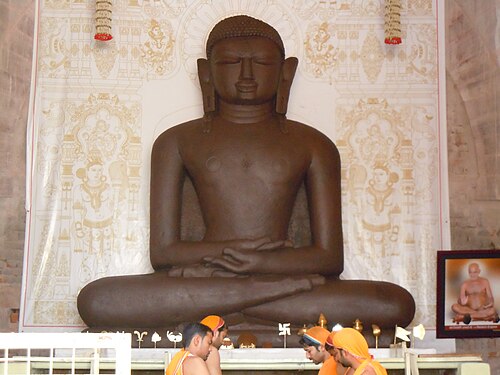
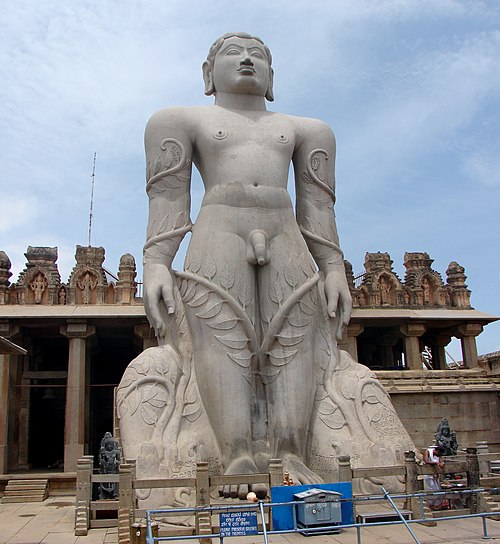
Holy Places Jains also revere their 24 Tirthankaras as living scriptures — their images in temples serve as objects of veneration and meditation.
[INTERMEDIATE]
The Svetambara Canon (Siddhanta)
The Svetambara canon comprises 45 texts divided into:
- 12 Angas (limbs) — the core teachings, including the Sutras (the earliest layer)
- 12 Upangas (secondary limbs) — texts on specific topics
- 6 Cheda Sutras (procedural texts on monastic discipline)
- 4 Mula Sutras (root texts)
- 10 Prakirnakas (miscellaneous texts)
- 2 Cūlikā Sūtras (the Nandī Sūtra and Anuyogadvāra Sūtra)
The Kalpa Sutra is particularly important: it contains biographies of the 24 Tirthankaras, including Mahavira's life story, and is read during the Paryushana festival. The manuscripts are famous for their illustrations, preserved in collections worldwide.
The Nandī Sūtra (one of the two Cūlikā Sūtras) classifies the five types of knowledge (jñāna).
The Digambara Tradition's Texts
The Digambara tradition rejects the Svetambara canon as later corruption. They recognize:
- Shatkhandagam (6 parts, 10 granthas) — attributed to the ancient sage Pushpadanta; considered the most authoritative text
- Bhagavati Ārādhanā — a text on the mendicant path and the discipline of the good death (āradhanā)
The earliest surviving Digambara texts date to the 2nd–5th centuries CE, suggesting earlier composition.
The Tattvartha Sutra (c. 2nd century CE)
The Tattvartha Sutra ("the meaning of the categories"; translated into English as "That Which Is") by Umāsvāti is the most important Jain text recognized by both traditions. It systematizes Jain philosophy in 357 sutras organized into 10 chapters:
- Universal substances (dravyas)
- Modifications (paryayas)
- Bondage of the soul
- Influx of karma
- Stoppage of karma
- Gradual dissociation of karma
- The three jewels (right faith, knowledge, conduct)
- The path to liberation
- The nature of the soul
- Liberation
[For translation and commentary, see S.A. Jain, "Reality," 1992]
[SCHOLAR]
The Canon Question: Historical Development
The question of the Jain canon is complicated by the different claims of the two main sects. The Svetambara tradition holds that Mahavira's disciple Gautama (not the Buddha) compiled the canon at the first council after Mahavira's death, and it was preserved orally for centuries. The Council of Valabhi (c. 453–468 CE, traditional dates vary) established the currently recognized canon. The Digambara tradition rejects this, holding that the original teachings were lost or never committed to writing.
Archaeological and textual evidence suggests the Svetambara canon reached something like its current form by the 5th century CE, but individual texts within it may be earlier or later. The oldest extant Jain manuscripts date to the 11th–12th centuries CE, though quotations in early commentaries provide evidence for earlier dates. The Digambara texts circulated mainly through oral tradition until much later; the Shatkhandagam was first published in the 19th century.
The Tattvaratha Sutra Attribution
The Tattvartha Sutra is traditionally attributed to Umāsvāti (also called Umāsvāmin), whose dates are debated (estimates range from c. 2nd to c. 5th century CE). Both the Digambara and Svetambara traditions accept the text as authoritative, although they differ on details of its interpretation. [W. J. Johnson, "Harmless Souls," 1995, ch. 1]
Section 5: Daily Practice & Ritual
[BEGINNER]
Daily Practices for Lay Jains
Most Jains are laypeople (shravakas) who live in the world — they have families, jobs, and responsibilities. But they try to incorporate Jain principles into daily life:
- Morning prayers: Jains typically begin the day with vandana (reverence) to the Tirthankaras and the guru
- Ahimsa in daily life: Being very careful not to harm any living being — using a small brush to avoid insects, sweeping floors carefully, being mindful of what you eat and how it's prepared
- Fasting: Many Jains fast on specific days (Panchami, Ashtami, Chauth, Paryushana)
- Charity (dana): Sharing food, money, or knowledge with those in need
Meditation
Jains meditate, especially focusing on:
- Samayika: achieving equanimity — becoming like a "witness" to whatever arises
- Sallekhana contemplation: remembering death and impermanence
Temple Worship
Jain temples (derasars) are places of beauty and reflection. Worship (puja) involves:
- Offering flowers, rice, and fruit to the Tirthankara images
- Lighting lamps
- Chanting mantras (especially the Namokara Mantra)
- Going around (pradakshina) the temple
- Prostrations
The Namokara Mantra (the most important Jain prayer):
Namo Arihantanam | Namo Siddhanam | Namo Ayariyanam | Namo Uvazzayanam | Namo No Pavajjayanam
"Homage to the Arihantas (Tirthankaras) | Homage to the Siddhas (liberated souls) | Homage to the Acharyas (spiritual teachers) | Homage to the Upadhyayas (preceptors) | Homage to all Sadhus (ascetics)"
Practices you can explore today:
-
Ahimsa Awareness: Today, try to be mindful of any ways you might be causing harm — even small harms. This could be physical violence, harsh speech, or even unkind thoughts. Simply noticing this with compassion, not guilt, is a Jain-inspired practice.
-
Anekantavada Listening: When you hear a opinion you disagree with, try the Jain approach: rather than immediately arguing, try to understand the perspective from which that view makes sense. You might say, "I can see why you would think that from your point of view." This does not mean you must agree — it means you are seeing more of reality.
-
Contemplation of Impermanence: The Jain insight is that everything in this world is changing. Nothing lasts. Take a few minutes today to simply sit with impermanence — noticing how your thoughts, feelings, and sensations are constantly arising and passing away.
[INTERMEDIATE]
Samayika: The Practice of Equanimity
Samayika ("going into the present moment") is the most important daily practice for Jains. The practitioner sits quietly and cultivates the awareness of being a "spectator" (sakshi) to whatever arises — pleasant or unpleasant sensations, thoughts, emotions — without reaction. The goal is to develop vitaraga (detachment/equanimity) toward all phenomena. Samayika is typically practiced for 48 minutes daily, often during the early morning or evening.
The practice involves:
- Sitting in a clean, quiet place
- Assuming a stable posture
- Calming the breath
- Cultivating the awareness: "I am not this body, not these sensations, not these thoughts — I am the witnessing consciousness"
- Maintaining equanimity toward whatever arises — pain, itching, desire, anger
Pratikramana: Twice-Daily Repentance
Pratikramana ("turning back toward the right") is a daily practice involving:
- Morning: reflecting on activities of the previous day, confessing any violations of the vows, and resolving to do better
- Evening: reflecting on activities of the day, confessing violations, and resolving to continue
This is not guilt-inducing but liberating: by honestly facing one's shortcomings, one weakens the hold of past karma and renews commitment to the path.
The Annual Paryushana (Sanskrit Paryuṣaṇā, from Prakrit Pajjusana)
Paryushana (Svetambara) / Das Lakshana (Digambara) is the most important annual observance — an 8–10 day period of intensive spiritual practice (August–September, during the monsoon). Observances include:
- Fasting (upavasa) — some Jains fast completely; others restrict diet
- Intensive meditation and study
- Pratikramana — especially on the last day (Samvatsari)
- Listening to the Kalpa Sutra readings
- Giving charity (dana)
- Seeking forgiveness from all beings (the ritual of Kevala Gyan on the final day)
On the final day, Jains greet each other with "Micchāmi Dukkaḍaṃ" — "Whatever wrong I have done, may it be forgiven."
[SCHOLAR]
Monastic Discipline: The Mahavratas
Jain monks and nuns (sadhus and sadhvis) take the five mahavratas (great vows) with absolute seriousness. The monastic discipline (ācāra) includes detailed rules covering every aspect of life. Digambara monks own no clothing, beg for food, eat only once daily (from the collected alms), practice fasting to an extreme (some take only every third or fifth day, some undertake fasting unto death), and live in caves or simple rooms.
The Svetambara tradition's monks and nuns wear white robes, carry a few possessions (a few books, a begging bowl, a broom for sweeping insects), and follow a less severe but still demanding discipline. The five mahavratas for monks are essentially the same as for laity but without exception or relaxation.
The Sallekhana Controversy
Sallekhana (or Santhara) is the voluntary peaceful death through fasting, undertaken when:
- Life is drawing to its natural end (from old age or incurable disease)
- The body is no longer useful for spiritual progress
- The monk/nun has completed all spiritual duties
The practice involves gradually reducing food intake over weeks or months while maintaining meditation, prayer, and equanimity. It is considered the ultimate act of non-attachment — letting go of the body that has served as an instrument for spiritual growth.
The practice was declared illegal (equivalent to suicide) by an Indian High Court in 2015, though this ruling was later overturned. Jain organizations argue it is a fundamental religious freedom; critics argue it is still suicide and should not be permitted. The debate raises broader questions about religious freedom, end-of-life ethics, and the boundaries of state tolerance. [The 2015 Rajasthan High Court judgment restricting santhara was stayed by the Supreme Court of India in August 2015; for the Jain perspective, see T. K. Tukol, "Sallekhana Is Not Suicide," 1976]
Section 6: Living Tradition Today
[BEGINNER]
Today, Jains live mainly in India, with diaspora communities in East Africa, North America, Europe, and elsewhere. They are about 0.4% of India's population (4–5 million), but they have been influential far beyond their numbers — especially in business, scholarship, and social reform.
Major Sects Today:
- Digambara: mainly in South India (Karnataka, Tamil Nadu) and among business communities in North India
- Svetambara: mainly in North India (Gujarat, Rajasthan, Maharashtra); includes:
- Murtipujaka (image-worshiping)
- Sthanakvasi (reform movement rejecting image worship)
- Terapanthi (reform movement rejecting certain practices)
Famous Contemporary Jains:
- Acharya Mahaprajna (1920–2010): Terapanthi leader who systematized the Jain meditation tradition (preksha dhyana)
- Gurudev Chitrabhanu (1922–2020): Jain teacher who introduced Jain meditation to the West
When to seek a human teacher:
Jain practice — especially meditation, fasting, and ethical observance — benefits greatly from guidance. If you want to:
- Learn Jain meditation properly
- Understand the specifics of ahimsa in your daily life
- Explore fasting practices
- Consider taking vows (even as a layperson)
...seeking a qualified Jain teacher (sadhu/sadhvi or experienced shravak/shravika) is recommended.
[INTERMEDIATE]
Jainism in the Modern World
Contemporary Jainism faces challenges common to all minority traditions: maintaining religious identity in a globalized world, adapting practices to modern life, engaging with science and modernity, and transmitting teachings to younger generations. Jain organizations worldwide have established schools, meditation centers, and temples.
The Jain Meditation tradition has gained global interest. Acharya Mahaprajna (1920–2010) systematized Jain meditation (preksha dhyana) into a structured practice that has been taught widely. The practice emphasizes:
- Cheitanya (consciousness) — understanding the nature of the soul
- Darshan (right perception) — direct acquaintance with reality
- Charitra (right conduct) — living according to Jain ethics
Jain Environmental Ethics
Jainism's radical ahimsa has contemporary relevance for environmental ethics. The Jain principle of ** aparigraha** (non-possession) resonates with sustainability movements; Jain texts anticipate ecological insights by millennia. Jains have been active in animal rights, environmental protection, and sustainable business practices. The Ahimsa foundation in India works on issues of violence reduction and environmental sustainability. [For Jain ethics and ecology, see Christopher Key Chapple (ed.), "Jainism and Ecology: Nonviolence in the Web of Life," 2002]
[SCHOLAR]
Internal Debates
Contemporary Jainism has several internal debates:
- Modernization vs. tradition: How to maintain traditional disciplines (dietary restrictions, fasting, dress) in modern contexts
- Women's status: Digambara vs. Svetambara perspectives; the question of whether women can attain liberation without rebirth as a man
- Reform movements: Sthanakvasi and Terapanthi rejections of image worship; debates about whether this is reform or deviation
- Science and religion: How Jain cosmology (with its eternal, uncreated universe) relates to modern science; how Jain karma theory relates to genetics and biology
- Interfaith dialogue: Jains have been active in interfaith work; but how to engage without compromising Jain distinctiveness
DivineLens presents perspectives from within this tradition, curated for authenticity. For personal spiritual direction, initiation, advanced study, or questions about lineage-specific practice, we recommend finding a qualified teacher in Jain Dharma. Our Advisory Council reviews all content for theological accuracy.
Through Travelers' Eyes
Foreign notices of Jainism are sparse — the tradition recorded itself. What outsiders left is summarised (paraphrased).
Xuanzang (630s–640s) lists naked Nirgrantha ascetics among the sects of several kingdoms — the Chinese pilgrim's word for Jains, glimpsed in passing between Buddhist monasteries and Brahmin temples. No detail, but a 7th-century timestamp: the Jains were visible enough to catalogue.
What silence means: unlike Buddhism, Jainism left no foreign pilgrim literature of its own — instead it wrote the Kalpa Sutra, raised Mount Abu and Shravanabelagola, and inscribed its history on temple walls. The first sustained outside descriptions come with 19th-century archaeology (British surveys mapping Jain remains at Mathura, Khajuraho, and Shravanabelagola) — colonial notebooks rather than travelogues, used here with that caution.
Known Limitations
- Citations require verification: All citations provided require scholarly validation.
- Omissions:
- Detailed coverage of Jain logic (Pramana tradition)
- Jain cosmology in detail (the universe's structure, the 14 gunasthanas)
- Art and architecture of Jainism
- Jain diaspora experiences
- Regional variations across India
- Questions for Advisory Council:
- Should we include the sallekhana debate? (Potentially controversial)
- How to handle the Digambara/Svetambara disputes?
- What is appropriate for an app accessible to all ages/health conditions regarding fasting?
Recommended reviewers: A scholar of Jain studies, a Jain monk or senior layperson from each major sect.
Jainism on the World Stage — The Chicago Parliament (1893, 1993)
1893 — Virchand Gandhi's Landmark Addresses
The World's Parliament of Religions (Chicago, 11–27 September 1893) was the first global platform for Jainism in the modern era. The community's representative was Virchand Raghavji Gandhi (1864–1901) — a 29-year-old Jain scholar and lawyer, dispatched by Acharya Vijayanandsuri (who could not travel overseas due to monastic vows).
Virchand Gandhi delivered multiple addresses at the Parliament and subsequent lecture tours through America and Europe (1893–1896). His presentation articulated the core Jain principles to Western audiences for the first time:
- Ahiṃsā paramo dharmaḥ — "Non-violence is the supreme religion." Expanded beyond bodily harm to include thought and word (mana-vachana-kāya).
- Anekāntavāda — the doctrine of non-absolutism or multiple viewpoints. No single viewpoint can capture absolute truth; every predication is partial.
- Syādvāda — the sevenfold logic of conditional predication: every statement is qualified by "syāt" ("perhaps" / "from a certain perspective").
- Aparigraha — non-possession / minimalism as ethical practice and economic principle.
- The Five Mahāvratas (monastic) and Aṇuvratas (lay):
- Ahimsā (non-violence)
- Satya (truth)
- Asteya (non-stealing)
- Brahmacharya (continence)
- Aparigraha (non-possession)
- Karma as impersonal moral physics, not as divine punishment. Karma is subtle matter that adheres to the soul; liberation is the progressive shedding of karmic matter.
- The Tīrthaṅkaras as "ford-makers" — not gods to be worshipped but liberated teachers whose example guides the path.
- Jiva and ajīva (soul and non-soul) as fundamental ontological categories.
- Syād-asti-syānnāsti — "In some sense it is; in some sense it is not" — the rigorous logic of plural perspectives.
Legacy
Virchand Gandhi's Parliament addresses are credited with:
- First Western recognition of Jain logic and philosophy as a world-historical tradition
- Introducing anekāntavāda as a conceptual resource for interfaith dialogue
- Inspiring the first Western academic interest in Jain studies
- Providing Mahatma Gandhi (then 24, studying law in London; no direct relation to Virchand) with reinforcement for the Jain-Vaishnava ahimsā synthesis that would drive the Indian independence movement
Virchand Gandhi died young (age 37, 1901) but his speeches and writings were later collected and published as "Speeches and Writings of Virchand R. Gandhi".
1993 — The Global Ethic
Jain delegates at the 1993 Chicago centenary were principal contributors to "Towards a Global Ethic" (Hans Küng). The Jain contribution to the Global Ethic was foundational:
- The Global Ethic's first commandment — "You shall not kill" / "Have respect for life!" — tracks directly to Jain ahimsa
- The Jain Golden Rule: "A man should wander about treating all creatures as he himself would be treated" (Sūtrakṛtāṅga I.11.33)
- Environmental ethics — the Jain teaching that even plants, earth, water, and air contain jīvas (souls) provided a spiritual foundation for ecological responsibility
- Economic ethics — aparigraha as critique of consumerism was central to the Parliament's "just economic order" commitment
Principles for Modern Jain Engagement from the Parliaments
- Ahiṃsā extended globally — the Jain principle applies universally, not only to Jains
- Anekāntavāda as interfaith method — multiple-perspectives logic as the natural grammar of interfaith dialogue
- Non-violence as positive ethical program — not merely refraining from harm but actively reducing harm
- Vegetarianism / veganism as ethical consequence, promoted through the Parliament network internationally
Cross-reference: Parliament of the World's Religions
Revision History
- 2026-04-22: Initial draft generated. . Requires Advisory Council review.
- 2026-04-24: Added Chicago Parliament (1893, 1993) section on Virchand Gandhi and Global Ethic contributions.
- 2026-08-14: Reference upgrade — tier-1 sources added (Dundas 1992/2002; Jaini 1979; Qvarnström 2003; Jacobi 1884; Johnson 1995; Cort 2001); factual errors corrected (Gosāla is the Ājīvika rival, not Mahavira's disciple; Umāsvāti is the author of the Tattvārtha Sūtra; the 19th Tirthankara is Mallinātha; Svetambara canon includes two Cūlikā Sūtras); fabricated citations removed; biography dates corrected (Mahaprajna 1920–2010, Chitrabhanu 1922–2020); sallekhana legal note updated.
Sources & provenance
- 📜Primary sourceBookPaul Dundas. The Jains (1992)
- 📜Primary sourceBookPadmanabh S. Jaini. The Jaina Path of Purification (1979)